
Staging starts with one question: has it spread?
According to Dr. Kasi, the first job of staging is to find out where the cancer is in the body. The care team wants to rule out stage 4. “Basically, it means it has spread to organs where it’s not supposed to go,” he explained. “If a colon or rectal cancer has spread to the liver or the lungs, distant organs, kind of beyond the neighborhood, then it’s considered stage 4.”
He also emphasized that staging rules are specific to each cancer type. What a friend or family member learned about breast cancer staging, for example, may or may not apply to colorectal cancer.
For colorectal cancer that has not spread to distant organs, there is still a wide range:
- Stage 1 can be as early as a cancer found incidentally during a colonoscopy where it’s mostly only in the polyp.
- Stage 2 means the tumor has grown deeper into the wall of the colon or rectum but has not reached the lymph nodes.
- Stage 3 means the cancer has reached nearby lymph nodes. As Dr. Kasi put it, “If it hits the neighborhood lymph nodes, automatically it becomes stage 3. Doesn’t matter if it’s 1 lymph node or 10 lymph nodes.”
That said, not all stage 3 cancers carry the same risk. “The risk keeps going up depending on how many layers of the colon it has breached, and how many lymph nodes it has spread to,” Dr. Kasi said.
Evidence-based guidance powered by NCCN Guidelines®
Personalized treatment plans shaped by the latest oncology standards—tailored to your diagnosis.
Get started
View your personalized treatment plan in the Outcomes4Me app
Use your diagnosis to unlock personalized NCCN Guidelines®-aligned recommendations.
Continue in app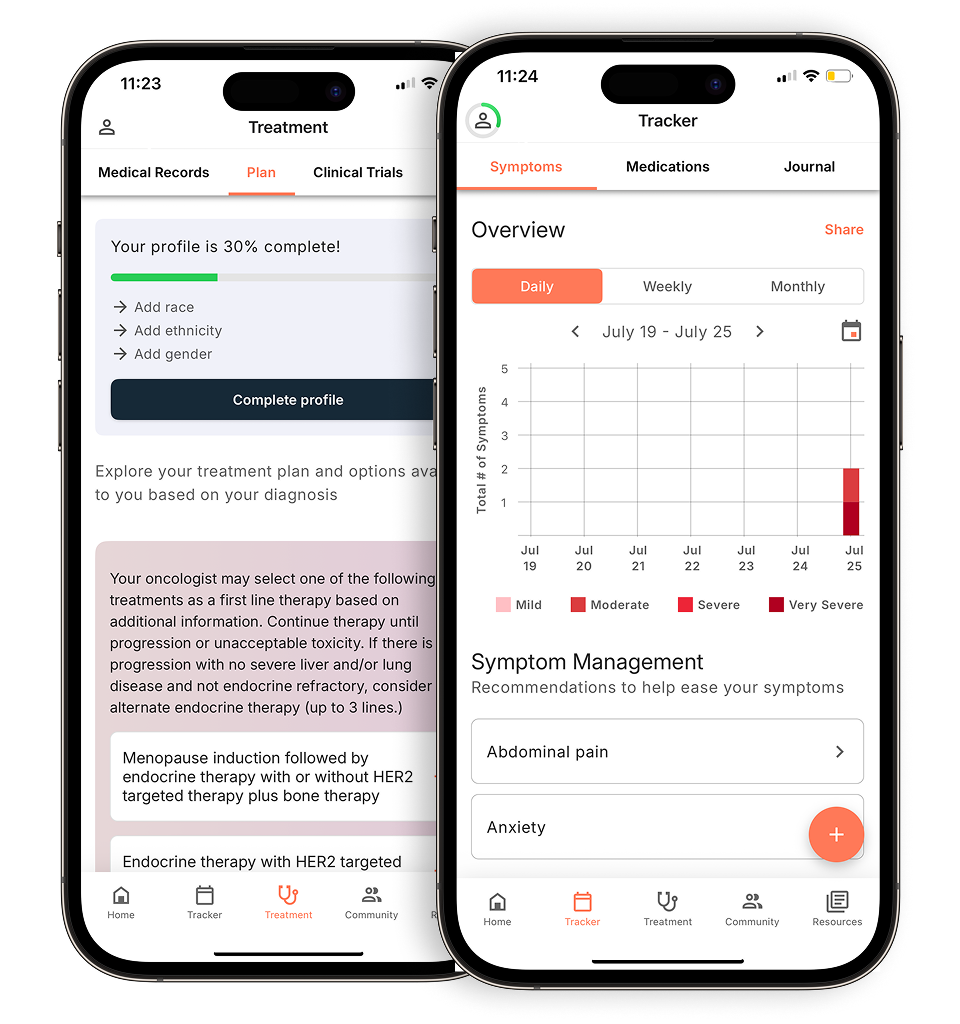
Those differences show up in outcomes. For someone with a smaller tumor and only one or two lymph nodes involved, he noted that the chance of cure with surgery and chemotherapy “could be as high as 80 or 90%.” When half a dozen lymph nodes are involved, or the tumor invades neighboring organs, that statistic changes.
Why “curable” usually means more than surgery
The reason staging matters so much, Dr. Kasi explained, is that early-stage treatment is given “with higher intent of cure being on the table,” but surgery alone often isn’t enough.
“Often these are not cured by surgery alone,” he said. “Often it’s a combination of surgery followed by some sort of chemotherapy.”
Rectal cancer, especially when the tumor sits low in the rectum, often calls for a bigger team. Dr. Kasi described this as tri-modality therapy: “I do my part with drugs, the surgeon does his part of the surgery, and we also seek the help of our colleagues in radiation oncology to make sure that the so-called margins of the neighborhood is clean when the surgeon takes the tumor out.”
The scans you should expect before treatment
Before any major treatment decision, Dr. Kasi said every patient should have good cross-sectional imaging. That usually means a CT scan of “the three basic cavities, the chest, the abdomen, and the pelvis,” which covers the lymph nodes, liver, and lungs. “That’s at least the minimum requirement for anybody diagnosed with colorectal cancer,” he said.
Rectal cancer requires more. “No surgeon would ever operate unless they’ve had a good, high-quality MRI,” Dr. Kasi said. “It gives you a lot more detail of how low or how high up the cancer is.”
Cancer care guidance for every step of your journey
Get treatment options, clinical trials, and support tailored to your diagnosis--all in one place.
Get started
See treatment options, manage symptoms, and stay informed—all in the app
View treatment options and trials personalized to your diagnosis—plus track progress in real time.
Continue in appThat detail matters because of the sphincter, the muscle that controls bowel function. A tumor close to it can affect whether surgery risks incontinence or a permanent ostomy. For patients with rectal cancer, Dr. Kasi said, an MRI and a hands-on exam by the surgeon are two additional steps that may not be needed for colon cancer.
The biomarker every patient should know: MMR and MSI
Biomarker reports can feel like alphabet soup: MMR, dMMR, pMMR, MSI-H, MSS. Dr. Kasi called mismatch repair (MMR) “one biomarker that has had tremendous impact in the world of cancer care.”
He offered a simple way to picture it. Mismatch repair proteins are “autocorrect machineries.” When cells copy their DNA, small “spelling mistakes” happen, and these proteins find and fix them. When that system is broken, the tumor is called mismatch repair deficient, or dMMR.
“It just simplistically leads to more mutations,” Dr. Kasi explained. That is why it matters clinically: the tumor carries so many mutations “that the body’s able to tell, the immune system is able to tell, this is not one of us.” As a result, he said, immunotherapy works well in these tumors.
The different acronyms are mostly different tests for the same underlying biology. “These are all different lenses, different lab tests, looking at the same function,” he said.
Term | What it means | What it can signal |
dMMR (mismatch repair deficient) | The tumor’s DNA “autocorrect” system is broken | Immunotherapy may be an option |
MSI-H (microsatellite instability-high) | A lab finding caused by dMMR | Same as dMMR |
TMB-high (high tumor mutation burden) | The tumor carries many mutations | Often seen with dMMR/MSI-H |
pMMR (mismatch repair proficient) / MSS (microsatellite stable) | The autocorrect system works normally | Standard immunotherapy has worked less well; newer options are being studied in trials |
Mismatch repair deficiency was so important that it became the first biomarker for which immunotherapy was approved regardless of where the cancer started. “It doesn’t matter if it’s a child with a bone tumor, or somebody with brain cancer, or somebody with colon cancer,” Dr. Kasi said.
Because of that, he said MMR testing should be routine for every colorectal cancer. It’s “a test that’s being done reflexively, meaning that we don’t even have to ask, or shouldn’t be asking at this stage in 2026,” he said, “because care is different for them. They have a different paradigm, different prognosis, different options.”
For the majority of patients whose tumors are mismatch repair proficient, research is moving quickly too. Dr. Kasi’s own trials are testing newer immunotherapies given before surgery in this group.
Questions to bring to your next appointment
Understanding the basics of your diagnosis can help you take part in decisions about your care. Consider asking your team:
- What is my exact stage, and where do I fall within that stage in terms of risk?
- Have I had a CT scan of my chest, abdomen, and pelvis?
- If I have rectal cancer, have I had a high-quality pelvic MRI and an exam by a colorectal surgeon?
- What is my tumor’s mismatch repair (MMR) or MSI status?
- Does the order of my treatments matter, and are there clinical trials I should consider before surgery?
Disclaimer: The information provided in this article is for informational purposes only and is not intended to be a substitute for professional medical advice, diagnosis, or treatment. Outcomes4Me is not acting as your caregiver, and any suggestions or guidance offered should not replace the advice of your healthcare provider or qualified medical professional. Always seek the guidance of your physician or other qualified health provider with any questions you may have regarding a medical condition.
Personalized support for real care decisions
Understand your diagnosis, explore clinical trials, and track symptoms--all in one place.
Get started
Compare treatments, prepare for appointments, and track side effects—all in the app
Built for your diagnosis, Outcomes4Me gives you the tools to make confident, informed decisions—right when you need them.
Continue in app