
The 2026 World Conference on Lung Cancer (WCLC) featured several important updates in the treatment of non-small cell lung cancer (NSCLC). The research highlighted new targeted therapies, immunotherapy approaches, and treatment strategies that could help people live longer and keep their cancer under control.
Here are seven NSCLC headlines from the meeting that stood out for their potential impact on patient care. While some findings are still being studied, they reflect continued progress toward more personalized treatment options for people with NSCLC.
1) Long-term analysis further validates osimertinib for patients with EGFR-mutated NSCLC
Long-term results from the ADAURA trial show that people with early-stage, EGFR-mutated non-small cell lung cancer (NSCLC) who received osimertinib after surgery continued to live longer than those who received a placebo. After eight years, 79% of people with stage IB-IIIA disease who received osimertinib were alive, compared with 64% who received a placebo. The benefit was also seen in people with stage II-IIIA disease, with 74% alive at eight years compared with 58% with placebo.
These findings are significant because they show that treating certain lung cancers with a targeted therapy after surgery can provide a lasting survival benefit, reinforcing the importance of testing tumors for EGFR mutations when lung cancer is diagnosed.
2) Encouraging treatment option for patients with ROS1-positive NSCLC
New data from the ARROS-1 trial suggest that zidesamtinib may be highly effective as an initial targeted treatment for people with ROS1-positive NSCLC. Among patients who hadn’t previously received a ROS1-targeted drug, 94% saw their tumors shrink, and 15% had no detectable cancer on scans. At one year, 90% of patients had not experienced cancer progression, and the median time before the cancer worsened hadn’t yet been reached. The treatment also showed promising activity against cancer that had spread to the brain, with all 10 patients who had measurable brain metastases responding to treatment.
Evidence-based guidance powered by NCCN Guidelines®
Personalized treatment plans shaped by the latest oncology standards—tailored to your diagnosis.
Get started
View your personalized treatment plan in the Outcomes4Me app
Use your diagnosis to unlock personalized NCCN Guidelines®-aligned recommendations.
Continue in app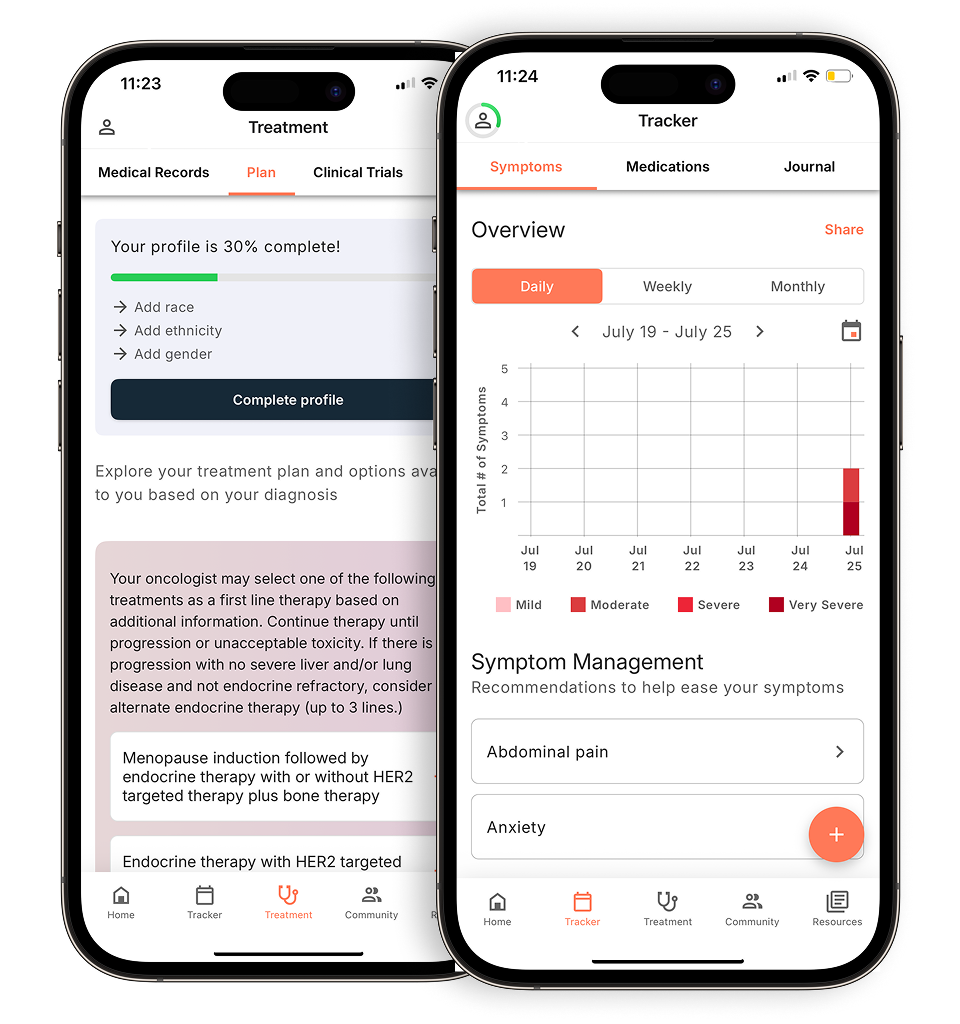
These findings are especially important because ROS1-positive NSCLC can often be controlled for years, making treatments that provide long-lasting control while limiting side effects particularly valuable.
3) An investigational drug outperforms pembrolizumab
New results from the phase III HARMONi-2 trial suggest that ivonescimab may help people with advanced NSCLC live longer than pembrolizumab, a commonly used immunotherapy. Patients who received ivonescimab lived an average of 30.8 months compared with 22.6 months with pembrolizumab, representing a 27% lower risk of death during the study. Ivonescimab also previously showed a benefit in delaying cancer growth, with patients going about 11.1 months without progression compared with 5.8 months with pembrolizumab. The treatment combines two approaches by helping the immune system attack cancer while also blocking a protein that helps tumors grow blood vessels.
While these results are encouraging, ivonescimab is still being studied in the U.S., and researchers are continuing to evaluate its safety and potential role in treating lung cancer.
4) Targeted treatment shows efficacy in NSCLC patients with a HER2 mutation
Results from the phase III DESTINY-Lung04 trial suggest that the targeted drug trastuzumab deruxtecan (T-Dxd) may be an effective first treatment for people with advanced NSCLC whose tumors have a HER2 mutation. Patients receiving T-Dxd went an average of 14.3 months before their cancer progressed, compared with 8.3 months for those receiving pembrolizumab plus chemotherapy. Tumors also shrank in 70% of patients treated with T-Dxd, compared with about 45% who received chemoimmunotherapy.
These findings are important because HER2 mutations are found in only a small percentage of NSCLC cases and have historically been associated with worse outcomes. However, overall survival results are still being evaluated.
5) Expanding treatment options for patients with a rare form of lung cancer
Final results from the PAPILLON trial show that adding amivantamab to chemotherapy can provide long-lasting benefits for people with advanced NSCLC whose tumors have an EGFR exon 20 insertion mutation. People in the trial had a median overall survival of 34.3 months, or nearly three years, which is longer than the roughly 1.5 to 2 years historically reported for this rare form of lung cancer. The findings are important because EGFR exon 20 insertion mutations are found in only about 1% to 2% of advanced NSCLC cases, leaving patients with limited treatment options.
Overall, the results add to the evidence supporting amivantamab plus chemotherapy as an important treatment approach for this specific type of NSCLC.
6) Emerging treatment combo helps control NSCLC with an EGFR exon 20 insertion mutation
Results from the phase III REZILIENT3 trial show that adding zipalertinib to chemotherapy helped people with advanced NSCLC and an EGFR exon 20 insertion mutation live longer without their cancer growing. Patients receiving the combination went a median of 14.5 months before their cancer progressed, compared with 8.5 months with chemotherapy alone. Tumors also shrank in 65% of patients receiving the combination, compared with 40% with chemotherapy alone, and responses lasted longer. The benefit was also seen in people whose cancer had spread to the brain, an important finding because brain metastases can make NSCLC more difficult to treat. More patients experienced severe side effects with the combination, but researchers reported that no new safety concerns emerged.
Overall survival data is still being examined, so longer follow-up is needed to determine whether the combination helps people live longer.
7) Immunotherapy before and after surgery more than doubles event-free survival
A phase III trial found that adding the immunotherapy atezolizumab to chemotherapy before and after surgery may help people with resectable stage IIB–IIIB NSCLC. People who received the combination went a median of 62.8 months without their cancer returning, progressing, or another major cancer-related event, compared with 34.9 months for those who received chemotherapy alone. More people who received atezolizumab had little to no cancer left in the tissue removed during surgery, which is an encouraging sign. However, the trial didn’t meet its main statistical goal, so researchers cannot yet say with certainty that the combination improves outcomes.
This study is still significant because the results add to growing research on using immunotherapy around the time of surgery to help lower the risk of cancer returning.
Disclaimer: The information provided in this article is for informational purposes only and is not intended to be a substitute for professional medical advice, diagnosis, or treatment. Outcomes4Me is not acting as your caregiver, and any suggestions or guidance offered should not replace the advice of your healthcare provider or qualified medical professional. Always seek the guidance of your physician or other qualified health provider with any questions you may have regarding a medical condition.
Personalized support for real care decisions
Understand your diagnosis, explore clinical trials, and track symptoms--all in one place.
Get started
Compare treatments, prepare for appointments, and track side effects—all in the app
Built for your diagnosis, Outcomes4Me gives you the tools to make confident, informed decisions—right when you need them.
Continue in app