
Lynch syndrome is an inherited condition caused by mutations in the DNA mismatch repair (MMR) genes, MLH1, MSH2, MSH6, and PMS2, along with EPCAM, a gene that can silence MSH2. These genes are thought to help correct small copying errors that occur when cells divide. When one copy is inherited in a broken state, errors accumulate, and tissue, like the endometrial lining, that divides rapidly is the first to show the consequences.
Testing criteria
Traditional lynch syndrome testing criteria rest on three clinical signals.
Age of onset. Endometrial cancer before age 50 sits well outside the typical pattern for sporadic disease and remains one of the strongest single indicators for genetic referral.
Family history patterns. Clinicians look for Lynch-associated cancers clustering across generations, including colorectal, endometrial, ovarian, gastric, urothelial, small bowel, pancreatic, and prostate cancer. Endometrial cancer and family history of colon cancer in a first-degree relative is a particularly common pairing.
Second primary cancers. A patient with both uterine and colon or ovarian malignancies warrants evaluation regardless of age.
So who should be tested for Lynch syndrome? Anyone diagnosed with endometrial cancer is now a reasonable candidate for tumor-based screening, with family history refining, not gatekeeping, the decision.
Tumor screening vs. germline testing
Understanding how to test for lynch syndrome means separating two distinct steps.
Endometrial cancer MMR testing begins with the tumor itself. Immunohistochemistry (IHC) stains the surgical specimen for the four MMR proteins; endometrial cancer loss of MMR proteins on one or more stains flags a repair defect. Endometrial cancer MSI testing measures the genetic “stutter,” unstable repeat sequences that pile up when proofreading fails. Either result can identify a dMMR endometrial cancer Lynch syndrome candidate. Genomic testing of a tumor can help guide breast cancer treatment by identifying specific mutations and targeted therapy options.
Evidence-based guidance powered by NCCN Guidelines®
Personalized treatment plans shaped by the latest oncology standards—tailored to your diagnosis.
Get started
View your personalized treatment plan in the Outcomes4Me app
Use your diagnosis to unlock personalized NCCN Guidelines®-aligned recommendations.
Continue in app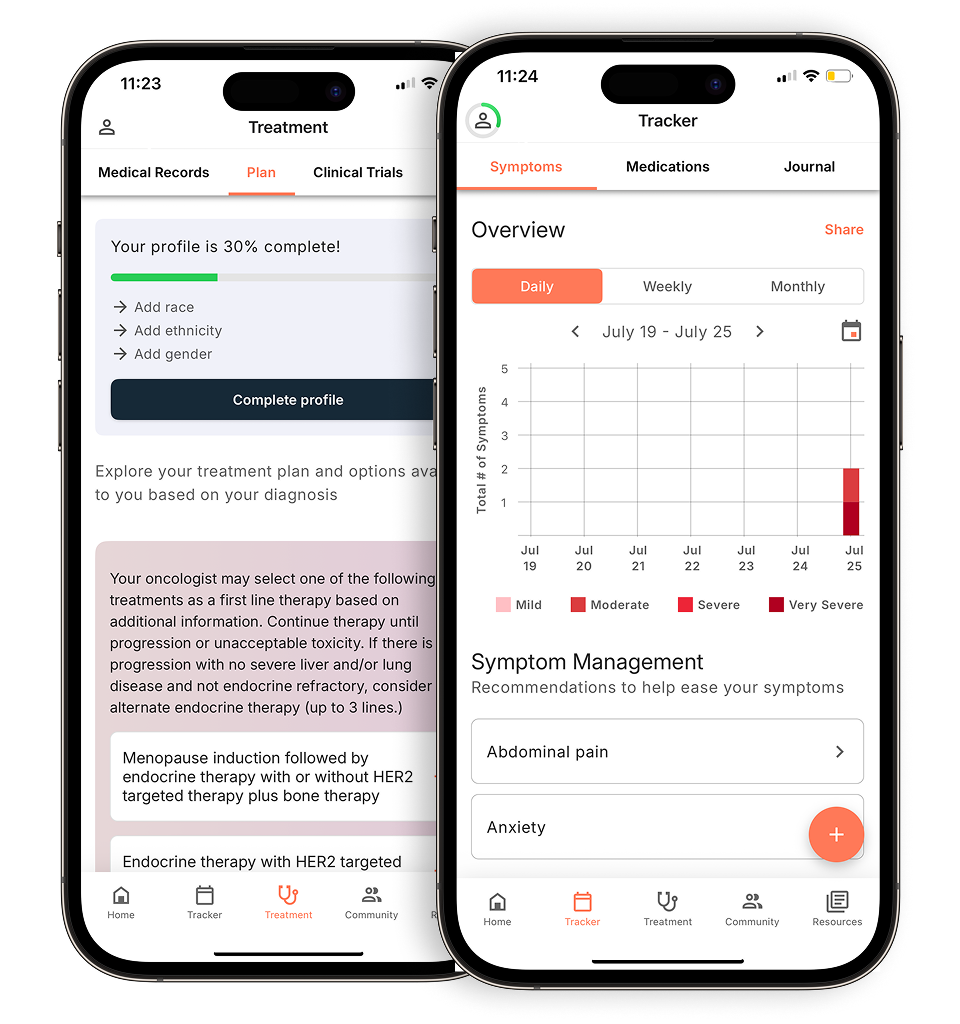
Neither test diagnoses the syndrome. Many dMMR tumors appear to be sporadic and may involve MLH1 promoter methylation. Your care team can discuss what testing results mean for your specific situation. MLH1 methylation testing endometrial cancer workflows routinely include reflex methylation analysis before anything further.
When methylation is absent, or MSH2, MSH6, or PMS2 is missing, the next step is germline Lynch syndrome genetic testing using a blood or saliva sample to look for inherited mutations in Lynch syndrome genes.
The case for universal vs. criteria-based screening
Not all families know their own risk history.
Many families with Lynch syndrome do not meet the Amsterdam criteria, and most people who meet the Bethesda criteria do not actually have Lynch syndrome. You can have Lynch syndrome without meeting any of these criteria, so they may not detect all cases in families.
Experts recommend that all people newly diagnosed with endometrial cancer receive tumor testing for mismatch repair deficiency (dMMR) or microsatellite instability-High (MSI-High). People found to have these biomarkers are then recommended for genetic counseling and testing for Lynch syndrome. The tissue determines risk status, not clinical judgment alone.
Should all endometrial cancer patients be tested for Lynch syndrome? The argument in favor is straightforward. Reflex tumor testing is inexpensive, already performed on tissue in hand, and informs the treatment of endometrial cancer independently of hereditary risk. Criteria-based screening also creates a false sense of security, as a patient told she doesn’t qualify may reasonably conclude she isn’t at risk.
Risk assessment
Lifetime endometrial cancer risk in Lynch syndrome carriers is substantially elevated above the general population and represents an important reason to identify carriers and offer screening and management options. That elevation is why Lynch syndrome uterine cancer deserves equal billing with colorectal disease in counseling conversations.
Cancer care guidance for every step of your journey
Get treatment options, clinical trials, and support tailored to your diagnosis--all in one place.
Get started
See treatment options, manage symptoms, and stay informed—all in the app
View treatment options and trials personalized to your diagnosis—plus track progress in real time.
Continue in appPeople with Lynch syndrome tend to develop endometrial cancer at an earlier age than those without the condition, which is the rationale behind endometrial cancer before age 50 Lynch syndrome referral patterns.
Risk varies across genes. MLH1 and MSH2 mutations generally carry the highest penetrance; MSH6 confers notable endometrial risk with later onset, while PMS2 sits lowest. These differences shape surveillance intervals and conversations about risk-reducing hysterectomy.
Knowing the gene allows targeted planning. Without this information, surveillance becomes reactive.
Insurance, cost, and genetic counseling
The logistics are more manageable than most patients expect, but they require asking the right questions early.
- Insurance coverage. Many insurance plans may cover germline testing when a patient meets published medical-necessity criteria. If you have a personal history of endometrial cancer with abnormal tumor screening results, ask your care team whether you might qualify for testing and whether your plan would cover it. Confirm prior authorization requirements before the sample is drawn, not after.
- Pre- and post-test counseling. A genetics professional can help you decide which genetic test is best for you and explain what your results mean based on your specific gene mutation and family history. Post-test sessions address cascade testing for relatives.
- Out-of-pocket pathways. Patients who don’t meet insurer criteria can ask laboratories about self-pay pricing and financial assistance programs; many publish rates directly.
- Documentation. A family history of Lynch syndrome ICD-10 code on the referral supports medical necessity and reduces claim denials.
Common misconceptions and limitations of testing
A normal tumor result isn’t a clean bill of genetic health. Immunohistochemistry (IHC) interpretation for Lynch syndrome can be challenging, as weak staining patterns in tumors may be difficult to distinguish from normal staining and could potentially be missed or misinterpreted. If the family history is compelling, germline testing proceeds regardless of what the tissue showed.
Variants of Uncertain Significance (VUS) are not diagnoses. Variants of Uncertain Significance (VUS) require careful interpretation by your genetic counselor or doctor, as they may not have clear implications for your cancer risk or medical management. Many are eventually reclassified as benign, which is why periodic re-contact with the testing lab matters.
Technology has blind spots. Standard sequencing for Lynch syndrome has improved over time, but some genetic mutations may still be missed depending on the testing method used. Specialized assays exist, but they aren’t always part of a default panel.
Timing is a legitimate variable. Immediately after diagnosis, some patients have no capacity for another decision. Deferring genetic counseling by a few weeks is reasonable; abandoning it isn’t.
Summary for patients and families
- Endometrial cancer is one of the cancers most commonly associated with Lynch syndrome in women, along with colorectal and ovarian cancer.
- Experts recommend that all people newly diagnosed with endometrial cancer receive tumor testing for mismatch repair deficiency (dMMR) or microsatellite instability-High (MSI-High). People found to have these biomarkers are then recommended for genetic counseling and testing for Lynch syndrome.
- Confirmed carrier status enables proactive surveillance for colorectal, ovarian, gastric, and urinary tract cancers, and informs decisions about risk-reducing surgery.
- Lynch syndrome inheritance is autosomal dominant, so first-degree relatives each face a meaningful chance of carrying the same variant.
- Work with a genetic counselor to interpret results and coordinate cascade testing across your family.
Disclaimer: The information provided in this article is for informational purposes only and is not intended to be a substitute for professional medical advice, diagnosis, or treatment. Outcomes4Me is not acting as your caregiver, and any suggestions or guidance offered should not replace the advice of your healthcare provider or qualified medical professional. Always seek the guidance of your physician or other qualified health provider with any questions you may have regarding a medical condition.
Personalized support for real care decisions
Understand your diagnosis, explore clinical trials, and track symptoms--all in one place.
Get started
Compare treatments, prepare for appointments, and track side effects—all in the app
Built for your diagnosis, Outcomes4Me gives you the tools to make confident, informed decisions—right when you need them.
Continue in app