The following questions and responses have been lightly edited for grammatical purposes.
How can doctors determine what kind of lung cancer I have?
The short answer is a tissue biopsy. Thankfully, technology is advancing, so when you are diagnosed with lung cancer, it’s usually either because of symptoms that brought you to your doctor or, if you have a history of tobacco use, you may be in a screening program, which is fantastic and really important.
Maybe the cancer was captured on a scan or through other means, and if we see something that looks like lung cancer, the next question is: how do we figure out if it really is lung cancer, and what type?
Evidence-based guidance powered by NCCN Guidelines®
Personalized treatment plans shaped by the latest oncology standards—tailored to your diagnosis.
Get started
View your personalized treatment plan in the Outcomes4Me app
Use your diagnosis to unlock personalized NCCN Guidelines®-aligned recommendations.
Continue in app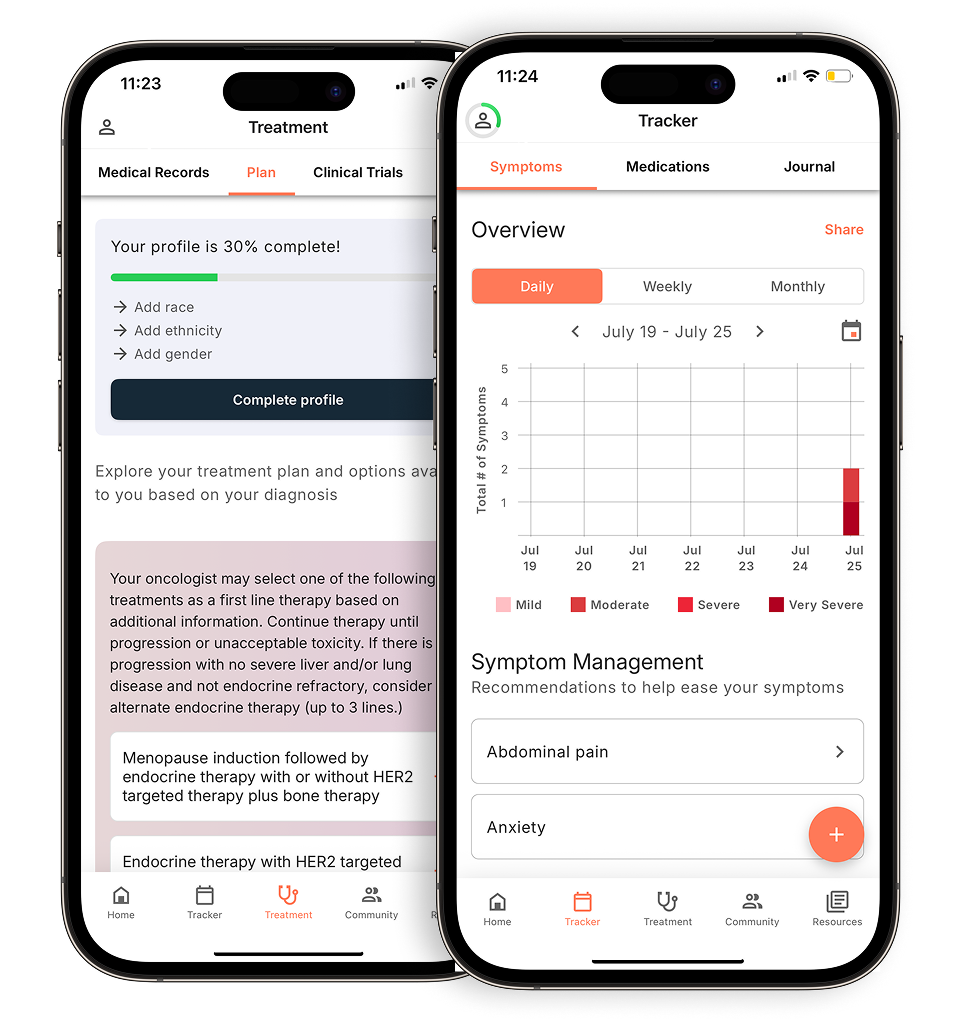
A tissue biopsy is currently the most accurate way to determine that because there are two main types of lung cancer: non-small cell and small cell. Non-small cell accounts for about 80% of cases, and small cell about 20%.
Even within non-small cell, there are different types, such as adenocarcinoma or squamous cell carcinoma. There are also different biomarkers, like PD-L1, that can affect treatment. All of these designations currently require a tissue biopsy.
I think we’re moving in the right direction, though. More and more of this may eventually be done non-invasively with a liquid biopsy, which is a blood test.
With a liquid biopsy, we can look at the genetics of your tumor, not the genes you were born with or can pass down, but specifically the genes of your tumor and the circulating tumor DNA. This can help guide potential targeted therapies or clinical trials.
However, it doesn’t yet tell us the histology—whether it’s non-small cell versus small cell—so we still need tissue biopsies. That said, we’re getting closer to the point where liquid biopsies may be able to provide more of that information in the future.
What’s the difference between small-cell lung cancer and non-small cell lung cancer?
Non-small cell lung cancer versus small cell lung cancer is exactly what it describes: the cells themselves are bigger versus smaller. They’re both lung cancers. Non-small cell lung cancer makes up about 80–85% of new lung cancer diagnoses.
Within non-small cell lung cancer, there’s an umbrella of types, including adenocarcinoma, squamous cell carcinoma, and a few other outliers. Typically, these are treated with some combination of chemotherapy and immunotherapy.
For early-stage diagnoses, treatment often includes a combination of surgery, radiation, chemotherapy, and immunotherapy. In recent years, there’s been so much progress that the conversation is very nuanced, and it’s important to discuss with your treating physician. For stage I, II, or III non-small cell lung cancer, there are multiple potential paths forward, some of which include curative treatment with a combination of these therapies.
For metastatic or stage 4 non-small cell lung cancer, genetic testing and histologic review, including PD-L1 testing, are important. PD-L1 is a marker of immune activation and helps guide the use of immunotherapy in treatment.
Overall, for non-small cell lung cancer, there are many treatment options, so the workup—including testing—is more complex. That complexity is actually beneficial because it allows for more personalized treatment, though it can be stressful for patients, especially in the first few weeks after diagnosis when details and treatment plans are still unclear.
For small cell lung cancer, the standard first-line therapy generally does not depend on genomics or PD-L1 testing. It’s usually a combination of chemotherapy and immunotherapy. This may change in the coming years as new targeted therapies are developed, which is an area of focus for me.
View the full discussion with Dr. Meador here.
Personalized support for real care decisions
Understand your diagnosis, explore clinical trials, and track symptoms--all in one place.
Get started
Compare treatments, prepare for appointments, and track side effects—all in the app
Built for your diagnosis, Outcomes4Me gives you the tools to make confident, informed decisions—right when you need them.
Continue in app