The following questions and responses have been lightly edited for grammatical purposes.
1) What’s the latest update on immunotherapy for patients with TNBC?
Dr. McCann: Most patients with TNBC in the curative setting qualify to have pembrolizumab (Keytruda) added to their chemotherapy plan, regardless of whether the tumor is expressing PD-L1. Pembrolizumab in the metastatic setting is still tied to PD-L1 as a biomarker, but that’s not the case in the curative setting, which can be a little confusing. The heavy lifting is still being done by the chemotherapy itself.
In the KEYNOTE-522 regimen, which was studied in the curative setting with five years of follow-up, the improvement in overall survival was about 5% at five years compared to chemotherapy alone.
Evidence-based guidance powered by NCCN Guidelines®
Personalized treatment plans shaped by the latest oncology standards—tailored to your diagnosis.
Get started
View your personalized treatment plan in the Outcomes4Me app
Use your diagnosis to unlock personalized NCCN Guidelines®-aligned recommendations.
Continue in app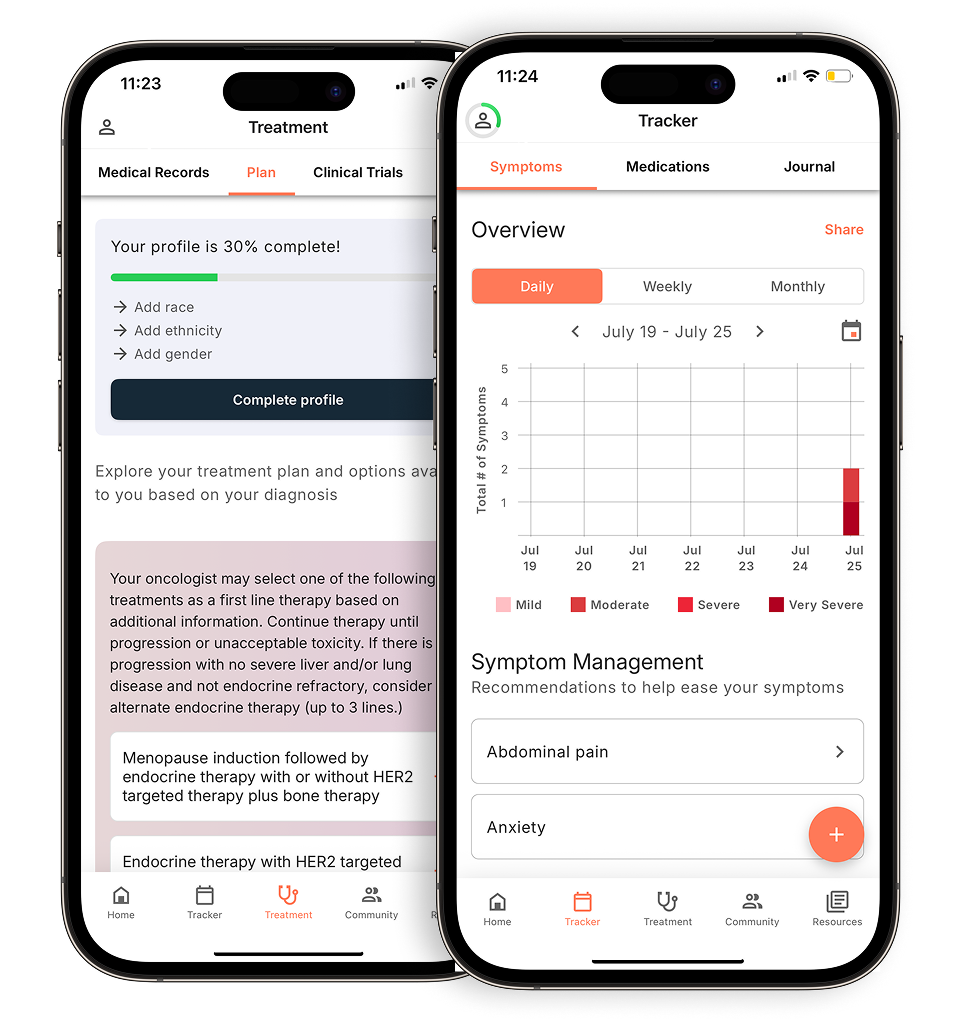
For most patients receiving these therapies, it’s really the chemotherapy they’re responding to, not necessarily the immune checkpoint inhibitor. One of the things we need to keep a close eye on is how to better predict who will benefit from immune checkpoint inhibitors like pembrolizumab and who will not, because these drugs do have toxicities.
Hypothyroidism could develop by the end of treatment. Very rarely, patients can develop things like type 1 diabetes or adrenal insufficiency—conditions that are permanent and require treatment for the rest of a patient’s life. Those are pretty severe toxicities, and we don’t yet know exactly who is going to benefit.
Right now, we treat everyone with pembrolizumab in hopes of saving more patients, and we do save more patients that way, but we also need to think carefully about who is unlikely to respond so we don’t expose them to unnecessary toxicity. Immune checkpoint inhibitors don’t work for everybody.
Several talks over the past year have focused on identifying who might benefit from immune checkpoint inhibitors by looking at tumor-infiltrating lymphocytes. These are immune cells that have entered the tumor. If you see them present, it suggests the immune system has recognized the cancer, and those patients are more likely to respond to immunotherapy.
2) Are there discussions about emerging biomarkers that give you hope we’ll be able to use more personalized strategies for TNBC in the future?
Dr. McCann: There are some things we can already target. If someone was born with a BRCA1 mutation, BRCA2 mutation, or PALB2 mutation, we can use therapies like olaparib, which was studied in the OlympiA trial. Olaparib can be used for patients who don’t achieve a complete pathologic response or who are at higher risk for recurrence.
We also use capecitabine for patients who don’t achieve a complete pathologic response, meaning there’s still tumor left after chemotherapy before surgery. Both olaparib and capecitabine are safe to combine with pembrolizumab, so we’re doing that in practice, even though we don’t yet have a specific clinical trial studying that exact combination.
Some of the most exciting recent work has been in patients with TNBC who don’t have a complete response and are eligible for antibody–drug conjugates. For example, drugs like sacituzumab govitecan (Trodelvy) and datopotamab deruxtecan (Dato-DXd) have been studied. These therapies are already approved in the metastatic setting and are now moving into the curative setting for patients who don’t achieve a complete response.
The biomarker for these drugs is TROP-2, which is highly expressed on TNBC cells. About 88% of triple-negative tumors express TROP-2 based on early clinical trials, making these therapies broadly applicable.
Ultimately, TNBC is defined by what it is not—ER-positive, PR-positive, or HER2-positive. Because of that, we’ve historically grouped it as one disease, when in reality it includes many different subtypes under a large umbrella.
Some tumors respond well to olaparib, some respond well to immunotherapy, and others respond better to different targeted approaches. It’s a complicated area, but in the future, we’ll have more options, especially for patients who don’t achieve a complete response. That future is coming soon.
Get the full SABCS 2025 recap from Dr. Kelly McCann and watch the full webinar.
Personalized support for real care decisions
Understand your diagnosis, explore clinical trials, and track symptoms--all in one place.
Get started
Compare treatments, prepare for appointments, and track side effects—all in the app
Built for your diagnosis, Outcomes4Me gives you the tools to make confident, informed decisions—right when you need them.
Continue in app