
Colorectal cancer (CRC) is often discussed as a single disease, but it includes both colon cancer and rectal cancer. In a recent “Ask the Expert” webinar, we asked MD Anderson Cancer Center’s Dr. Scott Kopetz to provide a general guide on screening, diagnosing, and staging for CRC.
Colon cancer vs. rectal cancer: What’s the difference?
Clinicians think of the colon and rectum “as a bit of a continuum,” which is why the term colorectal cancer is commonly used. Anatomically, there isn’t a clear dividing line between the two. Dr. Kopetz notes there isn’t a clear boundary of where the rectum ends and where the colon begins. The lining of the colon and rectum is the same, and the biology of cancers that arise there is often very similar.
The biggest difference between colon and rectal cancer comes down to location. Dr. Kopetz explains that the rectum sits in a tight, confined space deep within the pelvis, whereas most of the colon lies more freely within the abdominal cavity. Since the rectum is surrounded by limited space, tumors in this area have a higher risk of growing back locally after treatment. For that reason, Dr. Kopetz shares that clinicians may incorporate radiation therapy for rectal cancer “to reduce that local recurrence risk,” which is a key distinction from how colon cancer is typically treated.
Evidence-based guidance powered by NCCN Guidelines®
Personalized treatment plans shaped by the latest oncology standards—tailored to your diagnosis.
Get started
View your personalized treatment plan in the Outcomes4Me app
Use your diagnosis to unlock personalized NCCN Guidelines®-aligned recommendations.
Continue in app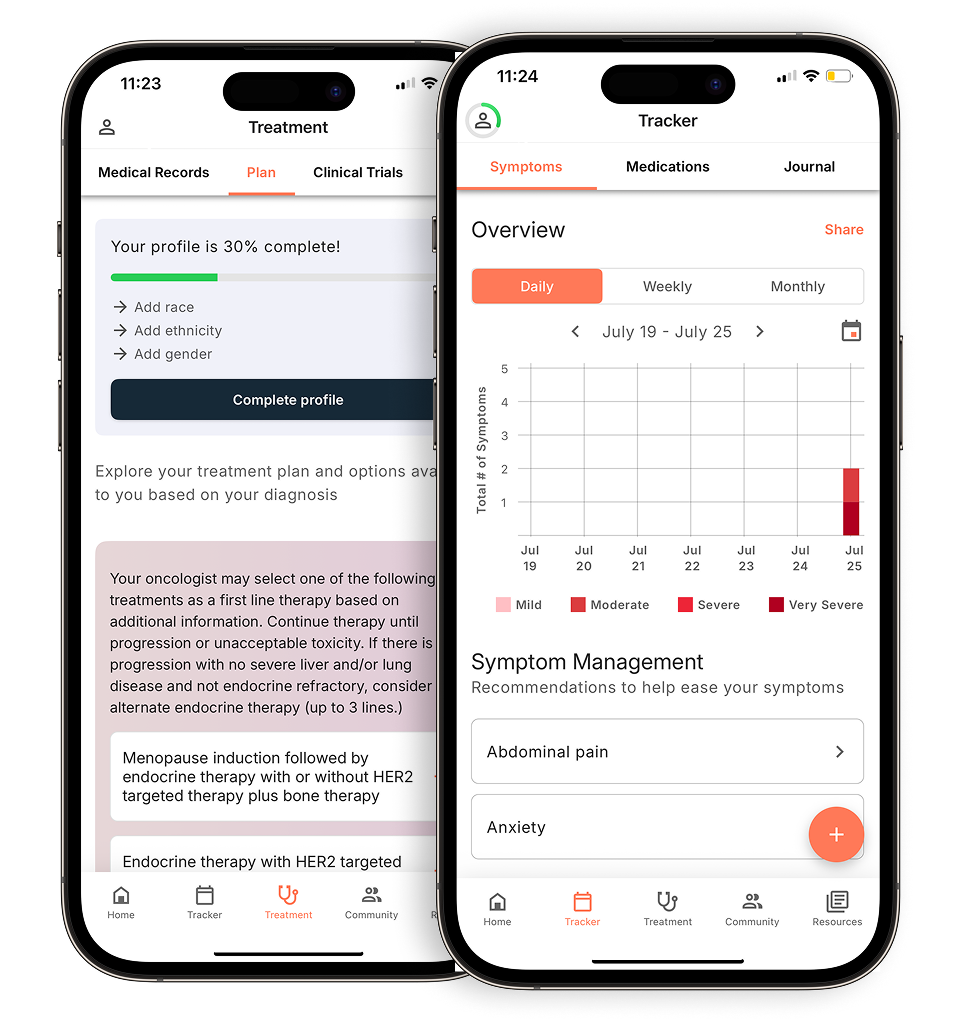
How is CRC diagnosed?
The goal with CRC is to diagnose it early, through routine screening, before symptoms ever appear. According to Dr. Kopetz, screening rates have improved over time, but there is still room for progress, especially now that guidelines recommend starting screening at age 45.
Importantly, screening is recommended even if you don’t have symptoms or a family history. As Dr. Kopetz emphasizes, “Don’t wait for symptoms to get screened if you’re 45 or older. It just should be part of what you’re doing on a routine basis.”
For adults over 50 who have good access to care and insurance coverage, screening rates can be as high as 70%. However, Dr. Kopetz pointed out that access and coverage vary widely, and some populations are much less likely to undergo screening.
What about people under 45?
Diagnosing CRC in younger adults can be more challenging. Routine screening is not yet standard for this age group, and symptoms may be subtle. Dr. Kopetz notes that younger patients often don’t present with anemia, which is sometimes how CRC is first detected in older adults through routine blood work.
He encourages younger individuals to pay close attention to their bodies. Changes in bowel habits, ongoing abdominal pain, or blood in the stool shouldn’t be ignored. “Be persistent. If you’re having bowel changes, abdominal pain, think about a colonoscopy early on,” he says.
One of the strongest motivators for screening is personal experience. Dr. Kopetz shares that “the biggest driver of screening is knowing somebody who has been impacted by CRC.” For that reason, he encourages patients and caregivers to speak openly about their diagnosis.
Understanding CRC staging
Once CRC is diagnosed, determining the stage is critical for guiding treatment decisions. Doctors typically classify CRC into four stages using the TNM system.
Dr. Kopetz explains TNM looks at how advanced the tumor is (T), whether it has spread to regional lymph nodes (N), and whether it has spread to distant parts of the body (M). These factors are combined to determine the overall stage.
Stages I and II are generally limited to the colon or rectum. The tumor may have grown into or through the bowel wall, but it has not spread to lymph nodes or distant organs. Stage III means the cancer has spread to nearby lymph nodes, which are typically removed during surgery.
Stage IV CRC is metastatic, meaning the cancer has spread beyond areas that would normally be removed during surgery. Dr. Kopetz emphasizes this doesn’t necessarily rule out surgery. He shares that about 20% of patients with metastatic CRC have disease that’s spread in a limited, contained way, allowing surgery to be part of their treatment plan. This is somewhat unique compared with many other cancer types, where surgery’s not typically an option once cancer has spread.
For the remaining patients, the cancer may be more widely distributed across different organs, requiring systemic treatments rather than surgery alone.
When does metastatic disease occur?
Metastatic CRC can be present at the time of diagnosis, or it can develop later as a recurrence. According to Dr. Kopetz, these scenarios are “about evenly split.” Some patients are diagnosed with advanced disease right away, while others initially have early-stage cancer that returns months or years later, even after surgery or additional treatments meant to reduce the risk of recurrence.
If you’ve been diagnosed with CRC, talking about your experience and simply asking loved ones if they’ve been screened can make a real difference. Some of the most meaningful stories Dr. Kopetz hears come from patients who shared their diagnosis with a colleague or friend, only to learn later that the conversation prompted that person to get screened and catch cancer early, or even prevent it altogether. He says, “Don’t discount the impact that sharing your own message and sharing your own experience can have on those around you.”
Listen to the full discussion with Dr. Kopetz here.
Personalized support for real care decisions
Understand your diagnosis, explore clinical trials, and track symptoms--all in one place.
Get started
Compare treatments, prepare for appointments, and track side effects—all in the app
Built for your diagnosis, Outcomes4Me gives you the tools to make confident, informed decisions—right when you need them.
Continue in app