Treatment options for chronic lymphocytic leukemia (CLL) are highly individualized. Your care team considers several key elements when designing your treatment plan, and clinical scientist and CLL expert Dr. Bita Fakhri highlights three of the most important: the characteristics of the leukemia itself, the patient’s overall health and preferences, and the potential risks and benefits of available therapies.
In this guide, Dr. Fakhri breaks down these considerations and shares how clinical trials can provide you with access to the latest treatment options.
1) Disease-specific factors
These are aspects of the leukemia itself that influence treatment choices. “[Things like] the IGHV mutation status and the CLL FISH panel. Also, does someone have a deletion 17p? We know those patients do a little less favorably with certain treatment approaches,” says Dr. Fakhri. Other features, like a complex karyotype (three or more chromosome abnormalities), can also affect outcomes. These are features that are critical to know.
2) Patient-specific factors
Age, overall health, and comorbidities play a major role. Dr. Fakhri explains, “I treat a 21-year-old very differently from a 90-year-old. I want to know about heart rhythm problems, blood pressure control, kidney function, diabetes, and what blood thinners they’re on.” Understanding these aspects and patient preferences is essential for safely choosing a therapy.
3) Therapy-specific factors
Different treatments carry unique risks. For instance, Dr. Fakhri shares that BTK inhibitors can increase cardiovascular toxicity, so a patient with certain heart conditions may not be an ideal candidate. Meanwhile, venetoclax, a BCL-2 inhibitor, requires good kidney function to reduce the risk of tumor lysis syndrome, which may not be a good fit for someone whose diabetes isn’t controlled. “All in all,” Dr. Fakhri summarizes, “the three major factors are patient-specific factors, disease-specific factors, and therapeutic-specific factors, and I try to reconcile all these factors.”
The case for time-limited therapy
Dr. Fakhri adds that she is “unapologetically biased toward time-limited therapy” because they’ve stood the test of time and have proven to be effective. With these therapies, she says, “You don’t have to worry about time toxicity, coming and seeing your doctor, drawing labs, and worrying about side effects all the time.”
While there are certain instances where an indefinite therapy may be applicable, Dr. Fakri shares that in general, therapies that have an end-date are preferred because “limited exposure to drugs lowers the risk of potential resistance mutations.”
Clinical trials: An opportunity for access and advancement
Clinical trials are also another avenue to pursue for cutting-edge treatment options. “In this time and age, clinical trials allow patients to benefit from breakthrough advances that have already passed early-phase testing,” she explains. Participating in a trial gives patients the chance to be among the first to receive promising therapies, sometimes years before they are widely available.
Clinical trials do require a significant commitment. Patients need to adhere to frequent lab checks, scans, and detailed reporting of any side effects, no matter how minor. Despite these challenges, Dr. Fakhri encourages patients to consider clinical trials whenever feasible. “If participating in a clinical trial makes sense for you, reach out to your doctor or request a second opinion at an academic center,” she advises.
She adds that patients are truly the cornerstone of these studies, and their involvement helps advance care for everyone living with CLL.
Watch the full webinar for more insights from Dr. Fakhri on navigating CLL.
Personalized support for real care decisions
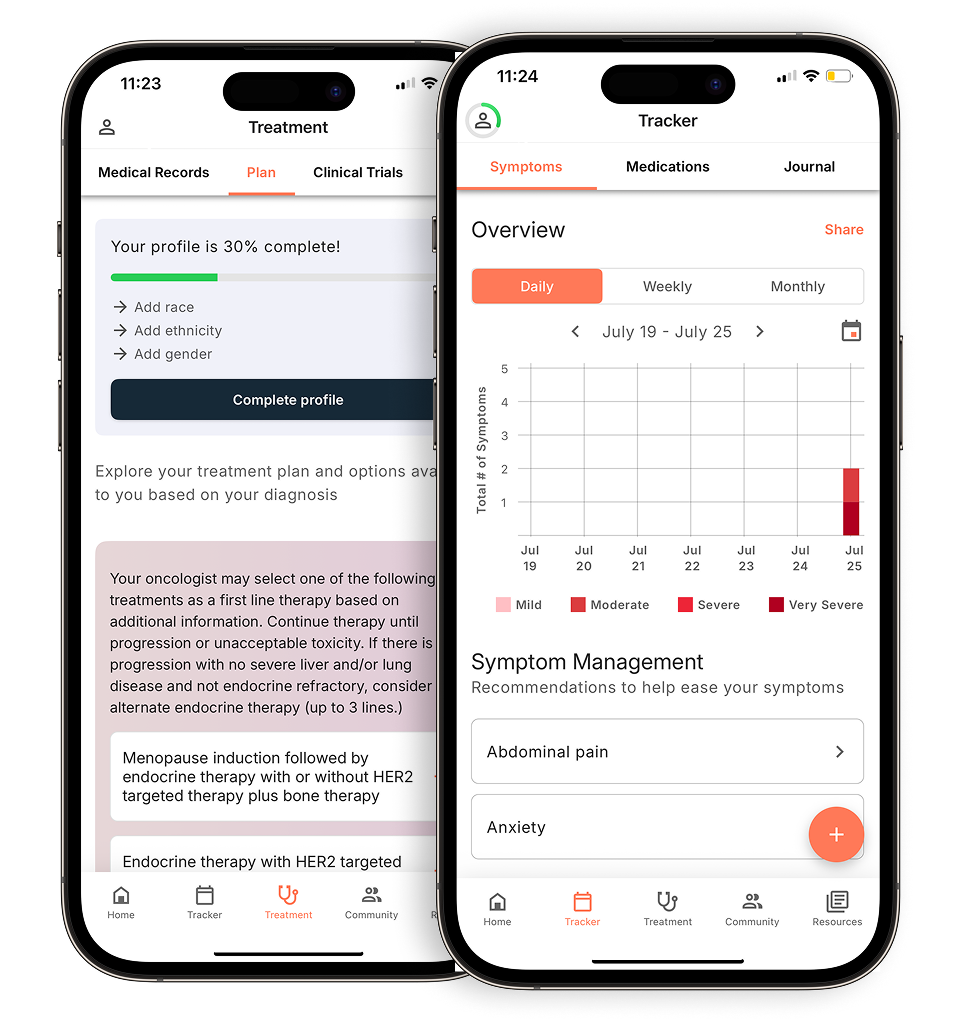
Understand your diagnosis, explore clinical trials, and track symptoms--all in one place.
Get started
Compare treatments, prepare for appointments, and track side effects—all in the app
Built for your diagnosis, Outcomes4Me gives you the tools to make confident, informed decisions—right when you need them.
Continue in app