
Recent advancements have brought attention to a specific group of breast cancers called “HER2-low.” These are tumors that have some HER2 protein on their surface (classified as HER2 1+ or HER2 2+ without gene amplification) but not enough to be considered HER2-positive.
Enhertu (trastuzumab deruxtecan [T-DXd]), has shown significant positive results for patients with HER2-low disease. However, a need to understand the biological differences, if any, between HER2-low tumors and those that have no HER2 protein at all, known as HER2-0, still exist.
To address this, researchers conducted a study presented at the ASCO Annual Meeting. Their goal was to examine the molecular makeup of HER2-low and HER2-0 breast cancers using a non-invasive method: blood tests. By analyzing circulating tumor DNA (ctDNA) – small pieces of DNA released by cancer cells into the bloodstream – they aimed to identify differences that could help oncologists make better treatment decisions early in the course of metastatic disease.
How the study was conducted
The study involved analyzing 226 blood plasma samples from 185 patients with metastatic breast cancer. The researchers used two main types of tests on the ctDNA:
Evidence-based guidance powered by NCCN Guidelines®
Personalized treatment plans shaped by the latest oncology standards—tailored to your diagnosis.
Get started
View your personalized treatment plan in the Outcomes4Me app
Use your diagnosis to unlock personalized NCCN Guidelines®-aligned recommendations.
Continue in app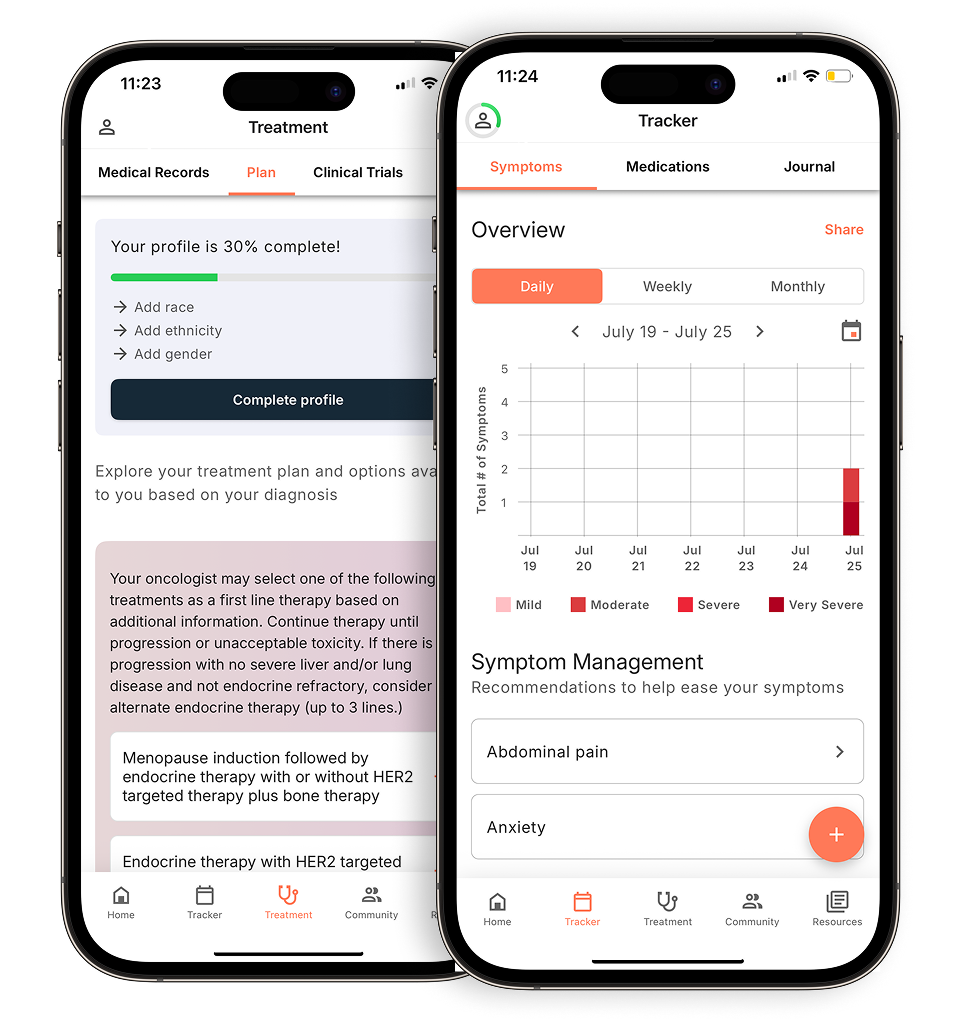
- mFAST-SeqS: This test helped estimate the “tumor fraction” (TFx), which is the amount of tumor DNA present in the blood. A higher tumor fraction generally means more cancer DNA is circulating.
- AVENIO ctDNA Expanded (77-gene panel): This test looked for specific changes, or “somatic variants,” in 77 different genes known to be involved in cancer. They also measured the “variant allele frequencies” (VAF), which indicates how common a particular gene change is within the tumor DNA.
The researchers compared these molecular profiles between HER2-low and HER2-0 samples. They also looked at differences between samples taken before a patient started their first line of treatment versus those taken before a second or later treatment line. For a smaller group of samples, more detailed whole-genome sequencing (WGS) was performed to look for differences in how genes are turned on or off.
Key findings
Out of the 226 samples, 147 were from patients with HR+/HER2-low breast cancer, and 76 were from patients with HR+/HER2-0 breast cancer.
One significant finding was related to the tumor fraction (TFx). HER2-low samples had a notably higher amount of tumor DNA in the blood compared to HER2-0 samples (median TFx of 2.89 vs. 1.85). This suggests that HER2-low tumors might shed more of their DNA into the bloodstream. However, the amount of tumor DNA in the blood did not significantly increase between samples taken before first-line treatment and those taken before second-line treatment.
When looking at gene changes (somatic variants), the study found that HER2-low and HER2-0 samples did not show major differences in the number of gene changes or their frequencies. Both groups had similar rates of alterations in important genes like PIK3CA, TP53, and ESR1. These genes are frequently mutated in breast cancer and can influence how the cancer behaves and responds to treatment.
The study also observed differences when comparing samples taken at different stages of treatment. Samples collected before a patient started their second line of treatment had a higher number of detected gene changes and higher frequencies of these changes compared to samples taken at the very beginning of treatment. Specifically, changes in the ESR1 gene were found more often in samples taken before second-line treatment. This suggests that the genetic landscape of the tumor can evolve as it progresses and is treated.
Despite these observations, the researchers noted that they did not find distinct “genomic fingerprints” – unique sets of gene changes – that clearly separated HER2-low and HER2-0 tumors. This indicates that at the level of common gene mutations, these two groups are quite similar.
Next steps
Because clear genomic differences were not found in the initial analysis, the researchers are continuing their work. They are currently analyzing the detailed whole-genome sequencing data to look for differences in “transcription factor activity.” This involves studying how certain proteins control which genes are active or inactive in the tumor cells. Such differences, even subtle ones, could potentially help to better distinguish between HER2-low and HER2-0 cancers and further refine treatment strategies.
While a notable difference in the amount of circulating tumor DNA was found, other major differences in gene mutations were minimal. The ongoing analysis of how genes are turned on and off may reveal more subtle biological distinctions that could ultimately lead to more precise and effective treatments for patients.
Discover how artificial intelligence is enhancing the accuracy of HER2 classification here.
Personalized support for real care decisions
Understand your diagnosis, explore clinical trials, and track symptoms--all in one place.
Get started
Compare treatments, prepare for appointments, and track side effects—all in the app
Built for your diagnosis, Outcomes4Me gives you the tools to make confident, informed decisions—right when you need them.
Continue in app