
Following major cancer conferences, like the 2026 ASCO Annual Meeting and the 2026 SGO Annual Meeting on Women’s Cancer, there have been many headlines about new ovarian cancer research. To help patients make sense of the latest findings, we spoke with Jennifer McClendon, Senior Manager of Mission Programming at the National Ovarian Cancer Coalition (NOCC), which provides support, education, and resources for people living with ovarian cancer and their caregivers.
In this Q&A, Jennifer shares her perspective on the most important research updates from ASCO 2026 and what they could mean for patients.
Q: What are some of the biggest ovarian cancer headlines you think patients should be paying attention to?
Jennifer McClendon: From a patient advocate and patient perspective, one of the most exciting themes discussed at these conferences was the promising outlook for people with platinum-resistant ovarian cancer. These are patients whose cancer does not respond well to platinum-based therapies, so there’s an urgent need for additional treatment options.
Fortunately, we’re starting to see some of those options come to fruition. One of the most exciting developments has been the FDA approval of relacorilant.
Relacorilant is a newer drug that, when combined with the chemotherapy drug nab-paclitaxel, has shown very encouraging results. That was definitely one of the highlights.
Evidence-based guidance powered by NCCN Guidelines®
Personalized treatment plans shaped by the latest oncology standards—tailored to your diagnosis.
Get started
View your personalized treatment plan in the Outcomes4Me app
Use your diagnosis to unlock personalized NCCN Guidelines®-aligned recommendations.
Continue in app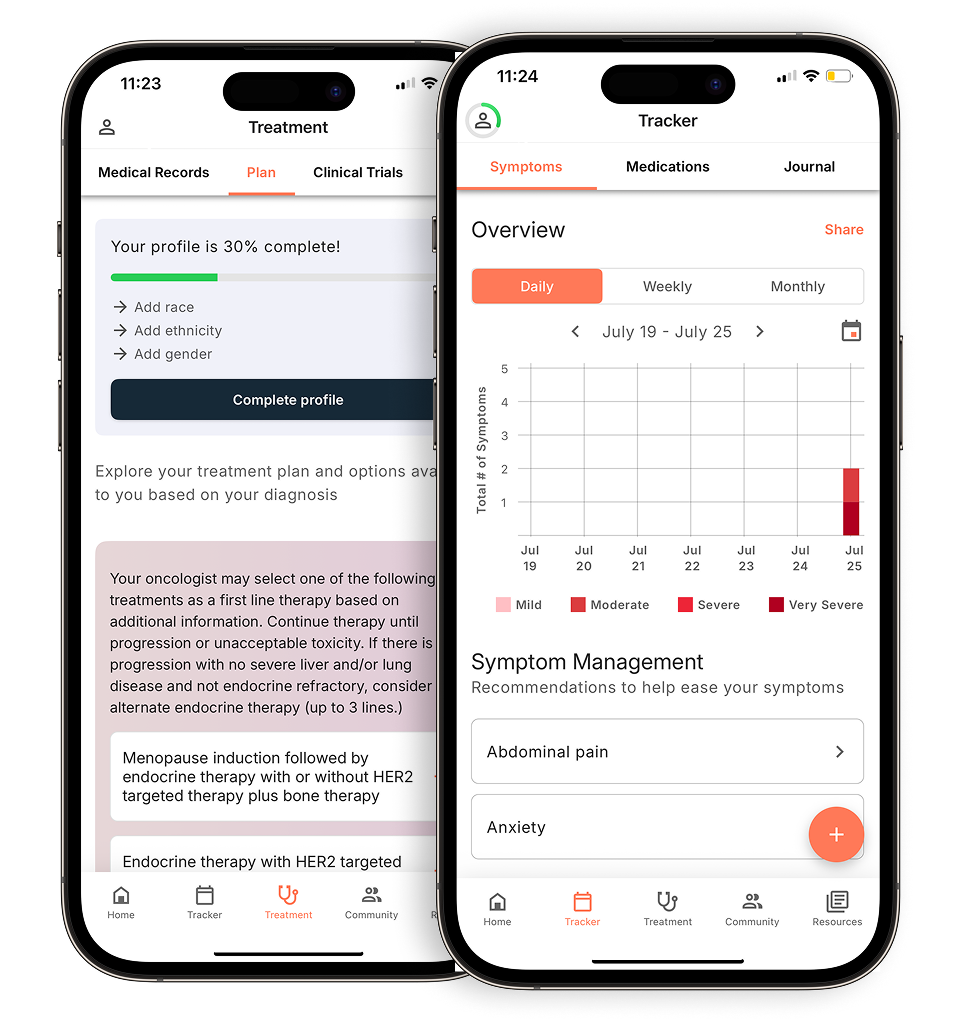
Another important aspect of this treatment is that patients do not need a specific biomarker to be eligible for it, making it a potential option for a broader group of patients. That’s really exciting.
The other major area that was discussed was immunotherapy. Historically, immunotherapy hasn’t been particularly effective in ovarian cancer. However, we’re now seeing encouraging survival benefits with pembrolizumab when it’s combined with chemotherapy for patients with platinum-resistant disease.
I think these advances give patients hope that the treatment landscape is expanding in meaningful ways. Those are probably the two most notable updates that were presented, and we’re very excited about both of them.
Both of these treatments are already FDA-approved and available to patients today. They’re being used now, and we’re seeing encouraging survival benefits from them.
Q: Are there any studies that didn’t receive a lot of media attention but that patients should know about?
Jennifer McClendon: I think it’s always important to acknowledge the rarer types of ovarian cancer that don’t receive as much attention or research funding.
Two examples are low-grade serous ovarian cancer, or LGSOC, and clear cell ovarian cancer. These subtypes are less common, but they often have unique challenges. In many cases, they don’t respond as well to chemotherapy, and outcomes can be less favorable, which is why additional research is so important.
There was some encouraging research presented on both of these subtypes. It may not have generated major headlines, but it’s meaningful for the patients living with these diseases, many of whom feel overlooked because their cancers behave differently from more common forms of ovarian cancer.
For clear cell ovarian cancer, there is ongoing research evaluating the immunotherapy drug nivolumab. The data are still early, but it’s an area that offers some hope.
There was also important research presented [at SGO 2026] for low-grade serous ovarian cancer. Researchers looked at the role of chemotherapy in treatment because this subtype typically does not respond particularly well to chemotherapy. The question was whether patients could potentially skip chemotherapy altogether and go straight to hormone therapy with a drug similar to letrozole.
Interestingly, the study did not show a benefit to skipping chemotherapy. The findings confirmed that chemotherapy remains an important part of treatment for this type of ovarian cancer.
While that may not sound like a breakthrough, studies like this are still valuable because they help confirm that the current standard of care remains the best approach. At the same time, they highlight the need for better treatment options for patients living with these rare subtypes.
So, while these studies may not have made a big splash in the headlines, I think low-grade serous and clear cell ovarian cancers are areas where we need to continue shining a light and investing in research.
Q: What are some advances in ovarian cancer that you’d like to see more of?
Jennifer McClendon: I would love to see more studies looking at quality-of-life improvement. It’s not something that we’ve heard much of, but I know that there are studies happening.
I’d like to see better access to some of these treatments and biomarker testing. For some patients, it’s just not as easy to get biomarker testing. There are ways that it can be held up, and there are political issues around it. So getting better access, clearer patient education, and ensuring that we’re still trying to make clinical trials accessible to everyone is important. Everyone should have access to and awareness of participating in studies, not just someone in a specific geographic region or someone with specific education.
I know it’s exciting to have new drugs, but I think it also has to include access, education, and the support that comes along with that.
Want more patient updates? Explore a collection of the latest ovarian cancer headlines here.
Personalized support for real care decisions
Understand your diagnosis, explore clinical trials, and track symptoms--all in one place.
Get started
Compare treatments, prepare for appointments, and track side effects—all in the app
Built for your diagnosis, Outcomes4Me gives you the tools to make confident, informed decisions—right when you need them.
Continue in app