
Hearing that ovarian cancer has returned can feel like the ground shifting beneath you, and that feeling is valid, recognized, and shared by countless patients navigating exactly this moment. But here’s what’s changed: a recurrence today is fundamentally different from a recurrence a decade ago.
Modern oncology has moved decisively away from a one-size-fits-all chemotherapy approach. Treatment for recurrent ovarian cancer is increasingly driven by your tumor’s unique biological profile, its genetic mutations, molecular markers, and how it responded to prior therapy. Recent research confirms this shift, noting that ovarian cancer recurrence is now approached through the lens of personalized medicine rather than standardized protocols.
Modern recurrence treatment aims to manage cancer long-term while protecting your quality of life. Targeted therapies have expanded what’s possible for patients.
Re-evaluating your tumor’s genetic profile is essential. Tumors can evolve between initial diagnosis and recurrence, meaning new vulnerabilities and new treatment targets may have emerged. Comprehensive biomarker testing at recurrence can reveal options that simply weren’t visible before. Understanding where your tumor stands now is the foundation of everything that follows, starting with one pivotal distinction your care team will consider.
Platinum-sensitive vs. platinum-resistant: why timing matters
The six-month mark after platinum-based chemotherapy is one of the most consequential thresholds in ovarian cancer care, as it determines which treatment pathways are available and how aggressively oncologists need to pivot.
Platinum-sensitive recurrence is generally defined as cancer that returns more than six months after completing platinum-based chemotherapy. Your care team can help you understand how this timing may influence your treatment options. In these cases, the tumor has shown it still responds to platinum drugs, so retreatment with a platinum-based regimen is often on the table, sometimes alongside targeted maintenance therapies.
Platinum-resistant recurrence occurs when ovarian cancer returns after platinum-based chemotherapy treatment, representing an important clinical challenge that emerges during the disease course for some patients. Platinum-resistant ovarian cancer requires a fundamentally different approach. The tumor has essentially sidestepped platinum’s mechanism, so retreating with the same strategy is unlikely to work.
This is precisely why platinum-resistant ovarian cancer treatment has shifted toward what researchers call “smart bombs” – therapies that can target cancer cells with far more precision than traditional chemotherapy. Rather than flooding the body with a broad cytotoxic agent, antibody-drug conjugates (ADCs) like trastuzumab deruxtecan and mirvetuximab soravtansine are targeted therapies that may be effective for ovarian cancers with specific biomarkers, such as HER2 overexpression or high folate receptor alpha.
Monitoring through CA-125 blood levels helps oncologists track disease activity over time, but it’s rarely the whole picture. Imaging, symptoms, and clinical judgment all factor into the recurrence call. Understanding this timing distinction sets the stage for a deeper question. Which specific molecular markers should guide the choice of targeted therapy? That’s where biomarker testing becomes essential.
Evidence-based guidance powered by NCCN Guidelines®
Personalized treatment plans shaped by the latest oncology standards—tailored to your diagnosis.
Get started
View your personalized treatment plan in the Outcomes4Me app
Use your diagnosis to unlock personalized NCCN Guidelines®-aligned recommendations.
Continue in app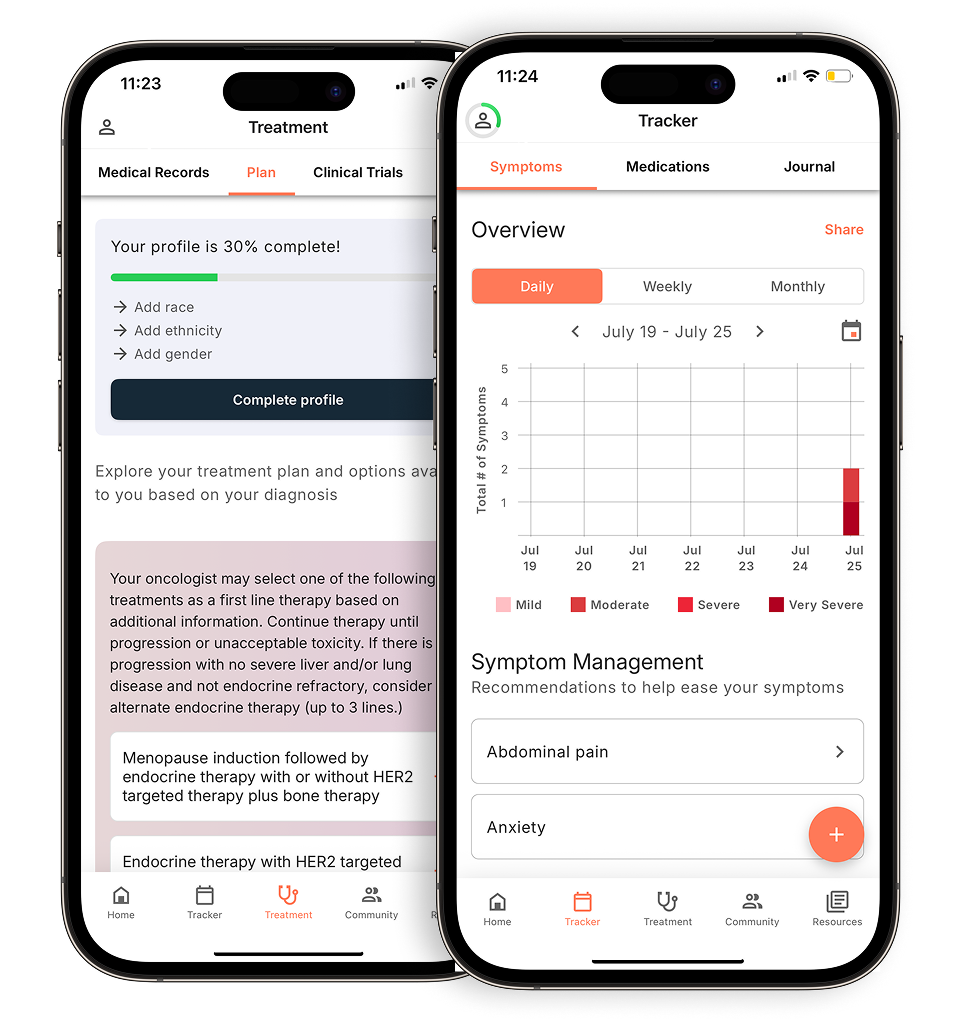
The power of biomarkers: HRD, BRCA, and FRα
Biomarker testing at recurrence is essential, it’s the roadmap that determines which treatments are most likely to work for you specifically.
Homologous Recombination Deficiency (HRD) refers to a tumor’s inability to repair damaged DNA through a specific pathway. When the DNA repair mechanism is broken, often because of BRCA1 or BRCA2 mutations, cancer cells become highly vulnerable to PARP inhibitors. Knowing your HRD status connects you to this entire class of drugs. A tumor that tests HRD-positive is far more likely to respond to PARP inhibitor maintenance therapy after platinum-based chemotherapy, which is why this result carries so much weight in treatment planning.
Folate Receptor Alpha (FRα) is a separate but equally important biomarker. Mirvetuximab soravtansine (Elahere) is FDA-approved for FRα-positive, platinum-resistant ovarian cancer. If your tumor expresses high levels of FRα, this drug may be an option when platinum-based treatment is no longer effective. Without testing, that door stays closed.
Tumor biology changes over time. A biopsy taken at initial diagnosis may not reflect what your tumor looks like today. That’s why a new tissue biopsy or liquid biopsy (a blood test that detects circulating tumor DNA) can be critical at recurrence.
These markers inform chemotherapy decisions and open access to maintenance therapies, newer targeted agents, and eligibility for clinical trials for recurrent ovarian cancer that require confirmed biomarker status for enrollment. The next section explores exactly how those targeted therapies work and why the distinction between them matters.
Targeted therapies. PARP inhibitors and ADCs
Biomarker testing for personalized cancer treatment has moved from a promising idea to the engine driving some of the most meaningful advances in recurrent ovarian cancer care. The drugs benefiting most from that shift fall into a few distinct categories.
PARP inhibitors block a repair mechanism that cancer cells depend on to survive. For patients with BRCA mutations or broader homologous recombination deficiency, olaparib and niraparib are used as maintenance therapy after second-line platinum-based chemotherapy. Rather than treating active disease, they work to delay the next recurrence. Maintenance PARP inhibitors improve progression-free survival in women with platinum-sensitive, recurrent ovarian cancer across multiple patient subsets, including those with BRCA mutations and HRD-positive tumors. The goal is to extend the treatment-free interval and keep the cancer from returning as quickly as it otherwise might.
Antibody-drug conjugates (ADCs) use a different kind of precision. Drugs like mirvetuximab soravtansine function like guided missiles. A targeting antibody latches onto a protein expressed on cancer cells and delivers chemotherapy directly, largely sparing healthy tissue. That selectivity matters enormously for managing side effects alongside efficacy.
Cancer care guidance for every step of your journey
Get treatment options, clinical trials, and support tailored to your diagnosis--all in one place.
Get started
See treatment options, manage symptoms, and stay informed—all in the app
View treatment options and trials personalized to your diagnosis—plus track progress in real time.
Continue in appBevacizumab (Avastin) takes yet another approach, targeting tumor blood supply rather than the cancer cell itself. By blocking VEGF (a protein that tumors use to grow new blood vessels), it can slow disease progression and is often combined with chemotherapy or used as maintenance therapy in certain recurrence settings.
For a smaller subset of patients whose tumors show microsatellite instability-high (MSI-H) status, pembrolizumab (Keytruda) offers an immunotherapy option by releasing the brakes the tumor places on the immune system. It’s appropriate for a limited group of ovarian cancer patients, but for those whose biomarkers point to it, the response can be meaningful.
Understanding which of these therapies applies to you depends entirely on what testing has revealed about your tumor. That same principle extends to clinical trials, where genetic markers are increasingly used to match patients to treatments that most conventional options haven’t reached yet.
Clinical trials. Moving beyond ‘last resort’ thinking
Clinical trials are increasingly the fastest route to treatments that wouldn’t otherwise be accessible, not a fallback option.
As previous sections have shown, targeted therapies like PARP inhibitors and antibody-drug conjugates for ovarian cancer have transformed what’s possible at recurrence. Many of those breakthroughs reached patients first through trials. Clinical trials offer access to the most advanced treatments before they’re widely available, which matters enormously when standard options have been exhausted or have stopped working.
Ask about trials at every recurrence, not just when chemotherapy fails. Today, many clinical trials enroll based on biomarker profiles such as BRCA status, HRD score, or FRα expression, rather than simply how many prior treatments you’ve had. That means genetic testing you’ve already completed could open doors to studies designed specifically for your tumor’s biology.
When evaluating a trial, it’s worth understanding what phase it’s in:
- Phase II trials typically focus on exploring how a treatment may work and gathering preliminary information in a specific patient group before larger studies are conducted.
- Clinical trials are conducted in different phases as part of the process to test new treatment approaches for recurrent ovarian cancer.
- Biomarker testing can help identify which clinical trials you may be eligible for, potentially giving you access to innovative therapies that are still in development.
Finding the right trial used to mean hours of searching dense medical databases. As the treatment landscape grows more complex, personalized navigation becomes just as important as the treatments themselves, a point we’ll return to in the final section.
The bottom line. What you need to know
Navigating ovarian cancer recurrence is complex, but a few core principles can help you cut through the noise and advocate for the most effective next step.
The six-month mark after platinum-based chemotherapy often determines which treatment categories are open to you and shapes every conversation with your care team from there. Biomarker testing is essential to access the full range of today’s targeted drugs.
Maintenance therapy is another lever worth understanding. For eligible patients, maintenance therapy with PARP inhibitors may be considered as part of treatment strategies to improve outcomes in advanced ovarian cancer, with treatment selection guided by biomarker testing and individual disease risk factors.
As genetic and biomarker results become the foundation of personalized ovarian cancer care, tracking this data accurately matters more than ever. Organizing your test results, treatment history, and trial eligibility in one place can make appointments significantly more productive.
Questions to ask your oncologist today
Walking into your next appointment with the right questions can meaningfully shift what treatment options are put on the table. Asking your doctor specific questions about biomarker testing helps you feel more prepared and informed, as biomarker testing may reveal new information that can influence your treatment options for recurrence.
Here are the questions worth bringing to your next conversation:
- “Has my tumor been tested for HRD status and Folate Receptor Alpha expression?” These markers directly inform whether certain targeted therapies are viable options for you.
- “Am I a candidate for secondary cytoreductive surgery, or is systemic therapy the right starting point?” The answer depends on your platinum-free interval, disease spread, and overall performance status, and it’s worth asking explicitly.
- “What is the goal of this next line of treatment, remission or symptom management?” This question clarifies the entire framework for decision-making, including how aggressively to pursue treatment and what trade-offs are acceptable.
- “What clinical trials am I currently eligible for, based on my genetic and biomarker data?” If gene testing results have revealed specific mutations, those findings should be actively matched against open trials.
You don’t have to hold these questions in your head or sort through records on your own. Organizing your biomarker results, treatment history, and matching your profile against clinical trials helps you walk into every appointment prepared, informed, and in control of your care.
Personalized support for real care decisions
Understand your diagnosis, explore clinical trials, and track symptoms--all in one place.
Get started
Compare treatments, prepare for appointments, and track side effects—all in the app
Built for your diagnosis, Outcomes4Me gives you the tools to make confident, informed decisions—right when you need them.
Continue in app