
Before starting ovarian cancer treatment, your care team will determine the stage of the cancer to understand how far it’s spread. This foundational step guides decisions about surgery, chemotherapy, radiation therapy, clinical trials, and more. Staging is essentially a roadmap that ensures your treatment is personalized for the best possible outcome.
To determine the stage, doctors use several approaches:
- Imaging tests: Ultrasound, CT, PET, or MRI scans, to see whether cancer has spread within the pelvis or to distant organs.
- Surgery and biopsy: This provides the most accurate staging by allowing the doctor to examine the tissue under a microscope.
- Blood tests: With ovarian cancer, certain proteins in the blood are elevated. A CA-125 blood test can help detect these protein levels. Other conditions can raise CA-125 levels, so a blood test alone is not enough to determine the stage.
Let’s go through the stages and substages to help you understand what they mean.
Stage I: Cancer confined to one or both ovaries
Symptoms at this stage are often subtle and can overlap with other digestive problems. These factors play a big role in why only 20% of ovarian cancers are diagnosed at an early stage. Some women notice abdominal bloating, pelvic discomfort, or changes in urinary or bowel habits.
Below are the substages:
Evidence-based guidance powered by NCCN Guidelines®
Personalized treatment plans shaped by the latest oncology standards—tailored to your diagnosis.
Get started
View your personalized treatment plan in the Outcomes4Me app
Use your diagnosis to unlock personalized NCCN Guidelines®-aligned recommendations.
Continue in app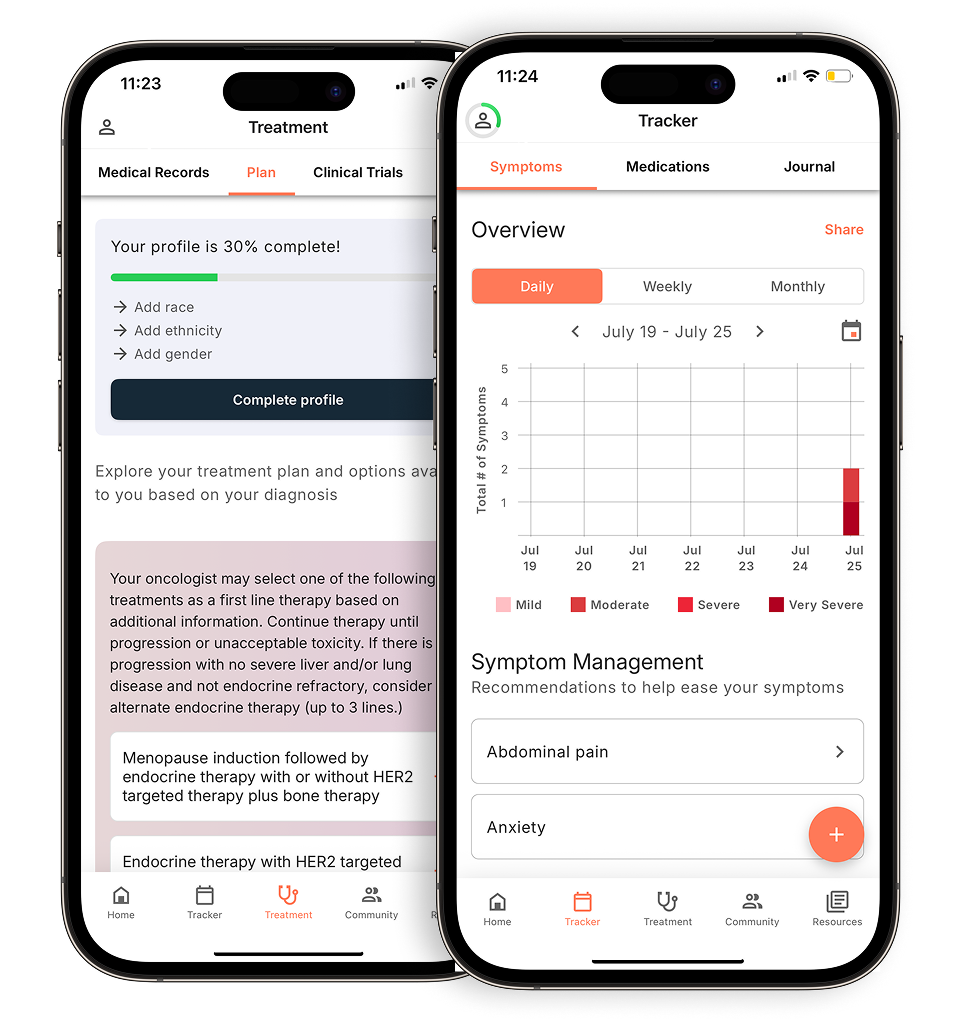
- Stage IA: Cancer is in one ovary, and the tumor is limited to the inside. No cancer cells are in the fluid of the abdomen.
- Stage IB: Cancer is in both ovaries, but has not spread outside the ovaries or into abdominal fluid.
- Stage IC: Cancer is in one or both ovaries with additional risk features:
- IC1: If the tissue surrounding the tumor breaks during surgery (surgical spill), cancer could spread to the abdomen and pelvis
- IC2: There’s cancer on the surface of the ovary/fallopian tube, or the tissue surrounding the tumor bursts before surgery
- IC3: Cancer cells found in the abdominal fluid
Treatment usually involves surgery to remove both ovaries, fallopian tubes, and uterus, and chemotherapy, depending on risk factors and your personal preferences.
Stage II: Cancer has spread within the pelvis
Symptoms of stage II ovarian cancer share many of the same symptoms as of stage I. Some less common symptoms include back pain, fatigue, weight loss, and pain during sex.
There are two substages in stage II:
- Stage IIA: Cancer has spread to the uterus or fallopian tubes.
- Stage IIB: Cancer has spread to other pelvic organs, such as the bladder, colon, or rectum.
Treatment usually involves surgery to remove all visible disease, followed by chemotherapy.
Stage III: Cancer has spread beyond the pelvis into the abdomen
Stage III indicates that cancer has spread beyond the ovaries and fallopian tubes. The following three substages provide more context:
- Stage IIIA: Microscopic spread of cancer in the pelvis area, nearby organs, or nearby lymph nodes detected only under a microscope.
- Stage IIIB: Visible cancer spread to outside the pelvis area, less than 2 cm in size.
- Stage IIIC: Cancer spread to the tissue lining, regional lymph nodes, or outer surface of the liver or spleen, and is larger than 2 cm.
Symptoms at this stage may include abdominal swelling, bloating, early satiety, or pelvic discomfort. Treatment at this stage also combines surgery and chemotherapy.
Stage IV: Cancer has spread to distant organs
At stage IV, symptoms may be more pronounced, including persistent bloating, abdominal pain, shortness of breath, fatigue, or unexplained weight loss. Stage IV means the cancer has spread to distant organs.
- Stage IVA: Cancer cells are found in the pleural fluid around the lungs.
- Stage IVB: Cancer has spread to distant organs, such as the liver or lungs, or to lymph nodes outside the abdomen.
Treatment focuses on controlling cancer, relieving symptoms, and improving quality of life, usually with chemotherapy and surgery.
Why staging matters
Staging is a crucial step in guiding treatment and planning follow-up care. While the stages may sound intimidating, they’re medical tools that help your doctors choose the safest and most effective approach. Every stage has options, and your care team will work with you to create a plan tailored to your needs.
You’re not alone. Join the Outcomes4Me Community for a safe space to share your story and connect with others who share your diagnosis.
Compare treatments, prepare for appointments, and track side effects—all in the app
Built for your diagnosis, Outcomes4Me gives you the tools to make confident, informed decisions—right when you need them.
Continue in app