
Managing your cancer journey shouldn’t feel like a second job. The right app can act as a personal assistant in your pocket, handling the logistics so you can focus on your well-being. It remembers your medication schedule, keeps detailed notes on how you’re feeling, and organizes questions for your next doctor’s visit. When you’re managing a complex diagnosis, a purpose-built advanced breast cancer treatment tracker simplifies everything. These tools are essential for tracking treatment progress and side effects, putting all the details in one secure place and giving you back a sense of control.
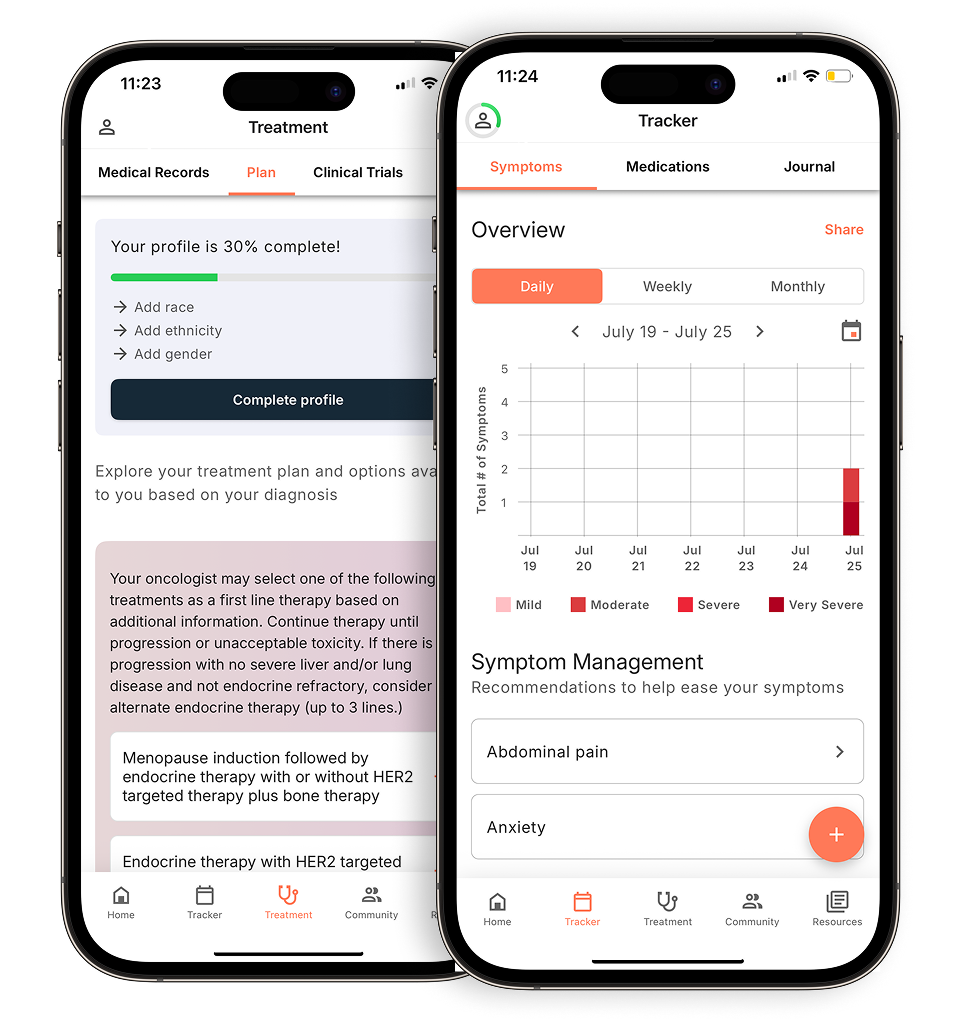
View your personalized treatment plan in the Outcomes4Me app
Use your diagnosis to unlock personalized NCCN Guidelines®-aligned recommendations.
Key Takeaways
- Organize Your Health Information: Use an app to create a single, reliable source for your symptoms, medications, and appointment notes, which reduces the mental load of managing treatment and helps you feel more in control.
- Have More Productive Doctor Visits: By tracking your symptoms over time, you can provide your doctor with clear data instead of just memories, leading to more focused conversations and better-informed adjustments to your care plan.
- Find Support Beyond Symptom Tracking: The best apps offer more than just a log; they connect you to patient communities, educational resources, and clinical trial information to support your emotional and logistical needs.
What to look for in a cancer symptom app
When you’re managing cancer treatment, the last thing you need is another complicated tool to learn. The right app should feel like a supportive partner, simplifying your life, not adding to your to-do list. While there are many options out there, the most helpful apps share a few core features designed to reduce your mental load and empower you in your conversations with your care team.
A great app helps you organize the details, from symptoms and side effects to medication schedules and appointment notes. It turns the overwhelming amount of information you’re juggling into a clear, manageable resource you can access anytime. Think of it as your personal health headquarters, right in your pocket. Let’s look at the key features that separate a truly great cancer symptom app from the rest.
A simple way to track your symptoms
One of the most important things an app can do is help you keep a consistent record of how you’re feeling. A great app lets you do more than just jot down a symptom; it allows you to track its severity, when it occurs, and how long it lasts. For example, apps like Cancer.Net Mobile let you log symptoms and view them on a graph, which can help you and your doctor spot patterns over time. This turns subjective feelings into concrete data you can share, making your appointments more productive. It’s also a perfect place to keep a running list of questions as they pop into your head.
Help managing your medications and reminders
Keeping track of medications, dosages, and schedules can be a full-time job. A quality app takes that burden off your shoulders. Look for features that allow you to create a detailed list of your medications and set up reminders for when to take them. Some apps focus specifically on medication management, sending you alerts for doses and even refills. This automation frees up your mental energy to focus on your well-being, ensuring you stay on track with your treatment plan without having to constantly watch the clock.
An easy way to connect with your care team
Your app shouldn’t be an isolated silo of information. The best ones act as a bridge between you and your healthcare providers. They make it easier to prepare for appointments by helping you organize your notes and questions. Some apps even offer direct lines of communication with cancer specialists. For instance, the ACS CARES app allows you to connect with American Cancer Society specialists 24/7. This feature provides a valuable layer of support, giving you a reliable place to turn for answers and guidance whenever you need it.
Find an App That’s Easy to Use
All the features in the world don’t matter if the app is confusing or frustrating to use. A simple, intuitive design is essential. You should be able to find what you need quickly and log information without a hassle. Sometimes, even the basic Notes app on your phone can be a powerful tool for its sheer simplicity. When choosing an app, also consider the practical side of things. Many offer free versions, but some advanced features might require a subscription. It’s a good idea to check if the app is available on your device (iOS or Android) and if it meets your specific needs before you commit.
Helpful apps for tracking cancer symptoms and treatment side effects
Finding the right app to help you manage your cancer journey can feel like a big decision, but it doesn’t have to be overwhelming. The goal is to find a tool that simplifies your life, not complicates it. A good app can help you keep track of how you’re feeling, manage your medications, and communicate more clearly with your care team. Think of it as a digital notebook that’s always with you. To help you get started, I’ve gathered some of the best apps available, each with its own unique strengths. Whether you need personalized treatment guidance, a simple medication reminder, or a way to see patterns in your symptoms, there’s an option here for you.
Outcomes4Me: For AI-powered, personalized care
Outcomes4Me is more than just a symptom tracker; it’s a personalized guide for your cancer treatment. The app uses artificial intelligence to give you information and options that are specific to your diagnosis, all based on the latest evidence-based guidelines. You can track your symptoms, manage your medications, and securely store your medical records in one place. What makes it stand out is its ability to provide you with a clear understanding of your treatment options, potential clinical trials, and questions to ask your doctor. It’s designed to empower you with knowledge so you can be a more active partner in your own care.
Cancer.Net Mobile: For comprehensive resources
From the American Society of Clinical Oncology (ASCO), Cancer.Net Mobile is a trusted and comprehensive resource. This app is fantastic for logging your symptoms, letting you rate their severity and see how they change over time in a simple graph. It’s also a great organizational tool. You can use it to jot down questions for your next doctor’s appointment, keep a detailed list of your medications (you can even add photos of the labels), and record important details from your consultations. It’s one of the most recommended apps for cancer patients because it helps you keep all your essential health information neatly organized and accessible.
MediSafe: For medication management
If your main challenge is keeping up with a complex medication schedule, MediSafe is a lifesaver. This app is specifically designed for medication management. You can set up reminders for every dose, get alerts when it’s time for a refill, and track your adherence to make sure you never miss a pill. One of its most helpful features is the ability to check for potential drug interactions, giving you an extra layer of safety. You can also share your progress with a caregiver or family member, which is a great way to build a support system around your treatment plan. It’s one of the most helpful apps for people living with cancer for this reason.
Bearable: For detailed symptom and mood tracking
Bearable was created by someone with a chronic illness, and that personal experience shines through in its design. The app helps you track not just your physical symptoms but also your mood, sleep, energy levels, and daily activities. By logging this information, you can start to see patterns and understand what might be triggering a good or bad day. This can be incredibly valuable information to share with your doctor. The app also includes reminder features to help you stay consistent with your tracking. It’s a great tool for anyone who wants to get a more holistic view of their health and is often included in lists of apps to support patients.
Wave Health: For all-in-one cancer management
Wave Health aims to be an all-in-one companion for your cancer journey. It allows you to track your symptoms, mood, and vital signs like your temperature or blood pressure. The app also sends medication reminders and helps you stay on top of your treatment schedule. A unique feature of Wave Health is that it provides information on clinical trial opportunities that might be relevant to you, making it easier to explore all your options. It’s a powerful tool for managing the day-to-day realities of cancer treatment while also keeping an eye on the bigger picture of your care plan.
ACS CARES: For a 24/7 support platform
Developed by the American Cancer Society, the ACS CARES app is focused on providing round-the-clock support for you, your family, and your caregivers. While it helps you stay organized, its main strength is connecting you with personalized information, programs, and services tailored to your specific needs. Whether you need help finding a ride to treatment, have questions about your diagnosis, or just need someone to talk to, this app connects you to the vast resources of the American Cancer Society. It’s a fantastic tool for ensuring you and your loved ones feel supported every step of the way.
Peer support and language options
Feeling understood and supported is a huge part of managing your health. Some apps recognize this and build features that connect you with real people. For example, the ACS CARES app gives you a direct line to American Cancer Society specialists anytime, day or night. It’s a comforting resource for when you have questions or just need guidance. Accessibility is also key, and some apps offer language options to make them more user-friendly. The ACS CARES app, for instance, will automatically appear in Spanish if that’s your phone’s default language, ensuring you can use the tool with ease and confidence.
Health Storylines App: For a mobile health diary
If you’re looking for a dedicated space to document your health journey, the Health Storylines app is an excellent choice. Developed by the Canadian Breast Cancer Network, this app functions as a mobile health diary. It gives you a simple way to track your symptoms, medications, moods, and more, creating a comprehensive “storyline” of your health over time. This detailed record can be incredibly helpful for both you and your care team, as it provides a clear picture of your day-to-day experiences. It’s a straightforward tool designed to help you organize your health information in one convenient place.
How apps can help you manage medications and appointments
Juggling cancer treatment can feel like taking on a second full-time job. Between medications, doctor’s visits, scans, and lab work, the sheer volume of information is overwhelming. It’s easy for important details to slip through the cracks when you’re also dealing with the physical and emotional weight of a diagnosis. This is where a good app can become your most trusted assistant, helping you organize the logistics of your care so you can focus more of your energy on healing.
Think of these apps as a central hub for your health information. They’re designed to streamline the most complex parts of your treatment plan, from remembering to take your pills to preparing for your next oncologist visit. By keeping everything in one secure and accessible place, you can reduce a significant amount of stress and feel more in control of your journey. These tools not only help you stay on track but also empower you to have more productive conversations with your care team, ensuring you get the best care possible.
Get reminders so you never miss a dose
When you’re managing multiple prescriptions—some to be taken with food, some without, all at different times of the day—it’s incredibly easy to miss a dose. Add in treatment-related fatigue or “chemo brain,” and staying on schedule becomes even more challenging. Apps like MediSafe are built specifically for this, sending you simple reminders so you don’t have to rely on memory alone. You can set up alerts for each medication and track when you’ve taken it with a quick tap. This creates a detailed log, which is invaluable for both you and your doctor to see if your treatment is on track and to understand how your medication schedule might be affecting your symptoms. Maintaining medication adherence is crucial for the best possible outcomes.
Check for drug interactions and manage your prescriptions
If you’re taking several different drugs for your cancer, its side effects, and other health conditions, there’s always a risk of negative interactions. Some apps have a built-in feature that can flag potential drug interactions, giving you the information you need to have an informed conversation with your doctor or pharmacist. While it’s not a substitute for professional medical advice, it serves as an important safety net. These apps can also help you manage your prescriptions by sending reminders when it’s time for a refill. This simple feature helps you avoid the stress of realizing you’re on your last pill, ensuring you have a continuous supply of the medications you need.
Keep track of appointments and coordinate with your team
Your calendar can quickly fill up with appointments for your oncologist, radiologist, surgeon, and other specialists. Keeping them all straight is a challenge in itself. Many healthcare systems use patient portals like MyChart, which often have a dedicated app to help you manage your schedule. Through these apps, you can view upcoming appointments, schedule new ones, and even check in online. More importantly, they often include a secure messaging feature, allowing you to communicate directly with your care team without waiting on hold. Having the ability to ask a non-urgent question, request a prescription refill, or view your latest lab results on your own time can be incredibly empowering.
Keep your treatment timeline organized
From your diagnosis day onward, your cancer journey is filled with important dates, decisions, and details. Over time, it can all start to blur together. An app helps you create a clear, organized timeline of your treatment. You can log your medications, track your symptoms, and keep notes from every appointment in one place. Apps like Cancer.Net Mobile even let you record questions as you think of them, so you arrive at your appointments prepared. This digital record becomes a comprehensive history of your care that you can easily reference. It’s not just for you—it’s a powerful tool that helps your doctor see the full picture of your health, identify patterns, and make more informed decisions about your treatment plan.
What other support can a cancer app offer?
While keeping a detailed log of your symptoms is a powerful tool, your journey through cancer treatment involves so much more than just physical side effects. The emotional, logistical, and educational aspects of your care are just as important. The good news is that many of today’s health apps are designed to be holistic resources, offering support that extends far beyond a simple tracking feature. Think of them as a digital extension of your support system, available right in your pocket.
These apps can connect you with vital information, link you to communities of people who understand what you’re going through, and even help you manage the day-to-day tasks that can feel overwhelming during treatment. From finding clinical trials to getting 24/7 answers from specialists, this integrated support can help you feel more in control and less alone. By exploring these additional features, you can find a tool that not only helps you manage your health but also supports your overall well-being.
Find reliable educational resources
Feeling informed is feeling empowered. When you’re facing a cancer diagnosis, having access to reliable, easy-to-understand information is critical. Some apps are designed to be comprehensive educational hubs, putting trusted knowledge at your fingertips. For example, apps like Cancer.Net Mobile offer a wealth of information on over 125 types of cancer, helping you learn more about your specific diagnosis and treatment options. This allows you to walk into your appointments feeling more prepared to ask questions and participate in decisions about your care. Having this resource on your phone means you can find answers whenever you need them, without getting lost in a sea of questionable online search results.
Connect with others who understand
You don’t have to go through this alone. Connecting with others who are on a similar path can provide a unique kind of comfort and validation that friends and family, however well-meaning, may not be able to offer. Several apps are built around this very idea, creating safe spaces for patients and caregivers to share experiences and advice. The BELONG — Beating Cancer Together app, for instance, hosts the largest online community for cancer patients, with support groups organized by cancer type. Finding your people can make a world of difference, reminding you that you are part of a strong, resilient community.
Learn about clinical trial opportunities
For some patients, clinical trials can offer access to cutting-edge treatments that aren’t yet widely available. However, finding a trial that’s right for you can feel like searching for a needle in a haystack. Certain apps are designed to simplify this process by matching you with relevant opportunities based on your diagnosis and health profile. An app like Wave Health can help you discover clinical trials you may be eligible for, giving you another avenue to discuss with your care team. This feature empowers you to explore all your options and take an active role in your treatment plan.
Get support from cancer specialists
Questions and concerns don’t always pop up during your doctor’s office hours. Whether it’s late at night or over a weekend, having a question about a symptom or medication can be stressful. Some organizations offer apps that provide around-the-clock support from medical professionals. The American Cancer Society’s ACS CARES app, for example, gives you and your family 24/7 access to cancer specialists who can answer your questions and provide guidance. This immediate connection can offer incredible peace of mind, ensuring you never have to wait long for a trusted answer.
A space to track your emotional well-being
Your emotional health is a vital part of your overall well-being, especially during cancer treatment. The journey can be an emotional rollercoaster, and tracking your moods and feelings is just as important as tracking physical symptoms. Apps like Bearable are specifically designed to help you monitor your mood alongside your physical health, allowing you to see patterns and identify triggers. Sharing this information with your care team can help them understand the full impact of your treatment, leading to more holistic support that addresses both your body and your mind.
Find support for caregivers and daily tasks
It’s okay to ask for help. During treatment, even everyday tasks like grocery shopping or getting a ride to an appointment can feel monumental. Some apps are designed to make it easier to coordinate support from your network of friends and family. The LivingWith app, for example, helps you create a support “Circle” where you can post requests for help with specific tasks. This takes the awkwardness out of asking and allows your loved ones to sign up for tasks they can manage, ensuring you get the practical support you need while also easing the burden on caregivers.
Beyond symptom tracking: Advanced monitoring methods
While tracking your symptoms in an app is a fantastic way to stay organized, technology is also giving us new ways to monitor health that go beyond what you can log manually. These advanced methods can offer your care team a deeper, more objective look at how your body is responding to treatment. Think of them as extra layers of data that can help paint a more complete picture of your well-being. From wearable devices that track your daily activity to simple blood tests that can offer early clues about treatment effectiveness, these tools are changing the way we approach cancer care. They provide insights that can lead to more personalized and timely adjustments to your plan, helping you and your doctor make decisions with even greater confidence.
These technologies aren’t meant to replace your own observations but to complement them. By combining the information you provide with objective data from these tools, your care team can get a holistic view of your health. This can be especially helpful for spotting subtle changes that might otherwise go unnoticed. It’s an exciting area of innovation that’s focused on making cancer care more precise and proactive, giving you and your team the best possible information to work with.
Wearable devices for physical activity
You might already have a powerful health-monitoring tool on your wrist. Wearable devices like smartwatches and fitness trackers are increasingly being used in cancer care to monitor physical activity. Studies have shown that tracking daily movement can provide valuable insights into a patient’s overall health and ability to tolerate treatment. For example, a consistent drop in your daily step count could be an early indicator of increasing fatigue or other side effects, prompting a conversation with your doctor before it becomes a bigger issue. This kind of continuous, real-world data helps your care team understand how you’re doing between appointments, offering a more dynamic view of your health than a simple check-in every few weeks.
Blood tests to monitor treatment response
One of the most promising advancements in cancer monitoring is the use of simple blood tests, sometimes called liquid biopsies, to see how well a treatment is working. These tests can detect and measure tiny fragments of tumor DNA circulating in your bloodstream. The exciting part is that this can be done very early in your treatment course. By tracking these levels, doctors can get a quick indication of whether a tumor is shrinking in response to therapy, often much sooner than a traditional scan could show. This allows your care team to make faster, more informed decisions, such as continuing with an effective treatment or quickly switching to a different one if the current plan isn’t working as well as hoped.
Tools for prediction, risk assessment, and research
Beyond monitoring your current health, a new generation of digital tools is helping patients and doctors look toward the future. These tools use data to help predict treatment outcomes, assess personal risk, and connect patients with vital research opportunities. They are designed to translate complex medical information into understandable insights, empowering you to have more meaningful conversations with your care team about your long-term health and the bigger picture of cancer care. Whether it’s understanding how a particular treatment might benefit you or finding a way to contribute to the science that will help future patients, these resources can add another layer of clarity and purpose to your journey.
Predicting treatment outcomes
When you’re faced with decisions about treatment, it can be helpful to understand the potential long-term benefits. Tools like Predict are designed to do just that for people with early-stage breast cancer. It’s an online tool that uses information about you and your diagnosis to estimate how different treatments, such as chemotherapy or hormone therapy, might improve survival rates after surgery. It’s important to remember that this is a statistical model, not a crystal ball, but it can be an incredibly useful resource for you and your doctor to explore together. It helps turn abstract statistics into personalized estimates, making it easier to weigh the pros and cons of your treatment options and make a choice that feels right for you.
Assessing breast cancer risk
For women who have not been diagnosed with breast cancer, understanding personal risk is key to making informed decisions about screening and prevention. Researchers are developing new ways to provide a more personalized risk assessment than ever before. For example, UC San Francisco has created a new digital tool that specifically calculates a woman’s risk of developing advanced breast cancer. By looking at a combination of health factors, it can help you and your doctor decide on the most appropriate screening schedule, such as whether you might benefit from starting mammograms earlier or having them more frequently. This kind of tool helps move beyond one-size-fits-all guidelines to a more personalized approach to breast health.
Key risk factors to know
To provide a personalized estimate, risk calculators look at a combination of factors that are unique to you. The UCSF tool, for instance, considers several key pieces of information, including your age, race, and ethnicity, family history of breast cancer, your body mass index (BMI), and whether you’ve had a prior breast biopsy. It also takes into account your breast density and menopausal status. By analyzing these factors together, the tool can create a more nuanced picture of your individual risk profile.
Contributing to research and finding options
Your personal health journey holds valuable information that can help drive cancer research forward. Several platforms now make it easier than ever for you to contribute your data and experiences to help scientists find better treatments. For example, MBC Connect is an initiative that allows patients with metastatic breast cancer to share their information to build a powerful database for researchers. At the same time, apps like Outcomes4Me can help you find options for your own care by using your unique diagnosis to match you with potential clinical trials. By participating in research, you not only gain access to cutting-edge care but also become an active partner in the fight against cancer for everyone.
How to have more effective talks with your doctor
Your doctor’s appointments are a critical part of your cancer care, but they can often feel rushed. A symptom tracking app does more than just help you remember how you felt last Tuesday; it transforms your daily experiences into clear, organized information. This data empowers you to have more productive, focused conversations with your care team, ensuring your voice is heard and your treatment plan is truly tailored to you. By bringing concrete data to your appointments, you can move from simply reporting symptoms to actively collaborating on your care.
Create easy-to-read reports to share with your doctor
Walking into an appointment with a detailed summary of your health can make a world of difference. Instead of trying to recall weeks of symptoms on the spot, many apps can create reports to show how your symptoms or medication use change over time. Presenting your health data in a structured, visual format makes it easier for your doctor to quickly grasp your progress and challenges. This means you can spend less time trying to remember details and more time discussing what to do next. These reports provide a clear snapshot of your experience between visits, helping your doctor make well-informed adjustments to your treatment plan.
See patterns in your symptoms and side effects
Some side effects might seem random, but tracking them consistently can reveal important patterns. An app can help you connect the dots between your treatments, activities, and how you feel. For example, some apps track symptoms and mood, helping you see patterns you might otherwise miss. Maybe you notice your fatigue always peaks two days after a specific treatment, or a certain food triggers nausea. Identifying these trends gives you valuable insights to share with your doctor. This information allows them to offer more personalized advice, whether it’s adjusting medication timing or suggesting new ways to manage side effects.
Come prepared with questions for your appointments
How many times have you thought of the perfect question in the middle of the night, only to forget it completely once you’re in the exam room? It happens to everyone. Preparation is key to making the most of your limited time with your doctor. Many health apps have a feature that lets you record questions for your appointments as they come to you. Keeping a running list in your app ensures you cover all your concerns and get the answers you need. This simple habit helps you lead the conversation, turning your appointment into a productive discussion where you feel informed and in control of your care.
Help your care team make informed decisions
When you consistently track your health, you’re not just keeping a diary for yourself—you’re building a powerful tool for your entire care team. Using these apps can help you give more accurate and complete information to your doctors during appointments. This detailed, real-time data allows your doctor to be more proactive. Instead of reacting to a problem after it’s become severe, they can spot early warning signs and make timely adjustments to your treatment. This proactive approach, fueled by the information you provide, can lead to better symptom management and a smoother treatment experience overall.
The patient perspective: Making informed decisions
Your cancer journey is uniquely yours, and so are the decisions you’ll make along the way. Being an active participant in your care isn’t about becoming a medical expert overnight; it’s about understanding your options well enough to make choices that feel right for you. This is often called shared decision-making, where you and your doctor work together as a team. An app can be a powerful tool in this process, helping you gather information, track what matters most to you, and clarify your own goals. When you feel informed and prepared, you can approach conversations with your care team with confidence, ensuring your treatment plan aligns with your personal values and priorities.
The importance of gathering information
Knowledge is a powerful tool for reducing anxiety and feeling more in control. When you’re faced with a diagnosis, having access to reliable, easy-to-understand information is essential for making sound decisions about your care. The right resources can help you understand your specific type of cancer, the standard treatment options, and what to expect. This is why platforms like Outcomes4Me are so valuable—they translate complex medical guidelines into clear, personalized information you can use. By learning about your diagnosis from trusted sources, you can move from feeling overwhelmed to feeling empowered, ready to have meaningful conversations with your doctor about the best path forward for you.
Considering long-term outlook and quality of life
Your treatment plan is about more than just targeting cancer cells; it’s about your life as a whole. It’s important to think about what quality of life means to you and to share that with your doctor. This includes your emotional well-being, which is a huge part of your overall health. Tracking your mood, energy levels, and ability to do the things you love is just as important as tracking physical side effects. Using an app to monitor these aspects can help you and your care team see the complete picture. This allows you to make decisions that not only address the cancer but also support your ability to live well during and after treatment, based on your own personal priorities.
Deciding when to stop treatment
Sometimes, the goals of treatment can shift. The decision to stop or change a course of treatment is deeply personal and there is no right or wrong answer. For some, the goal is to continue treatment for as long as possible, while for others, there may come a point where the side effects begin to outweigh the benefits. This is a conversation to have openly with your doctors and your loved ones. It’s about aligning your medical care with your personal values. As the Cleveland Clinic notes, this is a major decision, and it’s one that is entirely yours to make, based on what you feel is best for your quality of life.
How to choose the right app for you
With so many options available, finding the right app can feel like another task on your to-do list. But the goal is to make your life easier, not more complicated. The best app for you is the one that fits your specific needs and that you’ll actually use consistently. Think about what would be most helpful for you right now. Is it keeping track of medications? Is it understanding your symptoms? Or is it feeling more connected to a support system? Taking a moment to consider your priorities will help you narrow down the choices and find a tool that truly supports you on your cancer journey.
Think about what features you really need
Before you start downloading, think about what you want to accomplish. Mobile apps can help you manage a cancer diagnosis in many ways, so it’s helpful to know what you’re looking for. Do you need a simple way to track medications and get reminders? Are you trying to identify patterns in your symptoms and side effects? Some apps are comprehensive, offering a place to log everything from appointments to how you’re feeling each day. Others are more specialized, focusing just on mood or medication management. Make a short list of your must-have features, whether it’s symptom tracking, appointment logs, or access to educational resources. This will help you quickly see which apps are a good fit.
Consider how comfortable you are with technology
An app is only useful if you feel comfortable using it. You don’t need to be a tech expert to benefit from these tools. Many of the best apps are designed with simplicity in mind, featuring clean layouts and intuitive controls. When you’re exploring options, pay attention to the user interface. Does it feel straightforward and easy to understand? If an app seems confusing or overwhelming from the start, it’s probably not the right one for you. The goal is to reduce stress, not add to it. Look for apps that have good reviews regarding ease of use, and don’t be afraid to choose a simpler option if it feels like a better fit.
How to get started with a symptom tracker
Getting started is usually a simple process. Most apps are available for free on the Apple App Store or Google Play. Once you download one, you’ll typically be asked to create a profile and answer a few questions about your diagnosis and treatment plan. This helps the app personalize the information and features for you. My advice? Try one or two that look promising. Spend a few days using them to see how they feel. You’re not locked into the first one you download. The right app will make it easier to give accurate information to your doctors and feel more in control of your care.
Related Articles
- Top 6 Cancer Treatment & Symptom Tracker Apps
- 5 Best Apps for Managing Cancer Symptoms in 2025
- Symptom tracking made for breast cancer – Outcomes4Me
- Top 5 Apps for Breast Cancer Symptom Tracking
View your personalized treatment plan in the Outcomes4Me app
Use your diagnosis to unlock personalized NCCN Guidelines®-aligned recommendations.
Frequently Asked Questions
Is my personal health information safe in these apps? This is an incredibly important question, and the short answer is that reputable apps take your privacy very seriously. Most health apps use security measures like encryption to protect your data. Before you commit to an app, it’s always a good idea to look for its privacy policy. This document should clearly explain how your information is stored and used. Your health story is personal, and you deserve to feel confident that it’s being kept secure.
Do I have to pay to use these apps? Many of the most helpful apps are available for free, offering a full range of features without any cost. Some may offer optional premium subscriptions for more advanced tools, but you can often get everything you need from the free version. My advice is to start with a free app that seems like a good fit. You can always explore paid options later if you find you need a specific feature that isn’t included.
I’m feeling overwhelmed by all the options. Which type of app is best to start with? It’s completely understandable to feel overwhelmed. Instead of trying to find one app that does everything, think about your single biggest challenge right now. If keeping track of your pills is causing the most stress, start with a dedicated medication manager. If you want a clearer understanding of your treatment path and options, an all-in-one guide like Outcomes4Me would be a great place to begin. Focusing on your most pressing need will help you choose a tool that provides immediate value.
Can my caregiver or a family member use the app to help me? Yes, many apps are designed with your support system in mind. Some allow you to share your progress, medication schedules, or symptom logs with a designated caregiver or family member. This feature can be a huge help, as it allows your loved ones to stay informed and provide support without you having to constantly provide updates. It’s a great way to keep everyone on the same page and working as a team.
Will my doctor actually have time to look at the information I track? While your doctor’s time is limited, bringing organized information to an appointment is one of the best ways to make every minute count. Instead of trying to remember how you felt three weeks ago, you can show them a simple graph or a concise report of your symptoms. This gives them a clear, accurate picture of your experience between visits, helping them spot patterns and make better-informed decisions about your care more efficiently.