
A double mastectomy is performed to treat or reduce the risk of breast cancer. The goal of a double mastectomy is complete removal of breast tissue, which may also involve lymph nodes depending on staging. What follows is a three-phase healing process your body runs automatically:
- Inflammation (days 1–5): Your immune system floods the surgical site with blood flow and protective cells. Swelling, warmth, and discomfort are expected, not signs something’s wrong.
- Proliferation (weeks 1–6): New tissue forms, drains are typically removed, and the incision begins to close.
- Remodeling (months 2–12+): Scar tissue matures, sensation gradually returns, and your body settles into its new contour.
Recovery paths diverge early depending on your surgical plan. Patients who choose going flat (no reconstruction) typically have a straightforward recovery process, as this approach does not involve the additional steps required by reconstruction procedures. Those who pursue immediate tissue expander or flap reconstruction face a longer, more complex arc. If you’re navigating questions about how tissue expanders work during breast reconstruction after mastectomy, understanding the expansion process and recovery timeline can help you prepare for what to expect.
Drains and physical discomfort like chest tightness often bother patients most during mastectomy recovery, rather than pain from the incision itself. Restricted mobility, drain management, and fatigue collide directly with the emotional hurdles of adjusting to a changed body, often in the same week. That intersection is where week-by-week structure becomes most valuable, starting with the critical first seven days.
Week 1: navigating the acute post-operative phase
The 0–7 day window is defined by two priorities. Managing pain and caring for surgical drains. Most care teams send patients home with Jackson-Pratt drains, which remove fluid buildup from the surgical site. You’ll need to empty and measure the output at least twice daily, recording the volume each time. Drains typically stay in until output drops below 30cc over a 24-hour period. Your care team will confirm the exact threshold for your situation.
Pain management during this phase usually involves a combination of prescription medication and over-the-counter options. Take medications on the schedule your care team recommends rather than waiting for pain to peak, as staying ahead of discomfort is far easier than catching up to it.
Sleeping position matters more than most people expect. Many patients find that elevating their upper body at roughly 30–45 degrees may help with swelling and chest wall comfort. Talk with your surgical team about positioning strategies that work best for your recovery. Finding a comfortable sleeping position can be challenging during recovery. Some patients find that specially designed wedge pillows provide support and comfort.
Certain symptoms during this window demand immediate clinical attention:
- Fever above 101°F
- Red skin on your breast or around your incision, drainage from an incision, or a temperature above 101.5° F
- Contact your surgeon if you notice changes in your drain output or any signs of infection, as drain management is an important part of recovery.
- Severe pain not relieved by your prescribed pain medications is a symptom that requires you to call your surgeon.
If you notice drainage complications or unexpected pain around reconstruction hardware, prompt communication with your surgical team may help address problems early. Ask your care team what symptoms warrant immediate attention and when to schedule follow-up visits.
Evidence-based guidance powered by NCCN Guidelines®
Personalized treatment plans shaped by the latest oncology standards—tailored to your diagnosis.
Get started
View your personalized treatment plan in the Outcomes4Me app
Use your diagnosis to unlock personalized NCCN Guidelines®-aligned recommendations.
Continue in app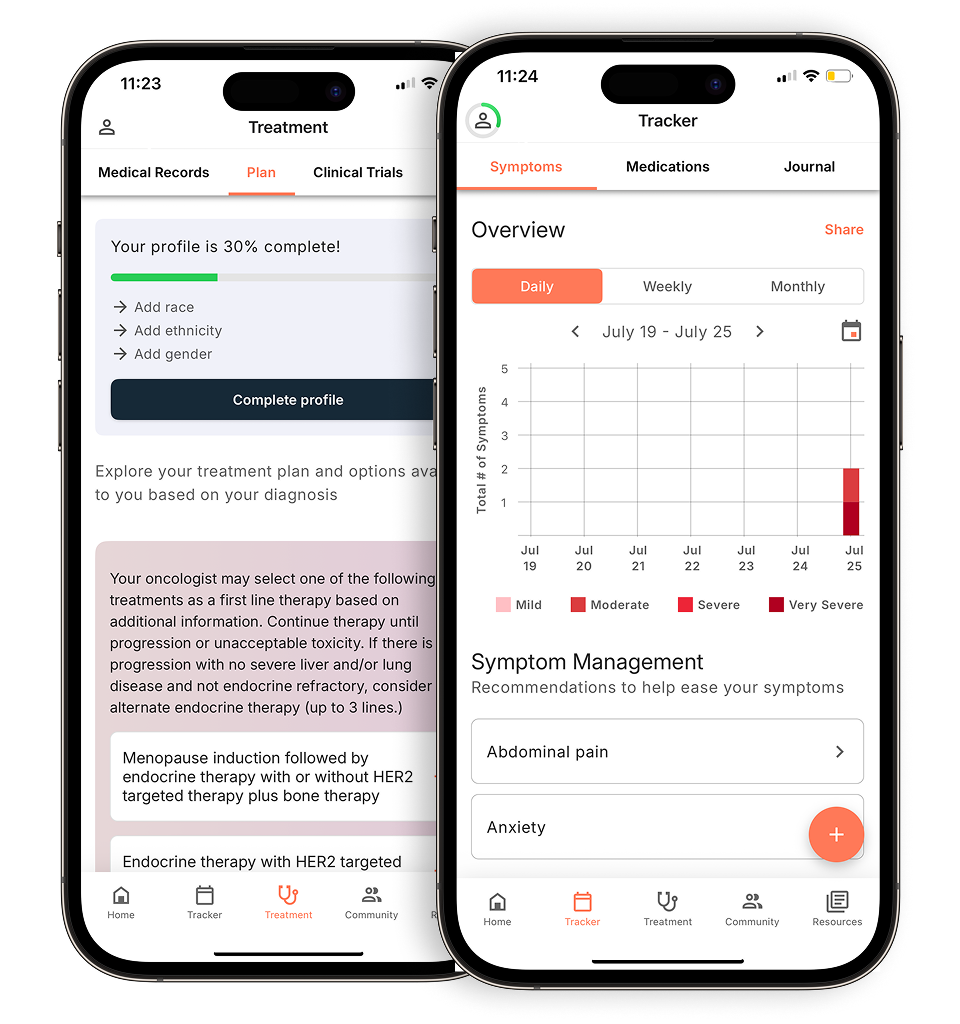
As week one draws to a close, the focus naturally shifts toward a new set of milestones: drain removal criteria, early movement, and the self-care adjustments that mark the transition into week two.
Milestones in early recovery
Managing surgical drains. Drains are thin tubes placed near incisions to prevent fluid from pooling under the skin, a condition called seroma. Your care team will ask you to empty and measure output twice daily. The standard removal threshold for drains is fewer than 30cc of fluid in a 24-hour period. Most people reach the drain removal threshold somewhere between days 7 and 21, depending on the extent of surgery. Keep a log. That data matters.
Range of motion basics. Restricted arm movement is expected, but complete inactivity creates a risk of stiffening of the shoulder joint sometimes called “frozen shoulder.” Surgeon-approved gentle exercises, like slow arm raises and shoulder rolls, typically begin within the first few days. When movement restarts is just as critical as how long a double mastectomy takes. Always confirm the specific exercises with your care team before starting.
Personal care adjustments. Until drains are removed and incisions are confirmed sealed, sponge bathing is the default. Some patients with waterproof dressings may get clearance to shower sooner than those without.
As drains come out and incisions stabilize, the recovery dynamic shifts noticeably, which is exactly where the next phase begins.
Weeks 2–4: transitioning to functional mobility
By weeks two through four of double mastectomy recovery, the sharp surgical pain fades, and a new set of sensations takes its place. Understanding them helps you stay ahead of anxiety.
Nerve sensations shift the experience. The acute, wound-level pain that dominated week one gradually gives way to itching, tingling, and occasional sharp ‘zinging’ feelings across the chest as nerves wake up.
Drain removal is often the turning point most people don’t anticipate. Once drain output drops below the threshold a care team sets (typically around 30 ml per day), drains usually come out somewhere between days 7 and 21. That single moment can dramatically change your physical comfort and range of motion. Suddenly, movement feels less tethered.
Return to work depends almost entirely on what your job demands. During the first 3 to 4 weeks of recovery, you will have restrictions on heavy lifting, arm raises, and driving, which may limit your ability to return to most work activities until you receive clearance from your surgeon.
Many people report noticing a shift in energy and comfort around weeks three and four of recovery, though the timing and extent vary from person to person. Physical improvement tends to outpace emotional processing. Give both equal attention.
How that timeline plays out also depends heavily on your surgical approach, and that’s exactly where reconstruction type becomes a defining variable.
Reconstruction vs. simple mastectomy timelines
How long it takes to recover from a double mastectomy depends heavily on whether reconstruction is part of the procedure.
Cancer care guidance for every step of your journey
Get treatment options, clinical trials, and support tailored to your diagnosis--all in one place.
Get started
See treatment options, manage symptoms, and stay informed—all in the app
View treatment options and trials personalized to your diagnosis—plus track progress in real time.
Continue in appThe three most common paths each carry a distinct timeline, and understanding the differences helps you set realistic expectations with your care team before surgery.
Going flat (simple mastectomy) is the most straightforward recovery arc. Going flat (simple mastectomy) without implants or donor tissue involved results in most people returning to non-strenuous daily activities within two to four weeks. Some patients who choose to go flat report that drain removal may happen sooner and that they experience less ongoing discomfort without a secondary reconstruction procedure. Talk with your surgical team about what timeline and recovery experience to expect with your specific plan.
Reconstruction with tissue expanders adds a layer of complexity. Tissue expanders are placed during initial surgery and gradually filled with saline over several months to slowly stretch the chest wall tissue. After each tissue expansion, you may feel tightness and fullness in your reconstructed breast, along with some discomfort in your shoulder or back that often improves within a few days.
Autologous flap reconstruction carries the longest recovery window. Recovery from a double mastectomy with reconstruction at the same time may take up to eight weeks for your wounds to heal, though the timeline varies depending on the type of reconstruction used. In autologous flap reconstruction, tissue is harvested from a donor site, typically the abdomen (TRAM or DIEP flap) or the back (latissimus dorsi flap). With autologous flap reconstruction, healing happens at multiple surgical sites simultaneously. With autologous flap reconstruction, recovery involves managing swelling and tightness at the donor site for about 6 to 8 weeks, in addition to incision discomfort at the breast area.
As weeks four through six approach, all three groups begin converging toward a shared milestone, and what happens at that threshold sets the stage for the longer remodeling phase ahead.
Weeks 6 and beyond. Long-term recovery and remodeling
Recovery from a double mastectomy typically takes 3 to 4 weeks, but you’ll need to follow gradual restrictions on activity, such as avoiding heavy lifting until drains are removed and waiting at least 6 weeks before swimming or bathing, as you progress through healing.
Many care teams begin discussing a gradual return to high-impact exercise and lifting over 10 lbs around the 6-week mark, though the exact timeline varies by individual and your surgeon’s guidance. For anyone tracking double mastectomy with reconstruction recovery time, it’s worth knowing that the visible healing you see at six weeks is only part of the picture.
Beneath the surface, the remodeling phase of scar tissue is just getting started. The remodeling phase of scar tissue maturation can continue for 12 to 18 months. Early scars are typically firm, slightly raised, and red, but will likely flatten and fade over several months to a year. Massage and silicone sheeting, when recommended by your care team, can support scar remodeling.
Internally, your surgeon may use absorbable sutures, which are designed to dissolve over time rather than requiring removal. Ask your care team about the expected timeline for your specific sutures. While deeper tissues gradually re-adhere to the chest wall after surgery, after a double mastectomy, you may experience tightness in the chest or arm area on the surgical side, which is a normal part of recovery. Range-of-motion exercises and stretches can help reduce this sensation.
Ongoing physical therapy plays a critical role here. Two complications that can emerge or linger past the six-week mark are:
- Axillary web syndrome (cording), Some patients experience axillary web syndrome (cording), in which tight, cord-like bands form along the inner arm and may restrict range of motion. If this occurs, talk with your care team about when symptoms typically improve, as recovery timelines can vary.
- Lymphedema risk, particularly relevant if lymph nodes were removed during surgery
Early treatment of lymphedema symptoms is important to prevent the condition from worsening, and your healthcare provider can help you monitor for signs of swelling or other changes after your surgery.
Recovery at this stage is less dramatic than the first weeks, but no less important to take seriously.
Limitations, considerations, and common misconceptions
Activity clearance after a double mastectomy means you’ve crossed a clinical threshold, not the finish line.
For some patients, numbness or loss of sensation can persist as a long-term or permanent side effect after mastectomy, particularly in the chest, underarm, or upper arm area. Nerve regeneration is slow, and tingling, hypersensitivity, or areas of complete numbness around the chest wall are common and may take a year or longer to resolve. That’s normal, and it’s worth setting realistic expectations with your care team before interpreting those sensations as complications.
Healing variability is real. Several factors, such as age, diabetes, prior radiation therapy, and overall immune health, may play a role in how quickly your body heals after surgery. Your surgical team can help you understand how your individual health profile might affect your recovery timeline. Radiation therapy to the skin and chest wall after flap-based breast reconstruction may cause complications during the healing process.
A persistent misconception is that a double mastectomy eliminates all future breast cancer risk. A double mastectomy significantly reduces breast cancer risk but does not reach zero. After a mastectomy, the body fills the empty space left under the skin with fluid, which is why drains are needed during recovery. This means ongoing surveillance still matters after a double mastectomy.
And perhaps most underappreciated, emotional recovery matters alongside physical healing after a double mastectomy. After breast surgery, many people experience emotional responses such as grief, sadness, or anxiety about body image changes, and adjusting to your new body takes time. Separate support, whether through a therapist or a support group, is part of a complete, personalized care plan.
These nuances are worth keeping in mind as you take stock of the full recovery picture.
Disclaimer: The information provided in this article is for informational purposes only and is not intended to be a substitute for professional medical advice, diagnosis, or treatment. Outcomes4Me is not acting as your caregiver, and any suggestions or guidance offered should not replace the advice of your healthcare provider or qualified medical professional. Always seek the guidance of your physician or other qualified health provider with any questions you may have regarding a medical condition.
Personalized support for real care decisions
Understand your diagnosis, explore clinical trials, and track symptoms--all in one place.
Get started
Compare treatments, prepare for appointments, and track side effects—all in the app
Built for your diagnosis, Outcomes4Me gives you the tools to make confident, informed decisions—right when you need them.
Continue in app