
Resistance to endocrine therapy is one of the most common and complex challenges in HR+ breast cancer, and understanding why it happens is the first step toward knowing what to do next.
If your hormone therapy has stopped working, you’re not alone, and this isn’t a reflection of something you did wrong. Approximately 30–40% of patients with HR+ breast cancer eventually develop resistance to standard endocrine therapy. That’s a significant portion of people facing a moment that can feel disorienting. Resistance is a biological shift, and one that oncologists are now equipped to address with increasing precision.
Primary vs. secondary resistance. Clinicians distinguish between two distinct patterns. Primary (de novo) resistance refers to disease that may progress or recur relatively early during adjuvant endocrine therapy. Your care team can discuss what timeframe may indicate resistance in your individual situation. Secondary (acquired) resistance describes relapse after at least two years of adjuvant therapy, or in the metastatic setting, progression following an initial response. The distinction matters because each pattern points toward different underlying biology and, ultimately, different treatment strategies.
At the core of both patterns is the molecular mechanisms cancer cells use to keep growing even when estrogen signaling is suppressed. Aromatase inhibitor resistance is a key example. Cancer cells can activate alternative signaling pathways, accumulate mutations in hormone receptor genes, or rewire their internal machinery so that estrogen is no longer required to drive growth. Think of it as cancer finding a detour around a blocked road. Understanding which detour a tumor has taken shapes a more targeted, personalized care plan going forward.
One of the most clinically significant escape routes involves a specific mutation in estrogen receptor gene, something your care team may already be testing for, or should be. We’ll explore that in detail next.
The ESR1 mutation
Among the genetic changes that drive acquired resistance, mutations in the ESR1 gene are the most clinically significant, and understanding how they work can change the way you read your genetic test results.
ESR1 codes for the estrogen receptor protein itself. Under normal conditions, that receptor only activates when estrogen binds to it. But when an ESR1 mutation develops, it causes the receptor to stay “switched on” even when estrogen isn’t present in the body. Think of it like a light switch that’s been jammed in the “on” position, removing the electricity (estrogen) no longer turns off the light.
This is exactly why traditional aromatase inhibitors fail once an ESR1 mutation is present. Aromatase inhibitors work by lowering estrogen levels in the body, effectively starving the receptor of its signal. If the receptor no longer needs estrogen to activate, cutting off the supply does very little. The cancer keeps growing regardless. It’s also worth noting that ESR1 mutations rarely appear in newly diagnosed patients, they typically emerge after prolonged exposure to aromatase inhibitors, which is why monitoring for them over time matters.
Evidence-based guidance powered by NCCN Guidelines®
Personalized treatment plans shaped by the latest oncology standards—tailored to your diagnosis.
Get started
View your personalized treatment plan in the Outcomes4Me app
Use your diagnosis to unlock personalized NCCN Guidelines®-aligned recommendations.
Continue in app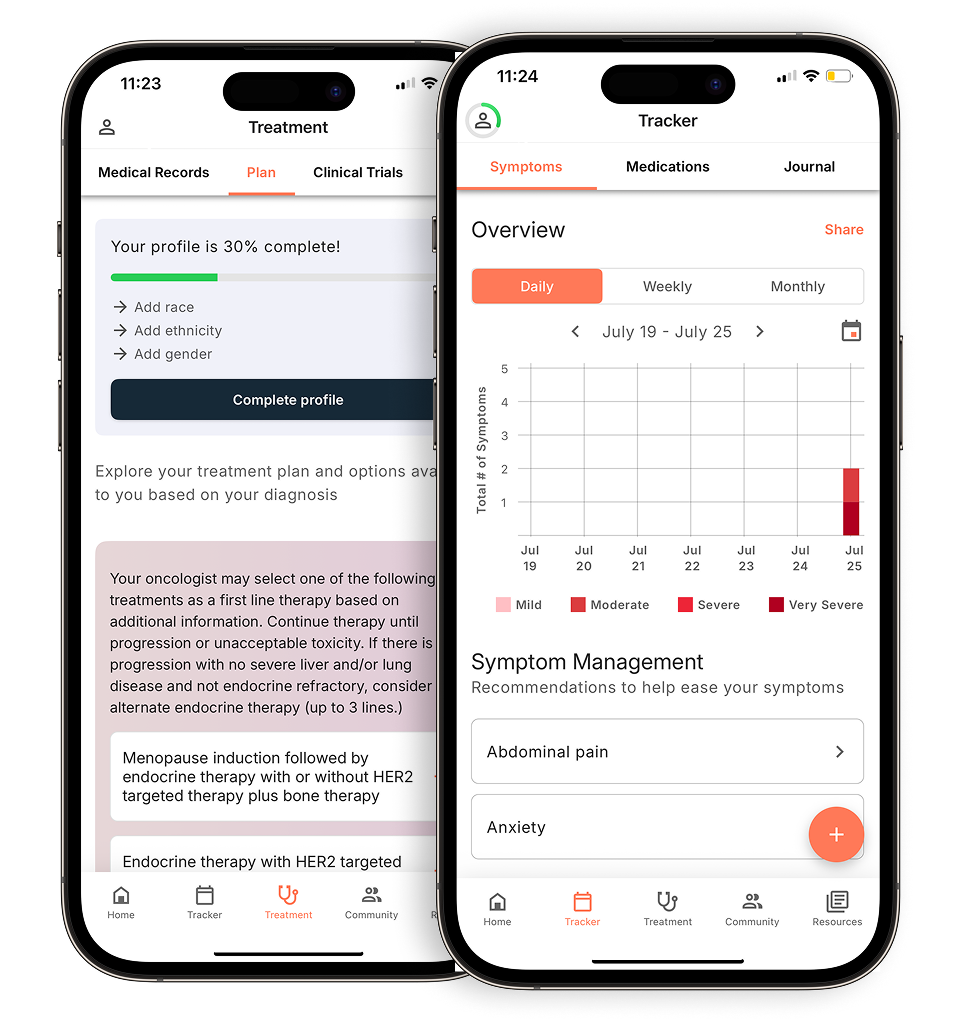
This biological reality is what makes SERDs (Selective Estrogen Receptor Degraders) so important. Rather than simply blocking the receptor or reducing estrogen, SERDs are designed to degrade and destroy the receptor entirely, eliminating the jammed switch rather than trying to flip it back. Treatment decisions after ESR1 resistance often involve combinations, for example, pairing a SERD with CDK4/6 inhibitors in breast cancer settings to attack tumor growth through more than one pathway at once.
Understanding this mechanism opens the door to another layer of the resistance story. When estrogen signaling is blocked, cancer cells often find alternate routes to survive, particularly through the PI3K/AKT/mTOR pathway.
Blocking PI3K and AKT pathways
When hormone therapy is blocked, cancer cells reroute through alternative signaling highways, most notably the PI3K/AKT/mTOR pathway, to keep growing.
Pathway crosstalk is the term oncologists use to describe this biological workaround. Even when estrogen signaling is suppressed, the PI3K/AKT/mTOR network can activate independently, telling cancer cells to divide and survive regardless of hormonal input. Resistance to endocrine therapy is rarely about just the estrogen receptor itself, which is why treatment for ESR1 mutations is only one piece of a larger puzzle.
For patients whose tumors carry a PIK3CA mutation, PIK3CA mutations are found in some HR+ breast cancers, and researchers are studying how often this occurs and what it means for treatment options. Alpelisib (a PI3K inhibitor) offers a targeted way to disrupt this pathway. It works by blocking the enzyme that PIK3CA mutations keep in a hyperactive state, and it’s approved for use alongside endocrine therapy, not as a standalone treatment. Combination approaches are key. Shutting down both the hormonal and the alternative signaling routes at the same time makes it significantly harder for resistant cells to find another escape route.
More recently, the treatment landscape expanded further with FDA approval of Capivasertib, an AKT inhibitor designed for patients whose tumors carry PTEN or AKT alterations. Like Alpelisib, it’s used in combination with endocrine therapy, in this case fulvestrant, to attack resistance from two directions simultaneously. The emergence of these targeted agents reflects a broader shift in how your care team now matches treatment to the specific molecular profile driving your cancer resistance. Understanding which pathway is fueling that growth has become just as important as identifying the mutation itself, reshaping what comes next in the treatment landscape, particularly around the evolution of drugs that degrade rather than simply block the estrogen receptor.
Cancer care guidance for every step of your journey
Get treatment options, clinical trials, and support tailored to your diagnosis--all in one place.
Get started
See treatment options, manage symptoms, and stay informed—all in the app
View treatment options and trials personalized to your diagnosis—plus track progress in real time.
Continue in appOral SERDs and the future of degraders
The shift from injectable to oral SERDs marks one of the most meaningful advances in treating ESR1-mutated breast cancer, offering patients more effective options with far greater convenience.
For years, fulvestrant was the go-to SERD, a drug that degrades the estrogen receptor rather than simply blocking it. But fulvestrant comes with a real drawback. It’s delivered as a painful intramuscular injection, typically twice monthly, and its ability to reach therapeutic levels in the body is limited. Newer agents accomplish this more effectively and on your own terms.
Elacestrant (Orserdu®) is an oral selective estrogen receptor degrader (SERD) that can help treat ESR1-mutated breast cancers, offering an alternative beyond fulvestrant, which was the only SERD available before 2023. Taken as a daily pill, elacestrant works more effectively than fulvestrant by more completely blocking the estrogen receptor. Clinical data confirms elacestrant improves progression-free survival in patients with ESR1 mutations.
PROTACs, like the investigational agent ARV-471, represent the next frontier. Rather than blocking or degrading the receptor through one mechanism, PROTACs hijack the cell’s own protein disposal system. A blocked receptor can sometimes still find ways to signal, but a degraded one is simply gone. That’s a fundamentally stronger approach, which is why researchers are watching this class of drugs closely.
Knowing which option fits your biology starts with understanding what’s driving resistance, and increasingly, the answer is hiding in your blood.
Why your next ‘blood draw’ might be a liquid biopsy
Genetic testing for breast cancer has moved beyond tissue biopsies. A simple blood draw can now detect the molecular signals of resistance before a scan ever shows a problem.
That shift is driven by ctDNA, or circulating tumor DNA. When cancer cells divide or die, they shed tiny fragments of their DNA into the bloodstream. A liquid biopsy captures and analyzes those fragments, giving your care team a real-time molecular snapshot of what the cancer is doing, without the discomfort or delay of a surgical biopsy.
What makes this especially powerful is the timing advantage. Liquid biopsies allow oncologists to detect ESR1 mutations in real-time, potentially switching therapies before a tumor shows growth on a scan. A mutation driving resistance can surface in a blood test weeks or even months before it becomes visible on imaging, giving you a meaningful window to act.
Why it matters: This early detection enables what clinicians call “precision switching”, adjusting your personalized care plan at the first molecular signal of resistance rather than waiting for visible disease progression. Earlier switching means less time on a therapy that’s losing effectiveness and faster access to one that may work better.
Ask your care team specifically whether regular ctDNA monitoring fits your current treatment plan, and what it would take to add it. Understanding the full picture of what’s happening at a molecular level puts you in a stronger position to make informed decisions alongside your providers.
What you need to know about resistance
Resistance to endocrine therapy signals that your cancer’s biology has shifted and your personalized care plan needs to shift with it.
Understanding what that means in practice cuts through a lot of the anxiety that comes with hearing the word “resistance.” The cancer has found a workaround, usually through a mutation like ESR1, PIK3CA, or AKT. That change is detectable and increasingly treatable. As research has moved toward multi-pathway blockade rather than “more estrogen blockade”, the options available after a first-line regimen stops working have expanded considerably.
Here’s what that means for you right now:
- Genetic testing is your roadmap. Testing for ESR1, PIK3CA, and AKT mutations determines which second-line therapies are appropriate for your specific cancer profile.
- Combination strategies are now standard. CDK4/6, PI3K, or AKT inhibitors paired with endocrine therapy are established approaches for overcoming acquired resistance rather than experimental ones.
- The pipeline goes further. If you’re asking what comes after CDK4/6 inhibitors, the answer increasingly involves oral SERDs and next-generation degraders like PROTACs, more effective and less invasive than earlier injectable options.
- Resistance has a direction. It follows biological patterns your care team can identify and respond to with targeted agents.
Start by asking your care team for your full genetic and genomic reports. If you haven’t had a breast cancer liquid biopsy yet, this is the moment to ask about it. These blood-based tests can detect mutations like ESR1 in real time, giving your care team the molecular detail needed to adjust your personalized care plan rather than guess at what’s driving resistance.
From there, precision medicine is moving fast, and that list of options is growing. With precision medicine, there is always a “next.” Resistance reshapes the path, but it doesn’t close it. You deserve a care experience that reflects that, one built around your biology, your data, and your goals.
Disclaimer: The information provided in this article is for informational purposes only and is not intended to be a substitute for professional medical advice, diagnosis, or treatment. Outcomes4Me is not acting as your caregiver, and any suggestions or guidance offered should not replace the advice of your healthcare provider or qualified medical professional. Always seek the guidance of your physician or other qualified health provider with any questions you may have regarding a medical condition.
Personalized support for real care decisions
Understand your diagnosis, explore clinical trials, and track symptoms--all in one place.
Get started
Compare treatments, prepare for appointments, and track side effects—all in the app
Built for your diagnosis, Outcomes4Me gives you the tools to make confident, informed decisions—right when you need them.
Continue in app