
Prostate cancer risk stratification changes how you understand your diagnosis, and critically, how your care team decides to treat it.
A diagnosis confirms that cancer cells are present, but it doesn’t tell you how aggressively those cells are likely to grow, spread, or respond to treatment. Risk groups provide that information. Your risk group is a critical factor in choosing the right treatment strategy, often more informative than your stage number alone.
Standard TNM staging describes the physical characteristics of a tumor: its size, whether it has spread to nearby lymph nodes, and whether it has reached distant organs. It’s essential information. But staging is only one part of the picture. Two patients with the same stage can have vastly different disease behaviors, one may be safely monitored with active surveillance over time, while another may need aggressive treatment immediately.
Risk stratification fills that gap. Risk groups help your doctor determine the most appropriate treatment for your cancer and guide decisions about whether you have a higher risk of aggressive disease that may spread beyond the prostate. Categories like low risk, prostate cancer favorable intermediate risk, and high risk are built from a combination of data points in your pathology report, not a single number.
Understanding your risk group puts you in control of your personalized care plan. Rather than accepting a broad recommendation, you can ask the right questions, weigh your options clearly, and make decisions that reflect your specific biology. The next section breaks down exactly which three numbers drive that classification.
The three pillars of your risk assessment
Your Gleason Score is one of the most important numbers in your prostate cancer diagnosis and directly shapes your treatment decisions, particularly when combined with your PSA level and other clinical factors.
PSA level is where your assessment begins. PSA, or prostate-specific antigen, is a protein produced by prostate tissue and measured through a simple blood test. A higher PSA often signals that something abnormal is happening, though it isn’t a diagnosis on its own. Your care team uses it as a baseline signal, and the trend over time can matter as much as any single reading.
Evidence-based guidance powered by NCCN Guidelines®
Personalized treatment plans shaped by the latest oncology standards—tailored to your diagnosis.
Get started
View your personalized treatment plan in the Outcomes4Me app
Use your diagnosis to unlock personalized NCCN Guidelines®-aligned recommendations.
Continue in app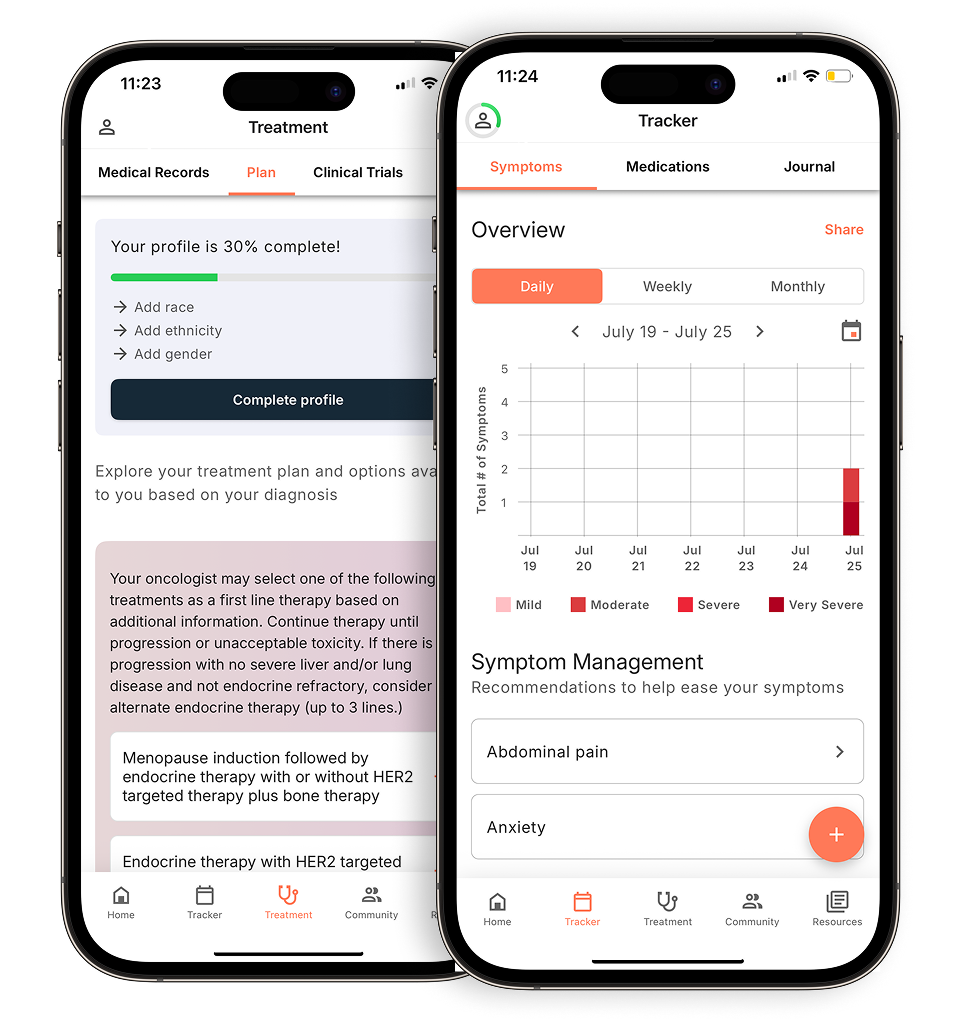
Gleason Score (Grade Group) tells your care team how aggressive the cancer cells look under a microscope. Pathologists assign a Grade Group on a scale of one to five based on how disorganized the cells appear. Grade Group 1 corresponds to a Gleason Score of six or less, meaning cells look relatively normal, while Grade Group 5 represents a Gleason Score of nine to ten, where cells appear highly abnormal. These Grade Groups are used to help estimate how aggressive your prostate cancer may be. Understanding the implications of high risk prostate cancer often starts here: a Grade Group of four or five is a key marker.
Clinical T-stage maps the physical reach of the tumor. Determined through a digital rectal exam (DRE) or MRI, it describes whether the cancer is confined to the prostate or has begun to extend beyond it. T-stage is one of the core inputs used alongside PSA and Grade Group to assign a risk category.
High risk prostate cancer is typically defined by the combination of a PSA above 20, a Grade Group of four or five, or a T-stage showing the tumor has grown outside the prostate.
Low-risk prostate cancer. The case for active surveillance
A low-risk prostate cancer diagnosis is defined by a PSA below 10 and a Gleason score of 6 (Grade Group 1) with the tumor confined to a small area. These precise thresholds distinguish low-risk disease from more aggressive categories, and that distinction has a direct impact on what your care team recommends next.
Active surveillance involves a deliberate, evidence-based strategy to protect your quality of life. Unlike older “watchful waiting” approaches, active surveillance involves scheduled PSA tests, periodic biopsies, and imaging to confirm the cancer isn’t changing. Avoiding side effects like urinary incontinence or sexual dysfunction when the cancer poses no immediate threat is the goal. For many men, monitoring rather than treating preserves everyday function without compromising long-term outcomes.
That said, low-risk doesn’t always mean low complexity. Genomic testing, such as Oncotype DX or Decipher, can reveal biological behavior that standard pathology misses, prompting a closer look even when all three risk indicators appear reassuring. Your care team may recommend these tests if there’s any uncertainty about tumor aggressiveness before committing to surveillance.
Understanding where low-risk ends is just as important as knowing what it means. As risk factors climb, a rising PSA, a higher Grade Group, or more extensive tumor involvement, the clinical picture shifts considerably. Intermediate risk prostate cancer introduces a more nuanced and often more urgent set of decisions, which the next section addresses in full.
Cancer care guidance for every step of your journey
Get treatment options, clinical trials, and support tailored to your diagnosis--all in one place.
Get started
See treatment options, manage symptoms, and stay informed—all in the app
View treatment options and trials personalized to your diagnosis—plus track progress in real time.
Continue in appIntermediate risk. Navigating the favorable vs. unfavorable divide
Intermediate-risk prostate cancer typically involves a PSA between 10 and 20, or a Gleason score of 7 (Grade Group 2 or 3). This is the most nuanced category, and where treatment decisions vary the most from one person to the next. But intermediate risk is split into two distinct subcategories that carry meaningfully different treatment implications.
Your subcategory, favorable or unfavorable, determines whether you’re eligible for monitoring or need more immediate treatment.
Intermediate-risk prostate cancers are further divided into favorable and unfavorable categories using additional factors beyond stage and grade alone. A 3+4 score, where the less aggressive pattern leads, behaves quite differently than a 4+3, where the more aggressive pattern dominates.
- Favorable intermediate: Favorable intermediate-risk prostate cancer is distinguished from unfavorable intermediate-risk cancer using additional factors beyond the basic Grade Group and PSA level criteria. Treatment options are broader and may include careful monitoring over time or single-mode therapy such as radiation or surgery alone.
- Unfavorable intermediate: Unfavorable intermediate prostate cancer typically calls for more proactive treatment, often radiation combined with short-term hormone therapy, or surgery.
The number of biopsy cores that contain cancer is one of several important factors your doctor considers when determining your treatment options. A patient with one positive core out of 12 is in a very different situation than someone with eight positive cores, even when the PSA and Gleason score look similar on paper.
Compared to low-risk prostate cancer, where active surveillance is almost always the first recommendation, intermediate risk demands a more individualized conversation with your care team. The right path depends on your full biopsy picture, not any single number. As the next section explores, that principle becomes even more critical when the stakes are higher.
High-risk prostate cancer: understanding aggressive treatment
A high-risk prostate cancer diagnosis is defined by a PSA above 20, a Gleason score of 8–10, or a T3 tumor that extends beyond the prostate capsule. High-risk prostate cancer demands prompt, decisive action. What matters most to understand. High risk does not mean incurable.
Treatment at this level is almost never a single approach. Because the cancer is more likely to behave aggressively, care teams typically combine therapies to address both the primary tumor and any microscopic spread. Common treatment combinations for high-risk prostate cancer include surgery followed by radiation, radiation plus androgen deprivation therapy (ADT), and combination radiation approaches.
- Surgery followed by radiation, Radical prostatectomy removes the prostate, with adjuvant or salvage radiation used if pathology reveals high-risk features post-operatively
- Radiation plus androgen deprivation therapy (ADT), External beam radiation paired with hormone therapy is often delivered over 18–36 months to suppress testosterone that fuels cancer growth
- Combination radiation approaches, External beam radiation can be combined with brachytherapy (internal seed implants) to deliver a higher, more targeted dose
Clinical trials also play a meaningful role here. Clinical trials may be an option for patients with very high-risk prostate cancer, providing access to newer treatments. Talking with your care team about open trial options is a practical step worth taking early. Understanding the full picture, across risk groups, metrics, and treatment approaches, is what we’ll bring together in the final takeaways ahead.
What you need to know
Understanding prostate cancer risk categories is ultimately what drives your treatment plan, far more than a stage number alone ever could.
Your risk group pulls together the “Big Three” metrics, PSA level, Gleason Score, and T-Stage, into a framework that establishes the standard for evidence-based oncology care. Stage tells you where cancer is. Risk group tells you what to do about it.
Here’s what each group means in practice:
- Low-risk: Prompt treatment isn’t always necessary. Active monitoring as an alternative to surgery or radiation can protect your quality of life without compromising outcomes.
- Intermediate risk: The favorable vs. unfavorable distinction matters enormously. Don’t accept a general “intermediate” label, ask your care team which subcategory applies to you.
- High-risk: Multi-modal treatment is typically necessary, but it’s worth emphasizing. High-risk prostate cancer remains highly treatable, especially when addressed promptly.
Your age, overall health, and personal priorities all factor into what the right approach looks like for you.
Disclaimer: The information provided in this article is for informational purposes only and is not intended to be a substitute for professional medical advice, diagnosis, or treatment. Outcomes4Me is not acting as your caregiver, and any suggestions or guidance offered should not replace the advice of your healthcare provider or qualified medical professional. Always seek the guidance of your physician or other qualified health provider with any questions you may have regarding a medical condition.
Personalized support for real care decisions
Understand your diagnosis, explore clinical trials, and track symptoms--all in one place.
Get started
Compare treatments, prepare for appointments, and track side effects—all in the app
Built for your diagnosis, Outcomes4Me gives you the tools to make confident, informed decisions—right when you need them.
Continue in app