
Finding the right lung cancer clinical trials is harder than it should be because the path between a patient and the right trial has significant gaps.
The problem starts with information overload. Public trial databases list thousands of studies, each packed with dense medical language, complex inclusion criteria, and protocol jargon that’s genuinely difficult to parse without a clinical background. Most patients walk away Biomarker testing has become an essential part of the initial diagnosis of lung cancer and in treatment decision-making, helping determine the optimal treatment for your specific cancer.
There’s another limitation worth naming directly. A hospital running three internal studies may not have visibility into dozens of trials at other centers that could be a better fit for your specific profile. Relying solely on that internal view means options go unseen.
The good news? Knowing what eligibility actually looks like, biomarkers, staging, performance status, puts you in a much stronger position to advocate for yourself.
Understanding eligibility. The basics of NSCLC biomarkers and staging
Before you can match yourself to a trial, you need to understand the three criteria that gatekeep almost every NSCLC study: your biomarkers, your stage, and your performance status.
Biomarkers are the starting point. Biomarkers like EGFR, ALK, and KRAS are part of your cancer profile and can help determine which trials you may be eligible for. A study targeting EGFR exon 20 insertions won’t enroll someone whose tumor carries an ALK rearrangement. Getting comprehensive biomarker testing done before you search saves significant time.
Stage and performance status then determine which phase of trial you can realistically access.
Other criteria are equally important to understand. Common ones include:
- Prior treatments
- Active autoimmune conditions or uncontrolled infections
- Certain organ function thresholds
- Brain metastases
Knowing where you stand across all of these dimensions, before you start searching, is what separates a productive trial search from a frustrating one.
Clinical trial vs. standard care: deciding your next move
The choice between a clinical trial and standard care depends on your biomarker profile, disease stage, and treatment goals.
Evidence-based guidance powered by NCCN Guidelines®
Personalized treatment plans shaped by the latest oncology standards—tailored to your diagnosis.
Get started
View your personalized treatment plan in the Outcomes4Me app
Use your diagnosis to unlock personalized NCCN Guidelines®-aligned recommendations.
Continue in app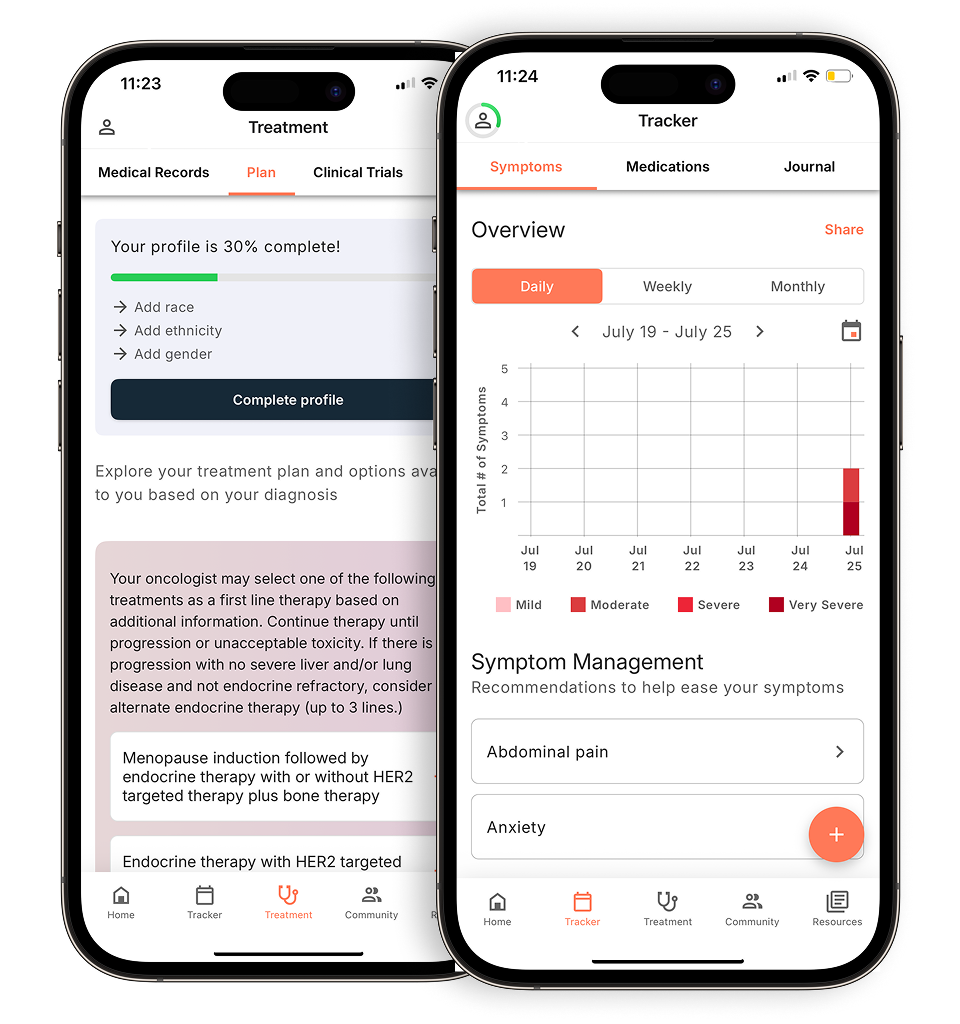
Standard of care refers to treatments that regulatory bodies like the FDA have already approved. For eligible NSCLC patients, this may include platinum-based chemotherapy combined with immunotherapy, though your care team can discuss which approaches may be appropriate for your situation. A clinical trial, by contrast, tests whether an experimental therapeutic approach can do better, either in safety, response rate, or survival.
The answer to whether to go straight to a clinical trial or start with standard of care depends on several factors. Having a clear conversation with your care team armed with the right questions helps you move from confusion toward a clear, personalized care plan.
The jargon you need to know before reading clinical trial listings
Clinical trial listings contain specific terminology that can make even a straightforward NSCLC study feel impossible to decode, but a few key definitions clarify everything.
Inclusion/exclusion criteria are the rules that define who can and can’t enroll. Inclusion criteria in clinical trials are guidelines that determine who can participate in a study. These criteria generally focus on key characteristics such as the type and stage of cancer, age, gender, or previous treatments. Exclusion criteria in clinical trials list what rules you out, like a recent surgery or a conflicting diagnosis.
Primary endpoints tell you what the study is actually trying to prove, such as overall survival, progression-free survival, or response rate.
Three structural terms also appear constantly:
- Open-label, both you and your care team know which treatment you’re receiving
- Randomized, assignment to a treatment group is done by chance, not by choice
- Placebo-controlled, in modern trials, placebo-controlled design typically pairs some participants with an inactive treatment layered with standard-of-care therapy, not a sugar pill alone
Knowing these terms before you open a listing means you’re evaluating trials on equal footing with your care team, which sets you up well for the practical and logistical considerations that matching tools, on their own, can’t always anticipate.
Cancer care guidance for every step of your journey
Get treatment options, clinical trials, and support tailored to your diagnosis--all in one place.
Get started
See treatment options, manage symptoms, and stay informed—all in the app
View treatment options and trials personalized to your diagnosis—plus track progress in real time.
Continue in appLimitations and considerations for clinical trials
Finding a match on a platform is genuinely meaningful progress. It’s different from enrollment, however. Many trials cap the number of participants per site, so even a strong medical match can stall if that location has already met its quota. Your care team can sometimes identify alternate sites running the same protocol, which is worth asking about directly.
The logistical side is equally real. Travel costs, time away from work, and the frequency of required visits can make an otherwise promising trial impractical. Insurance coverage for trial-related care varies widely, and out-of-pocket expenses aren’t always obvious upfront. Factor these considerations in early, not after you’ve grown attached to a specific study.
You might also meet every medical criterion and still not qualify. Scheduling conflicts, geographic restrictions, a site’s internal review process, or simply reaching the enrollment deadline can all result in a “no.” It isn’t a reflection of your eligibility on paper.
Common misconceptions about lung cancer research
Most people assume NSCLC clinical trials are either placebo experiments or last-ditch options. Both assumptions are inaccurate.
In practice, NSCLC trials are almost always layered on top of a standard-of-care treatment, not substituted for it. You won’t be left untreated. Many studies actively recruit patients at earlier stages to evaluate whether a treatment works before the disease progresses.
These misconceptions matter because they quietly discourage people from exploring options that could be genuinely relevant to their situation. Knowing the reality puts you in a better position to have an honest conversation with your care team, and to start looking in the right places, which we’ll walk through next.
Where to look next. Finding credible trial information
Knowing where to search for NSCLC clinical trials is as important as knowing what to search for, and not all sources carry the same level of reliability.
Start with government-maintained databases. The National Cancer Institute (NCI) website includes thousands of clinical trials happening in the United States across all cancer types. Non-profit advocacy groups, like GO2 Foundation for Lung Cancer provide personalized navigation support that a database alone can’t replicate. And academic medical center websites often list institutional studies that never appear in broader registries. Each source fills a different gap. Together, they give you a more complete picture, and better questions to bring to your care team.
The ‘questions for your doctor’ checklist
A search tool can surface trial options, but a focused conversation with your care team is what turns those options into real decisions.
Before your next appointment, write these questions down:
- “Has my biomarker testing been completed?”
- “How do available trials compare to standard care for my diagnosis?”
- “Am I eligible based on my current stage and treatment history?”
- “What would enrollment actually require of me?” T
- “How do I transfer my medical records to the trial site?”
- “Who do I contact if I want to leave the trial?”
And one more worth asking: “Is now the right time, or should we revisit this after my next scan?”
Common questions about NSCLC trial matching
Finding and qualifying for a clinical trial doesn’t have to feel like navigating a maze alone; the right tools and a proactive care team make the process far more manageable.
Eligibility for lung cancer trials varies widely. Your biomarker profile, cancer stage, prior treatments, and overall health all factor in.
Some NSCLC trials require additional biomarker testing, such as repeat tumor biopsies during treatment and at the time of disease progression. Your personalized care plan remains a shared decision between you and your care team. It’s a more active role, not a passive one.
Disclaimer: The information provided in this article is for informational purposes only and is not intended to be a substitute for professional medical advice, diagnosis, or treatment. Outcomes4Me is not acting as your caregiver, and any suggestions or guidance offered should not replace the advice of your healthcare provider or qualified medical professional. Always seek the guidance of your physician or other qualified health provider with any questions you may have regarding a medical condition.
Personalized support for real care decisions
Understand your diagnosis, explore clinical trials, and track symptoms--all in one place.
Get started
Compare treatments, prepare for appointments, and track side effects—all in the app
Built for your diagnosis, Outcomes4Me gives you the tools to make confident, informed decisions—right when you need them.
Continue in app