
Beyond the biopsy: why genomic testing is your most important post-surgery step
The most important question after early-stage breast cancer surgery is whether chemotherapy will actually help you. For many patients with hormone receptor-positive (HR+), HER2-negative early-stage breast cancer, the answer isn’t obvious from a biopsy alone. That’s precisely where genomic testing steps in.
It’s worth pausing on terminology here, because the distinction matters. Genetic testing looks at inherited DNA, the genes you were born with. Genomic testing is different. Genomic tests analyze the activity of specific genes within the tumor itself, measuring how those genes are behaving right now, in your cancer cells. That’s a different kind of information, and it’s what makes genomic testing powerful.
The primary goal is to avoid over-treatment. Standard statistics can tell your care team how a group of patients with similar tumors fared over ten years. But your tumor is not a statistic. Genomic assays translate biological signals from your specific cancer into a personalized risk profile, one that helps you and your care team decide whether chemotherapy is likely to add meaningful benefit or simply add side effects. That’s a decision worth getting right.
Two tests dominate this space. Oncotype DX and MammaPrint. Both are designed to inform the chemo-or-no-chemo decision, but they work differently, measure different things, and, critically, don’t always agree. Understanding the Oncotype DX vs. MammaPrint distinction is essential before you and your care team finalize your personalized care plan. The differences between them, starting with how each one reads your tumor’s biology, are what we’ll unpack next.
Oncotype DX: the gold standard for predicting chemotherapy benefit
Oncotype DX is the most widely used genomic test in early-stage breast cancer, and its core strength lies in answering one precise question. Will chemotherapy actually work on your cancer cells?
The test analyzes 21 genes from your tumor tissue and produces a Recurrence Score ranging from 0 to 100. Oncotype DX is specifically predictive, meaning it tells your care team how likely it is to respond to chemotherapy, not just how aggressive the cancer is. That’s a critical distinction when weighing treatment options. It’s also the primary reference point in most breast cancer recurrence score comparisons because of its extensive clinical validation.
Oncotype DX is indicated for hormone receptor-positive (ER+), HER2-negative early-stage breast cancer, a profile that affects a large share of patients diagnosed each year. For patients navigating non-metastatic Stage 2 HER2-negative breast cancer, this is likely the test your care team will order first.
TAILORx trial finding: The landmark TAILORx trial published in the NEJM demonstrated that most women over age 50 with a Recurrence Score of 0–25 can safely skip chemotherapy without compromising survival outcomes, a finding that reshaped treatment decisions globally.
That evidence gave clinicians and patients far greater confidence in low scores. A score below 18 is now considered low risk, 18–30 intermediate, and above 30 high risk, with thresholds informing NCCN-aligned care. But Oncotype DX tells only part of the genomic story. Another test approaches the same question from a broader biological angle, and its binary result can be just as decisive.
Evidence-based guidance powered by NCCN Guidelines®
Personalized treatment plans shaped by the latest oncology standards—tailored to your diagnosis.
Get started
View your personalized treatment plan in the Outcomes4Me app
Use your diagnosis to unlock personalized NCCN Guidelines®-aligned recommendations.
Continue in app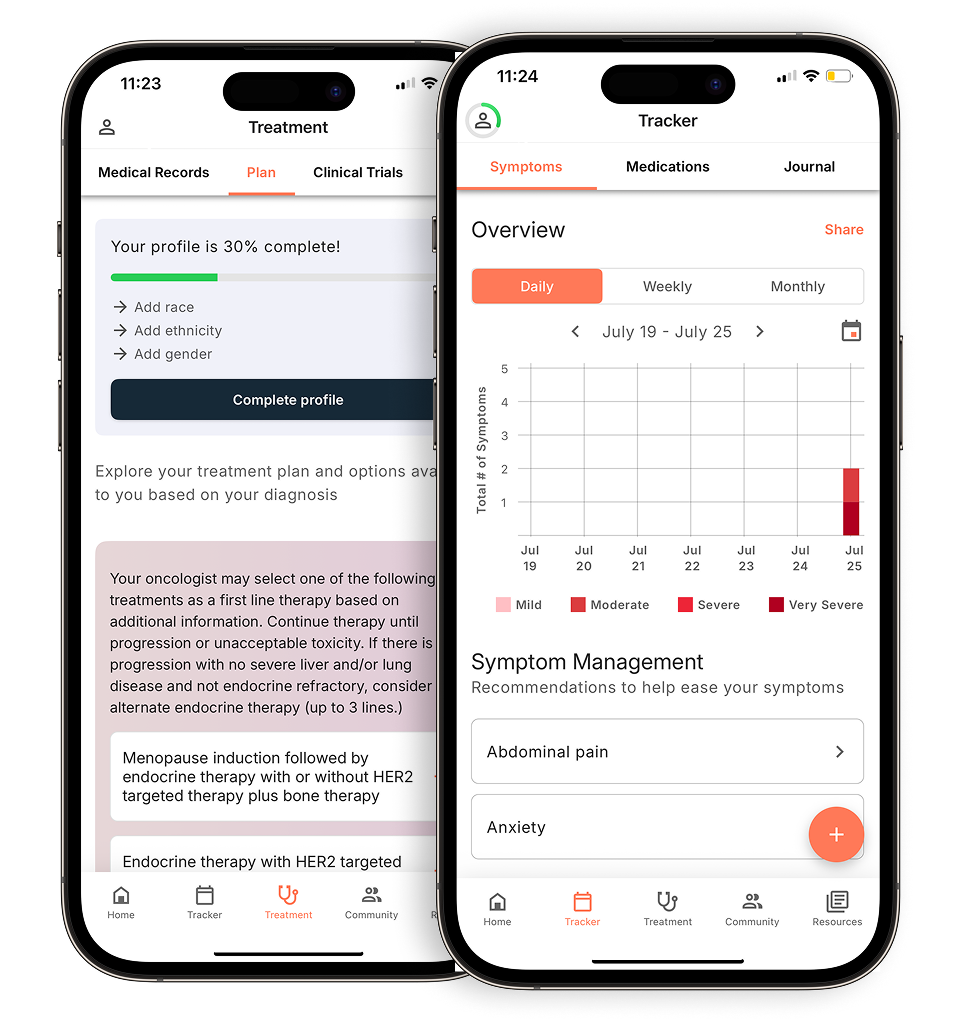
MammaPrint: a 70-gene deep dive into metastasis risk
MammaPrint analyzes 70 genes to assess whether your cancer is likely to spread beyond the breast. As the first FDA-cleared gene expression test for breast cancer recurrence risk, it’s built around a different clinical question: “How likely is this cancer to metastasize within the next 10 years?”
The result format is one of MammaPrint’s defining features, and for many clinicians, its greatest practical strength. Unlike the nuanced 0–100 scoring range of Oncotype DX, MammaPrint assigns your tumor to one of four risk categories, Ultra Low, Low, High Risk 1, or High Risk 2, based on the activity of 70 genes, helping your doctor determine whether chemotherapy may benefit you. There’s no intermediate category to wrestle with. This clear classification makes clinical conversations more direct.
The MINDACT trial is the landmark evidence behind MammaPrint’s clinical weight. The trial enrolled patients who were classified as high clinical risk, meaning traditional factors like tumor size and grade pointed toward aggressive treatment, but low genomic risk by MammaPrint. Among that group, roughly 46% were able to safely forgo chemotherapy without a meaningful difference in five-year survival outcomes. That finding gave care teams a powerful tool to spare certain patients from chemotherapy’s side effects when the biology simply doesn’t support it. Oncotype DX results are part of standard treatment guidelines from the National Comprehensive Cancer Network (NCCN) and American Society of Clinical Oncology (ASCO), which can help you understand how your test results guide treatment recommendations when you talk with your care team.
Both Oncotype DX and MammaPrint are validated, evidence-based options, but they’re built on different frameworks and answer slightly different questions. That distinction matters when it comes to shaping your personalized care plan, which is exactly what the next section unpacks.
The 21 vs. 70 gene debate: key differences for your care plan
Choosing between Oncotype DX and MammaPrint shapes the questions your care team can answer and the treatment path that follows.
| Feature | Oncotype DX | MammaPrint |
|---|---|---|
| Genes analyzed | 21 | 70 |
| Result format | 0–100 numeric score | Binary. High Risk / Low Risk |
| Primary purpose | Predictive (chemo benefit) | Prognostic (metastasis risk) |
| Nodal status | Node-negative and some node-positive | Node-negative and limited node-positive |
| Typical use case | HR+, HER2-negative early-stage breast cancer | HR+ or mixed HR status; aggressive clinical signs |
| NCCN-compliant | Yes | Yes |
Oncotype DX produces a Recurrence Score between 0 and 100, and knowing how to interpret an Oncotype DX score is central to its value. A lower number suggests hormone therapy alone may be sufficient, while a higher number signals that chemotherapy is likely to offer added benefit. ASCO guidelines specifically endorse it for predicting chemotherapy benefit in node-negative, HR+ breast cancer, making it the dominant choice in U.S. clinical practice.
Cancer care guidance for every step of your journey
Get treatment options, clinical trials, and support tailored to your diagnosis--all in one place.
Get started
See treatment options, manage symptoms, and stay informed—all in the app
View treatment options and trials personalized to your diagnosis—plus track progress in real time.
Continue in appMammaPrint bypasses numeric nuance entirely by delivering a clear High or Low result. It’s designed to tell you whether your cancer has the biological signature to spread, not whether chemo will help once it does. This makes it particularly useful when HR status is mixed or when clinical features look aggressive despite favorable pathology. Both tests are NCCN-compliant, meaning either can anchor a guideline-supported personalized care plan. But the right choice depends on which clinical question your care team most needs answered, a distinction the next section explores further when age and intermediate scores complicate the picture.
Navigating the gray area: age, menopause, and intermediate scores
Your Oncotype DX score doesn’t land in a vacuum; age reshapes what that number actually means for your treatment decision.
The Oncotype DX intermediate score range is 11–25, and understanding how age shifts its interpretation can save you from unnecessary chemo or from skipping it when it could genuinely help.
Here’s how age changes the calculus:
- Women under 50 with a score of 21–25. According to the TAILORx trial, women under 50 with an Oncotype DX score between 21–25 may receive additional benefit from chemotherapy added to hormone therapy, though the reasons for this benefit remain unclear.
- Women over 50 with a score of 11–25. The data shows hormone therapy alone performs comparably to chemo-plus-hormone therapy, making the “Low Risk” threshold more generous for this group.
The intermediate anxiety problem. Sitting in the middle of a risk scale is genuinely hard, and that’s not a small population. When a score doesn’t resolve clearly, your care team typically looks at secondary clinical factors: tumor grade, tumor size, and lymphovascular invasion. These variables help break the tie and inform a personalized care plan aligned with current treatment standards.
MammaPrint sidesteps this entirely by design. Rather than outputting a numerical continuum, it forces a binary High/Low result, no middle ground. That’s a structural advantage when the goal is a decisive, actionable answer rather than a probability to weigh. Whether that trade-off suits your situation depends on exactly the kind of factors your care team has already been considering. The next step is figuring out which test, and which question, maps most directly to your clinical picture.
The bottom line: which test should you ask for?
The best test is the one that gives you and your oncologist the confidence to commit to a treatment path, and that answer depends entirely on the question you need answered first.
If your primary concern is whether chemotherapy will actually benefit you, Oncotype DX is typically the right starting point. Its Recurrence Score is built on a large body of evidence showing which patients can safely skip chemo without sacrificing survival outcomes. The TAILORx trial results gave oncologists a precise, evidence-backed framework for interpreting the Oncotype DX number, particularly for postmenopausal women with hormone receptor-positive, HER2-negative, node-negative disease.
If your clinical picture is harder to read, maybe your tumor size and grade are sending conflicting signals, MammaPrint offers something different. Rather than a continuous score, it delivers a binary classification. Low risk or high risk. The MINDACT MammaPrint trial demonstrated that patients classified as genomically low risk, even when clinical tools suggested otherwise, could forgo chemotherapy safely. That clarity can be valuable when you and your care team are stuck in an ambiguous middle ground. Chemotherapy for breast cancer can cause side effects ranging from temporary ones like hair loss and nausea to more serious or permanent effects, which your doctor can help you understand when deciding whether chemotherapy is right for you.
A practical question worth bringing to your next appointment: “Based on my age and nodal status, which trial, TAILORx or MINDACT, applies more to my situation?” Your oncologist’s answer will quickly point toward the more relevant test. And before any order is placed, confirm that your insurance covers the specific test being requested. Coverage policies vary, and out-of-pocket costs for genomic assays can differ significantly.
Neither test operates in isolation, though. A genomic result is one data point within a broader clinical picture, and how you integrate it into a personalized care plan is where the real decision-making begins.
Integrating your results into a personalized path
Your genomic score, whether from TAILORx Oncotype DX or MammaPrint, is a powerful data point, but it’s one piece of a larger picture that also includes your pathology report, tumor biology, and what matters most to you personally.
Think of your score alongside your hormone receptor status, HER2 results, tumor grade, and your own goals for treatment, whether that’s minimizing side effects, preserving fertility, or reducing recurrence risk at any cost. Your care team is essential here, translating that score into a recommendation that reflects your full clinical profile.
Outcomes4Me is a direct-to-patient platform designed to help patients understand treatment options in line with National Comprehensive Cancer Network® (NCCN®) treatment guidelines. It helps you store your genomic results alongside your other records and understand what those results mean in the context of evidence-based standards of care. You have the clinical framework that your oncologist uses, right in your hands.
And if your score comes back high risk, the app can immediately match you with clinical trials investigating newer, targeted therapies. That kind of real-time connection to research options can open doors that a standard office visit might not surface quickly enough. Keep your data, your scores, your guidelines, and your personalized care plan organized in one place so every conversation with your care team starts from a position of clarity and confidence.
Disclaimer: The information provided in this article is for informational purposes only and is not intended to be a substitute for professional medical advice, diagnosis, or treatment. Outcomes4Me is not acting as your caregiver, and any suggestions or guidance offered should not replace the advice of your healthcare provider or qualified medical professional. Always seek the guidance of your physician or other qualified health provider with any questions you may have regarding a medical condition.
Personalized support for real care decisions
Understand your diagnosis, explore clinical trials, and track symptoms--all in one place.
Get started
Compare treatments, prepare for appointments, and track side effects—all in the app
Built for your diagnosis, Outcomes4Me gives you the tools to make confident, informed decisions—right when you need them.
Continue in app