What does it mean when your BRCA test comes back neither positive nor negative? That’s the position a variant of uncertain significance (VUS) puts you in. The laboratory found a change in your genetic code, but there isn’t enough published evidence yet to say whether that change raises your cancer risk or does nothing at all.
A VUS is not classified as a pathogenic finding, though its clinical significance may become clearer over time as more information becomes available. It’s also not a clean result. Many variants in the VUS category may eventually be reclassified as research and clinical data accumulate, though the timeline and outcome for any individual variant can be uncertain. A genetic counselor reads the laboratory report in context and explains what your specific variant does and doesn’t indicate.
What is a BRCA variant of uncertain significance?
Sequencing examines your BRCA1 and BRCA2 genes in detail and flags any differences from the reference. A BRCA variant of uncertain significance is a difference that researchers and databases have not yet been able to clearly link to disease risk or rule out as benign. The clinical significance of a BRCA1 VUS and a BRCA2 VUS may differ, and your care team can help you understand what your specific result means for your health. Research suggests that patients of non-European ancestry may receive VUS results more often, as reference datasets used to interpret genetic variants are often built from populations of primarily European descent.
Should I worry about a VUS result?
Inconclusive results are uncomfortable, you expected an answer and received a placeholder. In genetic testing, it’s important to separate two concepts. Uncertainty about how the science classifies a variant, and whether you personally have elevated risk. A VUS describes the state of the science, not your risk level. Some variants of uncertain significance may be reclassified over time as more information becomes available, though the clinical significance of many remains unclear.
Clinical implications and decision-making
Most experts recommend against using a VUS result alone to make decisions about risk-reducing surgery. Prophylactic mastectomy, oophorectomy, and other irreversible procedures are typically discussed with people who have pathogenic or likely pathogenic findings, rather than those with variants of uncertain significance. Your care team can help you understand whether such procedures might be relevant to your individual situation. A VUS does not come with a specific risk estimate based on current evidence, which is why your care team may recommend surveillance, additional testing, or other approaches to help guide next steps.
What does guide your care is the rest of your clinical picture. Your personal cancer history, the pattern of cancers in your relatives, and your age. Your care team builds a screening schedule from those inputs, not from the variant.
Evidence-based guidance powered by NCCN Guidelines®
Personalized treatment plans shaped by the latest oncology standards—tailored to your diagnosis.
Get started
View your personalized treatment plan in the Outcomes4Me app
Use your diagnosis to unlock personalized NCCN Guidelines®-aligned recommendations.
Continue in app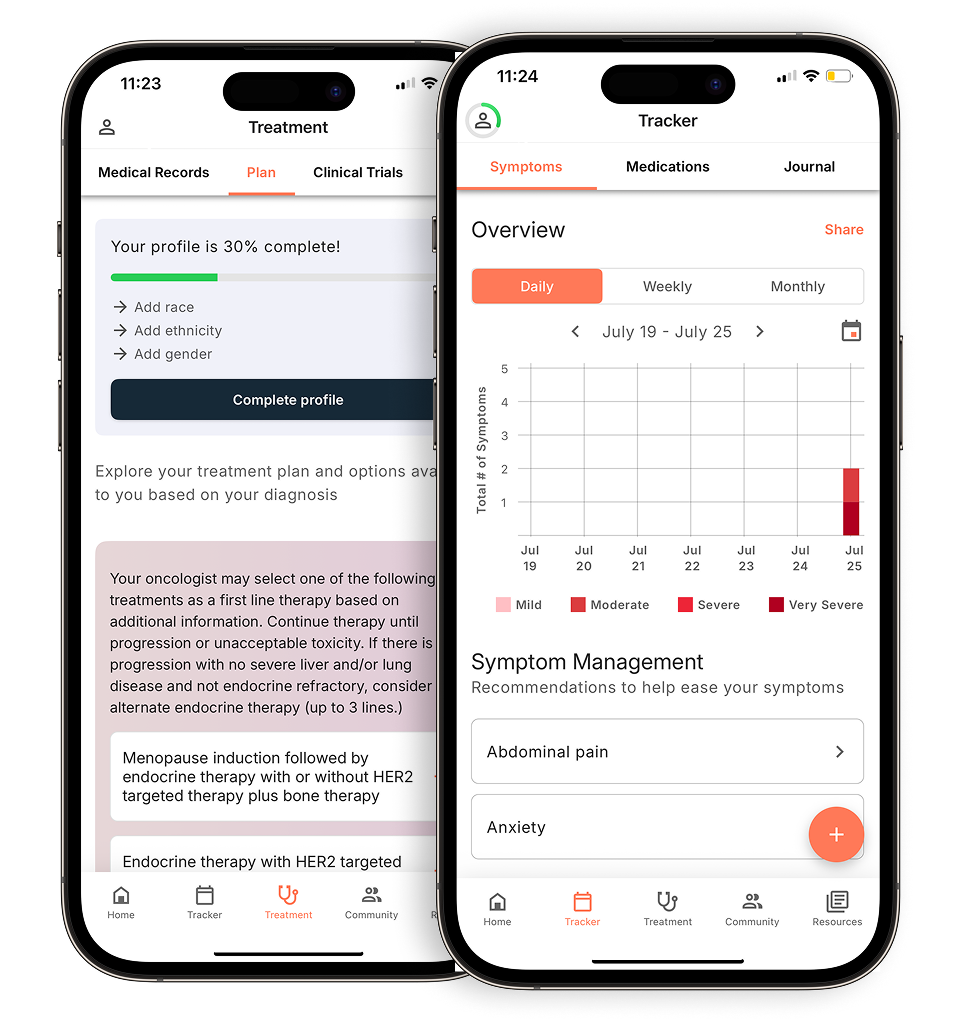
The same limitation applies downstream. A confirmed pathogenic BRCA variant may be required for eligibility in some BRCA-targeted therapies and certain clinical trials. Ask your care team whether a VUS result affects your options for specific treatments or studies you’re considering. A VUS may not currently qualify you for some BRCA-targeted therapies or certain clinical trials, though eligibility can vary. It’s important to discuss with your care team what this result means for your specific treatment and screening options.
Why you shouldn’t rush into surgery
Acting on inconclusive data involves accepting permanent consequences, surgical risk, hormonal changes, recovery, in exchange for no measurable reduction in a risk that hasn’t been established. Most genetics professionals recommend that uncertain variants alone should not be the only factor driving your cancer management decisions. Your doctor can help you understand how this result fits into your overall risk assessment and care plan.
The role of family history in risk assessment
Your family’s actual cancer history remains the stronger predictor. Document who was diagnosed, with what, and at what age among first-degree relatives (parents, siblings, children) and second-degree relatives (grandparents, aunts, uncles, nieces, nephews). Testing relatives can sometimes help researchers determine whether the variant tracks with cancer in your family, a question your counselor can assess.
Immediate next steps after your results
Within the first 30 days, a short checklist keeps this manageable:
- Request the full laboratory report, not just the summary letter.
- Confirm the exact variant nomenclature and which gene it sits in.
- Book a follow-up with a genetic counselor or your oncology care team.
- Confirm your current age-appropriate screening schedule is up to date.
Arrive at the follow-up appointment with written questions. Ask what the variant classification means for screening, and what would have to change for it to be reclassified.
When you tell relatives, start by clarifying what the result is not. Explain that no inherited risk has been confirmed, that nothing about their own care changes today, and that testing is a conversation to have with a professional rather than an emergency.
Scheduling a genetic counseling follow-up
Ask your counselor which classification system the laboratory used, what evidence is currently missing, and whether the variant has been reported elsewhere. Confirm the lab’s reclassification policy. Some notify the ordering provider automatically, others require you to request a review. Clarify who is responsible for contacting you, and agree on a recheck interval.
Updating your personal health records
Keep the complete PDF report somewhere you can retrieve it quickly; future providers will want the variant notation, not a paraphrase. Check that your electronic health record lists the finding as uncertain, not positive, since a miscoded entry can follow you for years. Digital tools like the Outcomes4Me app help you log screening results and symptoms over time.
Common misconceptions and ethical considerations
A VUS is sometimes mistakenly described as a weak positive. That framing is wrong. Classification isn’t a sliding scale of certainty about harm, it’s a statement about how much evidence exists. An uncertain variant sits outside the positive and negative categories entirely. Treating it as a diluted version of a pathogenic result leads to decisions the data can’t support.
Cancer care guidance for every step of your journey
Get treatment options, clinical trials, and support tailored to your diagnosis--all in one place.
Get started
See treatment options, manage symptoms, and stay informed—all in the app
View treatment options and trials personalized to your diagnosis—plus track progress in real time.
Continue in appTesting relatives to help clarify a variant raises real questions. Family members may learn things they didn’t want to know, and the information may not benefit them clinically. Participation should be voluntary and informed.
Finally, a VUS is not a false positive. The laboratory correctly detected a genuine change in your DNA. The sequencing was accurate. What’s missing is the interpretation, and that gap belongs to the research literature, not the test.
When this result isn’t the right approach for screening
An uncertain result can push people toward imaging they don’t need, which brings incidental findings and repeat biopsies. If the ambiguity itself is causing persistent distress, counseling and structured follow-up help more than added scans. Note also that insurers generally treat a VUS differently from a confirmed mutation when approving enhanced screening or preventive procedures.
The difference between VUS and pathogenic mutations
Pathogenic means the variant is believed to disrupt gene function and may raise cancer risk, based on current scientific evidence. Likely pathogenic means the evidence suggests that direction, though it’s not yet conclusive. For pathogenic and likely pathogenic variants, your care team may discuss risk-reducing surgery and intensified surveillance as options to consider based on your individual situation. An uncertain variant does not currently support a clear recommendation for risk-reducing surgery or intensified surveillance. Some variants of uncertain significance may be reclassified over time as more information becomes available, though the clinical significance of many remains unclear.
The future of genetic reclassification
As researchers study more people with VUS results, classifications may be updated over time, and your variant might be reclassified as more information becomes available. Laboratories may submit variant observations to shared public databases, where clinical outcomes, family studies, and functional experiments from multiple institutions can accumulate information about the same variant over time. A change that looked isolated in one lab’s records becomes interpretable once it appears in thousands of records worldwide.
Computational modeling is being used to help classify variants, and researchers continue to explore how these tools might improve the speed of classification. Researchers are exploring whether computational tools that analyze protein structure and evolutionary patterns might help classify uncertain variants, though these methods are still being refined and evaluated. These predictions feed into formal classification criteria alongside laboratory evidence.
This is why your result may change without you submitting another sample. Some VUS classifications may be reclassified over time as new data emerges. If reclassification occurs, your original laboratory may send you an amended report, though it’s worth asking your care team about the best way to stay informed of any updates.
How variants move from uncertain to known
Functional assays are the workhorse of variant classification. Researchers may insert the variant into cells to see how the resulting protein behaves and whether it appears to repair DNA as expected. A variant that seems to disrupt normal function may be more likely to be pathogenic, while one that appears to preserve function may be more likely to be benign. International data-sharing consortia may combine functional assay results with population frequency data as one approach to help classify variants. A variant seen in one small family may turn out to be common and harmless in a larger cohort.
Staying informed without obsessing
An annual check with your counselor is enough. Between visits, rely on your testing laboratory’s patient portal, national cancer organizations, and peer-reviewed sources rather than open forums, where individual anecdotes rarely reflect your variant. Whatever the classification, keep your standard age-appropriate mammography and other screenings on schedule.
Key takeaways: managing a BRCA VUS
- A BRCA VUS is not a positive result. It doesn’t justify prophylactic mastectomy, oophorectomy, or any other irreversible intervention.
- Many variants in the VUS category may eventually be reclassified as research and clinical data accumulate, though the timeline and outcome for any individual variant can be uncertain.
- Your screening plan should follow your family cancer history, personal diagnosis history, and age, not the variant.
- Confirm your electronic health record lists the finding as uncertain rather than positive, and keep the full laboratory report accessible.
- Check in with your genetic counselor annually and ask specifically about reclassification.
- Continue standard age-appropriate screening without interruption while you wait.
- If the uncertainty is causing sustained anxiety, raise it with your care team as part of your personalized care plan.
Where to look next
Start with the laboratory that ran your test; most publish variant classification methodology and patient-facing explanations of their reports. National cancer organizations maintain screening guidelines organized by risk category. For deeper reading, academic databases index peer-reviewed work on variant reclassification rates and functional assay methods.
Frequently asked questions about BRCA results
Which BRCA mutation is worse? BRCA1 and BRCA2 variants may be associated with different risk profiles, and your doctor can help you understand how your specific result applies to your personal health plan.
What does this mean for my children? An uncertain variant has not been shown to clearly establish inherited risk, so your care team may recommend waiting before considering testing in children, or may discuss your family history to help determine next steps.
Is a VUS a false positive? No. The change is real; its meaning is unknown.
Disclaimer: The information provided in this article is for informational purposes only and is not intended to be a substitute for professional medical advice, diagnosis, or treatment. Outcomes4Me is not acting as your caregiver, and any suggestions or guidance offered should not replace the advice of your healthcare provider or qualified medical professional. Always seek the guidance of your physician or other qualified health provider with any questions you may have regarding a medical condition.
Personalized support for real care decisions
Understand your diagnosis, explore clinical trials, and track symptoms--all in one place.
Get started
Compare treatments, prepare for appointments, and track side effects—all in the app
Built for your diagnosis, Outcomes4Me gives you the tools to make confident, informed decisions—right when you need them.
Continue in app