
When evaluating CDK4/6 inhibitor resistance in breast cancer, it’s important to understand the key differences. Three drugs, one shared mechanism. Vastly different outcomes, and that distinction could matter more than any other factor in your treatment plan.
CDK4/6 proteins act as gatekeepers in the cell cycle, controlling when cells replicate. CDK4/6 inhibitors have shown promise in treating hormone receptor-positive (HR+), HER2-negative breast cancer, and when added to endocrine therapy, they improve clinical outcomes and help delay disease progression. CDK4/6 inhibitors work by inducing G1 cell cycle arrest, which can help slow cancer cell division in certain patient populations. That shared mechanism once led many to treat them as interchangeable. They’re not.
Assuming these drugs behave identically is one of the most consequential oversimplifications in breast cancer care today. Real-world data and clinical trial results increasingly show meaningful differences in overall survival, side effect profiles, and dosing schedules. Ibrance and Kisqali follow a 21-days-on, 7-days-off schedule, while Verzenio is taken continuously every day, a practical distinction that affects everything from adherence to toxicity management. Beyond scheduling, CDK4/6 inhibitor resistance in breast cancer is an evolving clinical challenge, and researchers are increasingly focused on sequencing treatments strategically and using tools like blood tests to detect resistance mutations, which can help guide when it’s time to adjust therapy.
The survival standard: comparing Kisqali, Verzenio, and Ibrance
For patients with HR+/HER2- metastatic breast cancer, understanding your treatment options, including monitoring protocols and how your care team will track your response to therapy, is an important part of making informed decisions about your CDK4/6 inhibitor choice.
Overall survival (OS) is an important metric that should be considered alongside other endpoints like progression-free survival when evaluating CDK4/6 inhibitors.
Kisqali (ribociclib) stands out because of what happened across all three MONALEESA trials. Taken together, these studies demonstrated a statistically significant OS benefit in both pre- and post-menopausal women, a breadth of evidence that no other CDK4/6 inhibitor has matched. That consistency across hormone profiles is a key reason oncologists are increasingly treating Kisqali as the first-line standard of care.
Ibrance (palbociclib), meanwhile, has a more complicated track record. It demonstrated strong progression-free survival (PFS) results in the PALOMA-2 and PALOMA-3 trials, enough to earn early FDA approval. However, the PALOMA-2 and PALOMA-3 trials demonstrated median overall survival benefits for Ibrance (palbociclib) combined with endocrine therapy, though real-world outcomes have shown varied results depending on patient characteristics and disease burden. PFS tells you how long a treatment holds disease at bay; OS tells you whether it helps patients live longer. Those aren’t the same thing, and the gap matters deeply when you’re making a long-term treatment decision.
OS data comparison at a glance:
Evidence-based guidance powered by NCCN Guidelines®
Personalized treatment plans shaped by the latest oncology standards—tailored to your diagnosis.
Get startedView your personalized treatment plan in the Outcomes4Me app
Use your diagnosis to unlock personalized NCCN Guidelines®-aligned recommendations.
Continue in app
- MONALEESA trials (Kisqali): Statistically significant OS benefit confirmed across pre- and post-menopausal populations (ASCO / Novartis)
- PALOMA trials (Ibrance): Median overall survival benefits demonstrated with varied real-world outcomes (Oncology News Central)

Verzenio (abemaciclib) sits in a distinct category of its own. While its metastatic trial data, drawn from the MONARCH program, shows competitive outcomes, its most compelling evidence comes from a different setting entirely. That’s where the next section picks up: Verzenio’s distinct role in high-risk early-stage disease and its ability to reach places other CDK4/6 inhibitors can’t.
Verzenio’s distinct advantage: high-risk adjuvant care and brain metastases
When comparing Ibrance vs Kisqali vs Verzenio, one distinction stands out above the rest: Verzenio is the only CDK4/6 inhibitor currently approved for adjuvant treatment in high-risk early breast cancer. That’s not a minor footnote, it’s a fundamental difference in how and when this drug can be used. The monarchE trial demonstrated that Verzenio, combined with endocrine therapy, significantly reduced the risk of recurrence in patients with HR+, HER2-, node-positive early breast cancer who had high-risk pathological features. This means Verzenio isn’t just competing in the metastatic setting, it’s operating in an entirely different clinical space that the other two drugs simply can’t access. For patients who’ve completed primary treatment and want to reduce the chance of their cancer coming back, this approval changes the conversation entirely.
Verzenio also holds a meaningful advantage when brain metastases are part of the picture. One practical reason oncologists may favor it in this context is its ability to cross the blood-brain barrier more effectively than the other agents in this class, a property linked to its relative potency against CDK4 over CDK6. Because CDK4 activity is more central to cell cycle progression in many tumor types, this selectivity may translate to stronger activity in CNS lesions. While central nervous system involvement remains one of the most challenging aspects of metastatic breast cancer, emerging data suggests Verzenio’s ability to penetrate the CNS offers a meaningful clinical option for patients navigating this complication. If you’re in treatment now and weighing options with your care team, this is a conversation worth raising explicitly.
Of course, every drug’s advantages come paired with trade-offs, and Verzenio is no exception. Its distinct side effect profile sets it apart from the other two options in ways that can significantly affect day-to-day life during treatment.
Managing the trade-offs: neutropenia vs. gastrointestinal side effects
Each CDK4/6 inhibitor shares a common goal but delivers a distinct side effect profile, and understanding those differences helps you have more informed conversations with your care team.
Ibrance and Kisqali: monitoring for neutropenia. Both drugs suppress white blood cell counts, which is why regular blood work is non-negotiable. Ibrance follows a 21-days-on, seven-days-off schedule, that “off week” gives bone marrow time to recover and helps keep neutropenia manageable. Kisqali runs on a 21-days-on, seven-days-off cycle as well, but it carries two additional monitoring requirements that set it apart: periodic EKGs to watch for QT interval prolongation, and regular liver enzyme tests to screen for hepatotoxicity. Neither of these is typically required with Ibrance, so patients switching between the two should expect an adjusted monitoring schedule.
Cancer care guidance for every step of your journey
Get treatment options, clinical trials, and support tailored to your diagnosis--all in one place.
Get started
See treatment options, manage symptoms, and stay informed—all in the app
View treatment options and trials personalized to your diagnosis—plus track progress in real time.
Continue in app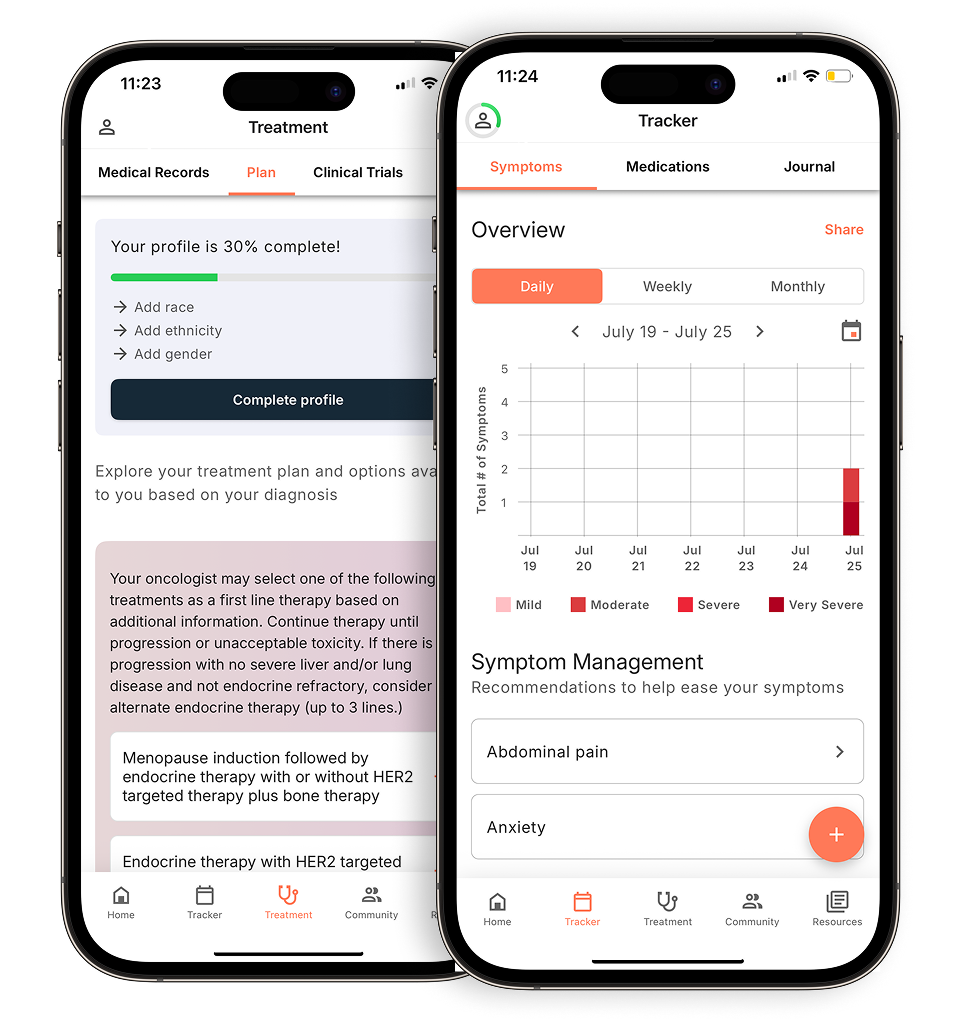
Verzenio: a continuous dose with a distinct GI profile. Unlike its counterparts, Verzenio is taken continuously, no scheduled break, which contributes to a higher rate of gastrointestinal effects. Managing Verzenio-related diarrhea is one of the most common practical challenges patients face: abemaciclib (Verzenio) is associated with higher rates of gastrointestinal toxicities, particularly diarrhea, compared to other CDK4/6 inhibitors, with cases occurring mostly during the first treatment cycle. Starting loperamide (Imodium) at the first sign of loose stools, rather than waiting, is the standard recommendation for keeping symptoms under control and avoiding dose reductions. Many patients who’ve navigated early decisions about treatment tolerability report that proactive symptom management made a meaningful difference in staying on therapy.
Tolerability isn’t a secondary concern, it directly affects whether you can stay on a drug long enough to benefit from it. That connection between side effects, dose continuity, and long-term outcomes becomes even more relevant when a treatment eventually stops working, which is worth planning for.
When therapy stops working: navigating CDK4/6 resistance
Even the most effective CDK4/6 inhibitors eventually face a formidable obstacle, cancer cells that find ways to bypass the treatment’s block on cell division.
Resistance doesn’t mean options run out; it means the treatment strategy needs to evolve. Doctors look for actionable mutations like ESR1 and PIK3CA, as well as other alterations, to guide next-line treatment decisions and help overcome resistance. Essentially, cancer cells rewire their signaling circuitry to keep proliferating, even with the drug present.
This is why genomic profiling at the time of progression is so important. Identifying whether you carry a PIK3CA mutation, for example, directly shapes which next-line therapies are most likely to work. The same logic applies to patients who’ve been receiving CDK4/6 inhibitors for brain mets, knowing the molecular profile of progressing lesions can inform both local and systemic treatment decisions.
When resistance does occur, your care team will typically consider:
- PIK3CA and ESR1 mutation testing to identify actionable targets
- Switching drug class, selective estrogen receptor degraders (SERDs) like elacestrant are approved for ESR1-mutated metastatic disease
- Antibody-drug conjugates (ADCs), which have shown meaningful activity in HR+ disease after CDK4/6 inhibitor progression
- Clinical trial enrollment, particularly for combinations targeting resistance pathways
If you’re wondering how others have navigated treatment decisions after a CDK4/6 inhibitor, real patient perspectives on mutation-driven treatment can offer useful context alongside your care team’s guidance.
Understanding resistance biology isn’t just academic, it’s what makes the difference between a reactive approach and a truly personalized one. And that distinction becomes central when weighing everything from survival data to side effect tolerance, which we’ll bring together next.
The bottom line: what you need to know
Three CDK4/6 inhibitors, three distinct clinical profiles, and the right choice depends on far more than availability or familiarity.
Here’s how the evidence currently stacks up:
- Kisqali leads on overall survival in the metastatic setting, making it the evidence-backed frontrunner for patients who are newly diagnosed with HR+/HER2- metastatic breast cancer and don’t have contraindications related to cardiac or liver health.
- Verzenio is the preferred option for high-risk early-stage disease and has shown activity in brain metastases, a meaningful distinction when spread to the central nervous system is a concern. Patients sharing their real-world experiences on Kisqali highlight how individual responses can vary widely, reinforcing why one-size-fits-all thinking doesn’t apply here.
- Ibrance remains widely used and is often the best-tolerated option day-to-day, particularly for patients with lower bone marrow reserve, but it currently lacks the overall survival data its competitors have demonstrated.
Your side effect history should be a deciding factor, not an afterthought. If you have a history of QT prolongation or liver concerns, Kisqali’s monitoring requirements carry real weight. If GI tolerance is your primary challenge, Verzenio’s diarrhea burden warrants a frank conversation with your care team before committing to that regimen. Questions to ask your doctor after your diagnosis can help you navigate these trade-offs with confidence.
The good news is that understanding these trade-offs is now within reach for every patient, and knowing the right questions to ask your provider is the first step toward a treatment plan that’s truly centered on you.
Taking control: how to personalize your treatment path
Choosing the right CDK4/6 inhibitor isn’t a passive process, it’s one where your active participation can meaningfully shape your outcomes. The Outcomes4Me platform is built on NCCN® treatment guidelines, making it the only direct-to-patient digital platform that translates those evidence-based standards into personalized, accessible guidance you can act on.
That foundation matters because NCCN guidelines represent the most current clinical consensus on treatment sequencing, combination options, and post-progression strategies. When you open the app, you’re not navigating general health information, you’re engaging with the same framework your oncology team uses to make decisions.
Your genetic results add another critical layer. Mutations in genes like PIK3CA or ESR1 don’t just inform prognosis, they can determine whether you’re eligible for specific clinical trials or next-line therapies after CDK4/6 resistance develops. Integrating those results within the platform helps surface trial opportunities you might otherwise miss. Recent updates from major oncology conferences underscore how quickly this landscape is evolving, with new agents showing benefit even after CDK4/6 progression.
Disclaimer: The information provided in this article is for informational purposes only and is not intended to be a substitute for professional medical advice, diagnosis, or treatment. Outcomes4Me is not acting as your caregiver, and any suggestions or guidance offered should not replace the advice of your healthcare provider or qualified medical professional. Always seek the guidance of your physician or other qualified health provider with any questions you may have regarding a medical condition.
Personalized support for real care decisions
Understand your diagnosis, explore clinical trials, and track symptoms--all in one place.
Get started
Compare treatments, prepare for appointments, and track side effects—all in the app
Built for your diagnosis, Outcomes4Me gives you the tools to make confident, informed decisions—right when you need them.
Continue in app