
The spectrum of plasma cell disorders: a staged approach
MGUS, smoldering multiple myeloma (SMM), and active multiple myeloma are three points on a single biological continuum, each defined by how aggressively abnormal plasma cells are behaving in your body.
Understanding where you fall on that spectrum matters more than you might think. The conditions share underlying biological markers, specifically the presence of abnormal plasma cells producing a measurable protein, but their clinical management looks completely different. MGUS typically calls for monitoring, not medication. Active multiple myeloma requires prompt treatment. SMM sits at a meaningful crossroad between the two.
That distinction shapes how often you see your care team, what tests you’ll need, and whether treatment enters the picture at all. Research supports a “watchful waiting” approach for lower-risk stages, while active disease demands a personalized care plan built around your specific markers and overall health.
Here’s the reassuring part: most MGUS cases never progress to anything more serious. Studies suggest the risk of progression for MGUS is roughly 1% per year, meaning the majority of people live their entire lives without moving further along the continuum. SMM carries a notably higher progression risk, which is why it represents a more significant clinical decision point.
The sections ahead break down exactly how each stage is defined, starting with the specific diagnostic thresholds your care team uses to tell them apart.
Diagnostic criteria. Defining MGUS and smoldering myeloma
What separates MGUS from smoldering myeloma comes down to two measurable thresholds: M-protein levels in the blood and the percentage of abnormal plasma cells in the bone marrow.
For MGUS, the cutoffs are relatively low. M-protein stays below 3 g/dL, and bone marrow plasma cells account for less than 10% of total cells. Cross either of those lines, and the diagnosis shifts to smoldering myeloma, where M-protein reaches 3 g/dL or higher, and plasma cells occupy 10–60% of the bone marrow.
Both stages share the complete absence of CRAB symptoms. CRAB stands for hyperCalcemia, Renal dysfunction, Anemia, and Bone lesions. These are the hallmarks of active multiple myeloma. As long as none of them appear, a patient remains in precursor territory, regardless of how elevated the numbers get. That distinction matters enormously for treatment decisions.
Neither MGUS nor SMM stage requires immediate therapy. What they do require is monitoring, because the numbers alone don’t tell the whole story of who’s at risk of progressing further.
When does MGUS become myeloma? The risk of progression
MGUS carries roughly a 1% annual risk of progressing to active multiple myeloma, meaning most people with MGUS will never develop the disease at all.
That said, “most” isn’t “all,” and knowing which factors tip the odds matters. Research points to three key risk elevators:
- An abnormal free light chain ratio is prognostic and helps predict disease progression in patients with MGUS, smoldering myeloma, and symptomatic myeloma.
- Non-IgG M-protein type, IgA or IgM subtypes carry a higher progression risk than IgG
- M-protein level at or above 1.5 g/dL, higher baseline levels correlate with faster movement along the spectrum
SMM patients face a steeper climb. The risk of SMM progressing to active disease is approximately 10% per year in the first five years, a meaningful difference from MGUS.
Your numbers help your care team determine how often to monitor you and what thresholds might eventually trigger a shift in management, from watchful waiting to active therapy. That shift is precisely where the next section picks up.
The pivot point. Identifying active multiple myeloma
The shift from smoldering myeloma to active multiple myeloma marks the critical threshold where watchful waiting ends and treatment must begin.
Evidence-based guidance powered by NCCN Guidelines®
Personalized treatment plans shaped by the latest oncology standards—tailored to your diagnosis.
Get started
View your personalized treatment plan in the Outcomes4Me app
Use your diagnosis to unlock personalized NCCN Guidelines®-aligned recommendations.
Continue in app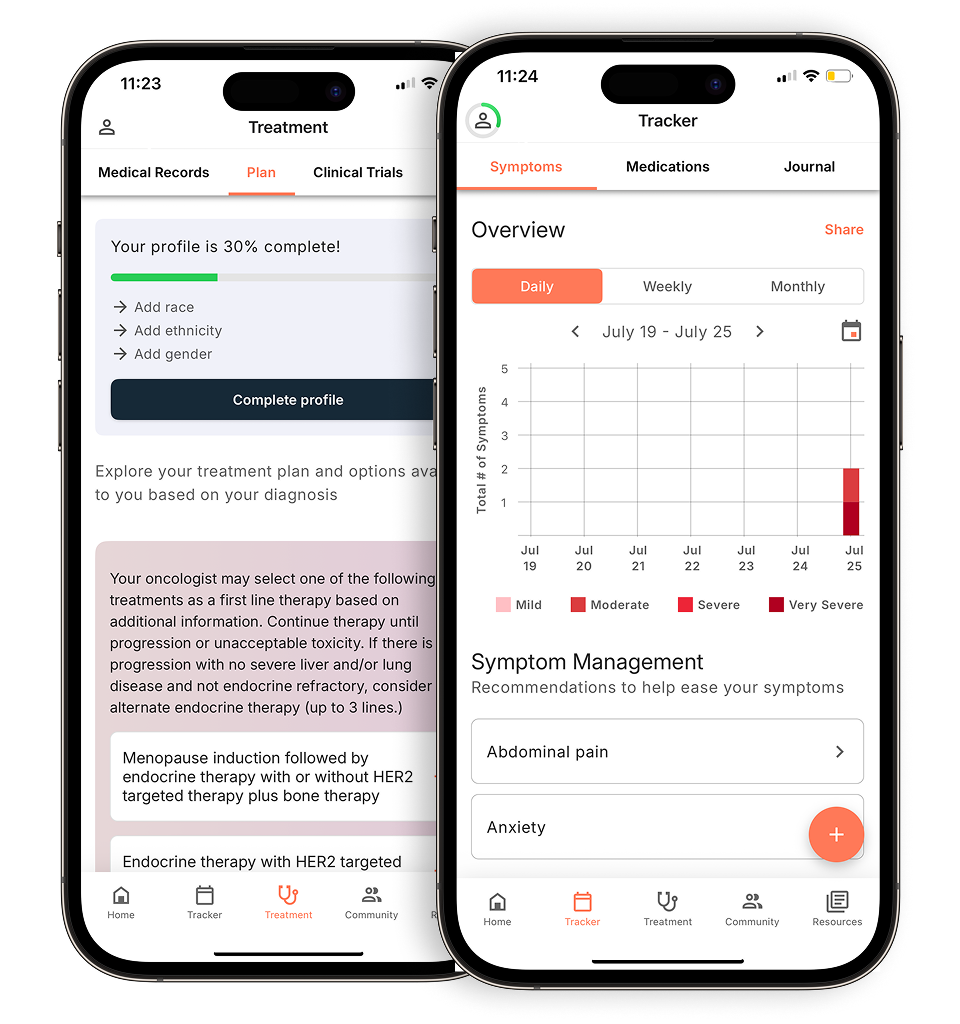
What changes at this pivot point? In short, measurable disease activity that threatens organ function. Unlike MGUS or smoldering myeloma, where monitoring is the primary strategy, active multiple myeloma demands an immediate, personalized care plan.
One of the clearest biochemical markers is the 60% plasma cell threshold. When bone marrow plasma cells reach or exceed 60%, providers classify the condition as active myeloma even if you’re feeling fine and have no obvious symptoms. You don’t need to feel sick for the disease to be causing serious internal damage.
Early detection matters enormously here. Some organ damage caused by active myeloma, particularly to the kidneys and bones, can be irreversible if treatment is delayed. Catching the transition early, before permanent harm sets in, is one of the strongest arguments for consistent monitoring throughout every earlier stage. The next question becomes. What specific markers tell your care team that the threshold has been crossed? That’s where the CRAB criteria come in.
The CRAB criteria: markers of active disease
When providers detect organ damage tied to plasma cell growth, four markers called CRAB signal that treatment can’t wait: Calcium elevation, Renal insufficiency, Anemia, and Bone lesions.
Each marker reflects real harm happening in the body. Calcium elevation occurs when myeloma cells break down bone, releasing calcium into the bloodstream. Renal insufficiency develops as abnormal proteins clog and damage the kidneys. Anemia results from myeloma crowding out healthy red blood cell production in the bone marrow. Bone lesions are areas of bone destruction.
Once CRAB criteria appear, your care team has clinical justification to begin chemotherapy or immunotherapy. This is the threshold that separates watchful MGUS monitoring from active intervention. Waiting is no longer the safer option.
Finding bone damage early requires more than a standard X-ray. Providers typically use:
- MRI, sensitive for detecting early marrow involvement before lesions are visible elsewhere
- PET/CT, maps active disease sites across the whole body
- Low-dose whole-body CT, often the first-line imaging choice for its speed and coverage
Blood tests measuring calcium levels, creatinine (kidney function), and hemoglobin round out the picture alongside these imaging tools. Together, they give your care team a precise map of where multiple myeloma stands, and what needs to happen next.
Not every case is straightforward, though. Some patients sit in a gray zone where damage is emerging but CRAB criteria aren’t fully met. That gray zone, particularly for high-risk smoldering disease, raises one of the most debated questions in myeloma care today.
High-risk smoldering myeloma: to treat or not to treat?
For high-risk smoldering myeloma, the question of early intervention is one of the most actively debated topics in oncology today, and one that patients frequently raise.
If providers can see that progression is likely, why wait? The answer involves weighing the risk of MGUS and SMM progression against the real burden of treatment side effects.
The 20/2/20 rule has become a practical tool for care teams trying to identify which patients are most likely to progress within two years. It flags patients who have:
- Bone marrow plasma cells at or above 20%
- An M-protein level at or above 2 g/dL
- A free light chain ratio at or above 20
Meeting two or more of these thresholds signals significantly elevated risk, shifting the conversation from observation toward earlier action.
But earlier treatment involves real trade-offs. Starting immunotherapy or other systemic therapies means accepting potential side effects such as fatigue, infection risk, and neuropathy before symptoms have even appeared. On the other hand, waiting risks organ damage that a personalized care plan may not be able to fully reverse. Neither path is without cost.
Cancer care guidance for every step of your journey
Get treatment options, clinical trials, and support tailored to your diagnosis--all in one place.
Get started
See treatment options, manage symptoms, and stay informed—all in the app
View treatment options and trials personalized to your diagnosis—plus track progress in real time.
Continue in appWhat’s clear is that this decision belongs to each patient and their care team together, informed by data, values, and individual health factors. The distinctions between these stages become even more intuitive when laid out side by side, which is exactly what the next section does.
Side-by-side comparison: MGUS vs. SMM vs. active myeloma
Where you fall on the plasma cell disorder spectrum determines how your care team will monitor and treat you.
The table below distills the core distinctions into a quick reference. Free light chain MGUS is one form of the condition where the abnormal protein is detected through free light chain ratio testing rather than standard M-protein measurement. Your doctor can help determine which type of testing is most relevant to your situation.
| Condition | Plasma cell % | M-protein level | CRAB symptoms | Standard action |
|---|---|---|---|---|
| MGUS | < 10% | < 3 g/dL | Absent | Observation |
| Smoldering myeloma (SMM) | 10–60% | ≥ 3 g/dL | Absent | Observation (or clinical trial) |
| Active multiple myeloma | > 10% | Varies | Present | Active therapy |
The sharpest dividing line sits between SMM and active multiple myeloma, and it’s CRAB criteria, not tumor burden alone, that tips the scale toward treatment. MGUS and SMM both sit firmly in the observation track; active multiple myeloma demands a personalized care plan built around your specific disease profile.
Understanding which track you’re on sets the stage for the next critical question. What does living with observation actually look like day to day?
What to expect during ‘watch and wait’
Living with a precursor condition means sitting with uncertainty, and the emotional challenges that come with that are real.
The practical reality of “watch and wait” is a scheduled rhythm of blood work, imaging, and waiting. For most people with MGUS, that means monitoring every 6 to 12 months. For SMM, monitoring typically occurs every 3 to 6 months, depending on your risk level. Each appointment tracks the same core markers, M-protein levels, kidney function, hemoglobin, looking for any shift that signals progression.
But numbers on a page don’t capture the full picture. Anxiety between appointments, the urge to over-research every ache, these are common responses, not overreactions. Acknowledging those emotional challenges is part of staying well.
Communicating with your care team matters enormously here. Don’t wait for your next scheduled visit if something changes. New back pain, unusual fatigue, or recurring infections are worth a prompt conversation. Write symptoms down, when they started, how often, how intense, so your care team has something concrete to work with.
Tools like the Outcomes4Me app can help you track symptoms between visits, so nothing slips through the cracks before your next appointment. And as you build that monitoring routine, it’s worth knowing exactly what physical signs your care team is watching for, which brings us to the earliest warning signals of myeloma.
What are the first warning signs of myeloma?
Multiple myeloma’s earliest symptoms are easy to dismiss, and that’s exactly what makes catching them so difficult.
Persistent back or bone pain is often the most telling physical signal of multiple myeloma, alongside fatigue, frequent infections, and unexplained weight loss. But here’s the problem. These symptoms mimic everyday aging. A sore back feels like a pulled muscle. Tiredness gets blamed on a busy schedule. Recurring infections seem like bad luck. Because nothing screams “urgent,” many people wait months before mentioning these changes to their care team.
In the lab, specific red flags tend to surface before symptoms become obvious. Rising creatinine levels can signal kidney stress in multiple myeloma, a hallmark concern, while falling hemoglobin points to anemia developing as abnormal plasma cells crowd out healthy blood production. Elevated calcium and abnormal protein levels on routine bloodwork are key indicators of myeloma.
And that word, “routine,” matters more than you’d think. Lab results tracked over time help your healthcare team monitor how well treatment is working and detect signs that myeloma may be returning, rather than relying on a single test result. Which raises an important question. What happens when the tests themselves have limitations? That’s exactly where the next piece of this picture gets complicated.
Limitations of current diagnostic testing
Multiple tests together give a more reliable picture than any single test alone, and understanding why helps you feel less unsettled when your care team orders yet another round of labs.
Bone marrow biopsies are an important tool your care team may use to help stage multiple myeloma and understand your disease, though other tests are often used alongside them. A bone marrow biopsy captures only a small slice of marrow, and plasma cell distribution isn’t always uniform. You could have a higher concentration of abnormal cells elsewhere in the bone that the needle simply didn’t reach. Blood tests carry their own limitation. M-protein levels can vary between tests, and your care team may consider factors like hydration, lab differences, or when the test was done when interpreting your results.
That’s why your care team looks for trends over time, not isolated data points. One elevated result rarely changes a diagnosis without a consistent pattern to back it up. Serial monitoring, comparing results across multiple visits, gives a far more reliable picture of where things actually stand.
And here’s something worth holding onto. Some patients with smoldering myeloma never progress to active disease in their lifetime. The biology varies enormously from person to person, which is exactly why personalized care plans matter. These diagnostic limitations aren’t failures of medicine, they’re reminders that staging is an ongoing process, not a single verdict. The next section pulls together what all of this means for you and your caregivers in practical terms.
Key takeaways for patients and caregivers
Knowing where you fall on the spectrum, MGUS, smoldering, or active multiple myeloma, shapes everything about how your care team will monitor and treat you.
Understanding the distinction matters. MGUS and smoldering myeloma (SMM) are precursor stages with no end-organ damage, while active disease requires immediate treatment. MGUS is a common, low-risk condition with most people requiring only periodic check-ups rather than any intervention.
High-risk SMM is different. It’s now the focus of numerous clinical trials exploring whether early treatment, including immunotherapy, can delay or prevent progression to active disease. That research is evolving fast.
And accurate staging depends on working with specialists. Proactively engaging a care team experienced in multiple myeloma ensures you’re not under- or over-staged, a distinction with real consequences for your personalized care plan.
Disclaimer: The information provided in this article is for informational purposes only and is not intended to be a substitute for professional medical advice, diagnosis, or treatment. Outcomes4Me is not acting as your caregiver, and any suggestions or guidance offered should not replace the advice of your healthcare provider or qualified medical professional. Always seek the guidance of your physician or other qualified health provider with any questions you may have regarding a medical condition.
Personalized support for real care decisions
Understand your diagnosis, explore clinical trials, and track symptoms--all in one place.
Get started
Compare treatments, prepare for appointments, and track side effects—all in the app
Built for your diagnosis, Outcomes4Me gives you the tools to make confident, informed decisions—right when you need them.
Continue in app