
The moment of diagnosis: moving from ‘what’ to ‘how’
A kidney cancer diagnosis can stop you in your tracks. One moment you’re scheduling a routine scan; the next, you’re navigating a conversation that reshapes everything. That disorientation is real, and it’s valid, but it doesn’t have to last.
Staging transforms a diagnosis from a single, overwhelming fact into a roadmap your entire care team can act on. Understanding how kidney cancer is staged means understanding the language your providers use to measure how much cancer is in your body and where it’s located, a critical first step the Kidney Cancer Association identifies as the foundation of every treatment decision.
Think of staging as a shared communication tool. It gives your oncologist, surgeon, and radiologist a common reference point, so everyone on your team is aligned on the same clinical picture. That alignment matters enormously, because stage directly shapes the menu of treatment options available to you, from surgery and targeted therapy to immunotherapy and clinical trials. Before you can evaluate what comes next, you need to know where you’re starting.
If you’ve already received a pathology report and felt puzzled by the terminology, you’re not alone, and reading those results takes practice, and the stage is only one piece of a larger picture.
Renal cell carcinoma (RCC) includes several subtypes, with clear cell RCC being a major form of kidney cancer. To understand what your stage actually means, it helps to break down the system that produces it, and that starts with the TNM framework.
Decoding the TNM system: the math behind your stage
Your kidney cancer stage isn’t a single measurement, it’s a three-part equation that describes exactly where cancer exists in your body. The TNM system, recognized as the most widely used staging framework for kidney cancer according to the Mayo Clinic, combines three distinct scores to produce the overall stage that will guide your kidney cancer treatment by stage.
Understanding each component helps you read your own pathology report and ask sharper questions at your next appointment.
- T — Tumor: This score reflects the size of the primary tumor and how far it’s grown within or beyond the kidney. A T1 tumor is 7 cm or smaller and still contained; a T4 tumor has grown into surrounding structures like the adrenal gland or major blood vessels. Size and local reach matter enormously here.
- N — Node: This component tells you whether cancer cells have traveled to nearby lymph nodes. N0 means no lymph node involvement; N1 means at least one regional lymph node is affected. Lymph node status is a key signal of how actively the cancer is moving.
- M — Metastasis: This is the binary question, has cancer spread to distant organs such as the lungs, liver, or bones? M0 means no distant spread; M1 confirms it has, which shifts the conversation toward systemic treatment options.
Once your care team has scored all three components, they combine them into a Roman numeral stage, Stage I through Stage IV, that anchors every treatment conversation going forward. Stages I and II, where the tumor remains confined to the kidney, typically open the door to very different options than later stages do.
Evidence-based guidance powered by NCCN Guidelines®
Personalized treatment plans shaped by the latest oncology standards—tailored to your diagnosis.
Get started
View your personalized treatment plan in the Outcomes4Me app
Use your diagnosis to unlock personalized NCCN Guidelines®-aligned recommendations.
Continue in app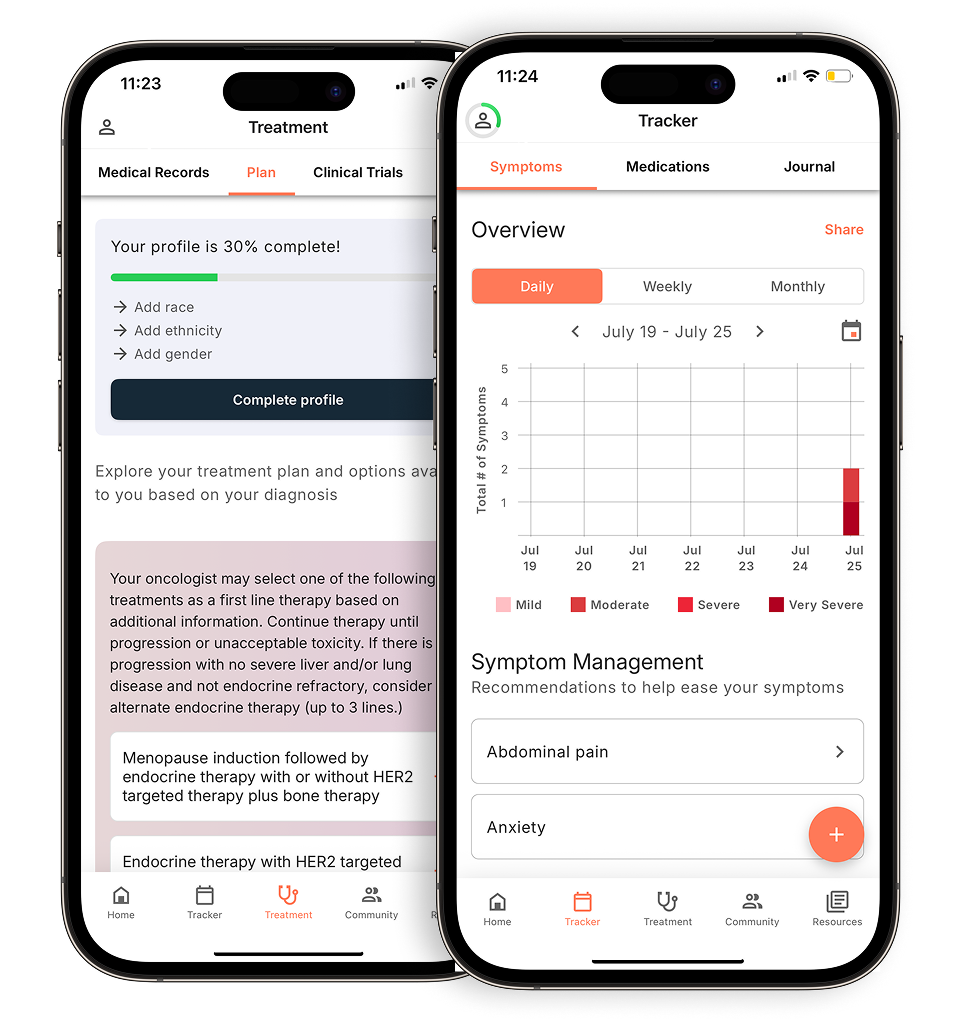
Stages I and II: the focus on localized control
For patients with early-stage renal cell carcinoma, the clinical picture carries genuinely encouraging news. When a tumor is caught while it’s still confined to the kidney, treatment goals shift firmly toward cure, and the data backs that up. The 5-year survival rate for localized kidney cancer is approximately 93%, making early detection one of the most powerful factors in your overall outlook.
Stage I means the tumor measures less than 7 cm and hasn’t grown beyond the kidney itself. Stage II follows the same logic, the tumor remains confined to the kidney, but it’s larger than 7 cm. In both cases, the cancer hasn’t reached nearby lymph nodes or distant organs, which is precisely what makes localized control the central treatment objective.
For most patients at these stages, surgery is the primary recommendation. The key surgical decision is between a partial nephrectomy, which removes only the tumor and a small margin of healthy tissue, and a radical nephrectomy, which removes the entire kidney, and that choice depends heavily on tumor size, location, and your overall kidney function. When surgery isn’t the right fit, thermal ablation techniques such as radiofrequency ablation or cryoablation offer effective minimally invasive alternatives. You can read more about how patients weigh this surgical decision in real-world conversations within the Outcomes4Me community.
As reassuring as Stages I and II are, the treatment picture shifts considerably once cancer begins spreading beyond the kidney, which is where Stages III and IV come in.
Stage III and IV: navigating advanced and metastatic care
When kidney cancer moves beyond the kidney itself, the TNM staging system that kidney cancer teams rely on signals a critical shift, from localized surgery to treatments that work throughout the entire body.
Stages III and IV require a fundamentally different playbook than earlier stages. Stage III means the tumor has grown into a major vein like the renal vein or vena cava, or cancer cells have reached nearby lymph nodes, but it hasn’t spread to distant organs. Stage IV indicates that cancer has traveled to remote sites such as the lungs, bones, liver, or brain, which is what clinicians mean by metastatic disease.
For Stage III, surgery remains a central part of treatment, but the conversation around additional systemic therapy becomes more urgent. For Stage IV, systemic treatments move to the front line. According to the Cleveland Clinic, kidney cancer treatment may include immunotherapy and targeted therapy, two approaches that work very differently and can be combined based on your individual situation:
Cancer care guidance for every step of your journey
Get treatment options, clinical trials, and support tailored to your diagnosis--all in one place.
Get started
See treatment options, manage symptoms, and stay informed—all in the app
View treatment options and trials personalized to your diagnosis—plus track progress in real time.
Continue in app- Immunotherapy (checkpoint inhibitors): These drugs, such as nivolumab or pembrolizumab, don’t attack cancer directly. Instead, they release the brakes on your immune system so it can recognize and destroy cancer cells on its own.
- Targeted therapy (TKI inhibitors): Research shows that blocking proteins like VEGF and TIE-2 can reduce the formation of new blood vessels that tumors need to grow and spread, helping to slow kidney cancer progression.
The stage alone, however, doesn’t tell the whole story. Two patients with the same Stage IV diagnosis can respond very differently to the same treatment, which is exactly why understanding your tumor’s genetic profile matters so much.
Beyond the stage: why genetics and NCCN guidelines matter
Staging tells you where the cancer is, but genetics increasingly explain how it will behave. Two patients can share an identical Stage II diagnosis and yet face very different clinical paths depending on the molecular profile of their tumor. As NCBI research notes, molecular genetics of kidney cancer have significant implications for the physician and patient in choosing therapy. That’s not a minor footnote, it’s a fundamental reason why your stage number is only part of the picture.
Genetic testing of the tumor itself can reveal subtypes of renal cell carcinoma that respond very differently to targeted therapies, immunotherapy, or clinical trials for kidney cancer. Clear cell renal cell carcinoma (ccRCC) is the most common type, and papillary and chromophobe variants each carry distinct genetic drivers as well. Knowing which one you’re dealing with helps your care team match treatment to tumor biology rather than rely on stage alone. If you haven’t already, it’s worth asking your provider directly: “Can we run molecular profiling on my tumor sample?” The answer shapes not just initial treatment, but long-term monitoring too.
Treatment decisions for kidney cancer depend mainly on the stage of your cancer and your overall health, along with other factors such as the type and grade of the cancer, meaning your stage is an important starting point, not the only factor that determines your care. They’re updated regularly as new data emerges, which means your care should reflect the most current evidence available. Keeping both your tumor’s genetic profile and evidence-based recommendations in view gives you a clearer, more complete picture of your options, and sets up a more informed conversation about what comes next.
The bottom line: your staging checklist
Your kidney cancer stage isn’t a verdict, it’s a roadmap that shapes every treatment decision ahead. As earlier sections have shown, the same diagnosis can look very different depending on TNM scores, tumor biology, and whether current guidelines point toward curative surgery or long-term management. Here’s what to carry forward.
Staging determines the goal of treatment. For localized disease, the aim is typically cure, often through surgery, and sometimes with no further treatment required. For advanced or metastatic kidney cancer, the focus shifts to controlling the disease, preserving quality of life, and extending survival as long as possible. Knowing which category applies to you changes how you interpret every recommendation your care team makes.
Your TNM score is the foundation of your pathology report. Tumor size, lymph node involvement, and metastasis status together define your stage, and that stage directly influences which therapies are on the table. If you’ve had surgery, understanding your post-surgical findings can help you make sense of what comes next.
Evidence-based guidelines translate evidence into action. They exist to ensure that every patient, regardless of where they’re treated, has access to the same evidence-based standard of care. Clinical trials should be considered at every stage, not just when standard options run out. Trials offer access to emerging therapies before they’re widely available, and they’re often more accessible than patients expect. The most common form of kidney cancer is clear cell renal cell carcinoma, and breakthrough therapies for renal cell kidney cancer are advancing rapidly.
The data you already have is more powerful than you may realize, and the next step is knowing how to use it.
Taking control: how to use your data for better outcomes
Your kidney cancer stage is only meaningful when you know how to act on it, and that starts with accessing the data you already have.
Your TNM scores are yours. Patient portals like MyChart give you direct access to pathology reports, imaging summaries, and the T, N, and M values that define your stage. If you haven’t reviewed these yet, logging in and locating your most recent pathology report is a concrete first step. You don’t need to decode every term on your own, but having the numbers in front of you puts you in a better position to ask the right questions.
Treatment decisions for kidney cancer depend on multiple factors beyond stage alone, including your overall health, tumor characteristics, and personal preferences, your doctors will consider all of these when recommending an individualized treatment plan. Whether you’re weighing surgery options or wondering whether connecting with others who’ve been through similar experiences might help, having the right resources and support makes a real difference.
The landscape of kidney cancer care is evolving faster than at any point in recent history. Targeted therapies, immunotherapy combinations, and genomic-guided treatment are reshaping what’s possible, even at advanced stages. Your stage is not a ceiling; it’s a starting point. With the right information and the right tools, you can move from passive recipient to active participant in your care, and that shift makes all the difference.
Disclaimer: The information provided in this article is for informational purposes only and is not intended to be a substitute for professional medical advice, diagnosis, or treatment. Outcomes4Me is not acting as your caregiver, and any suggestions or guidance offered should not replace the advice of your healthcare provider or qualified medical professional. Always seek the guidance of your physician or other qualified health provider with any questions you may have regarding a medical condition.
Personalized support for real care decisions
Understand your diagnosis, explore clinical trials, and track symptoms--all in one place.
Get started
Compare treatments, prepare for appointments, and track side effects—all in the app
Built for your diagnosis, Outcomes4Me gives you the tools to make confident, informed decisions—right when you need them.
Continue in app