
An incidental renal mass, a kidney tumor discovered by accident during imaging ordered for something else entirely, is disorienting. That shock is completely valid, but accidental discovery is often your greatest advantage. Most kidney cancers are now discovered incidentally or accidentally, particularly small tumors that are increasingly detected through advanced imaging such as ultrasound, CT scans, and MRI.
Renal cell (kidney) cancer rarely causes symptoms in its early stages. There’s no reliable pain signal, no obvious warning sign that prompts a targeted scan. Most patients who develop symptoms, blood in the urine, unexplained weight loss, persistent fatigue, are already at an advanced stage, where treatment options narrow considerably. When a scan for an unrelated condition catches a mass early, it means you have more options.
This is what clinicians sometimes call the “asymptomatic advantage.” Finding a small, localized tumor before it spreads gives you and your care team far more flexibility in building a personalized care plan, and far better odds of a favorable outcome. Understanding exactly what that imaging report is telling you, including tools like the Bosniak classification for renal cysts, is the critical next step.
Your imaging report, Bosniak scores and mass size
The first distinction your report will make is between a solid mass and a cystic mass. Solid masses are composed of tissue and are more likely to require prompt evaluation. Cystic masses, fluid-filled sacs, are far more common and usually benign, but they’re not all the same. That’s where the Bosniak classification comes in.
Developed to standardize how radiologists assess cystic renal masses, the Bosniak system assigns a category based on imaging features that suggest the likelihood of malignancy:
- Bosniak I: Simple cyst with thin walls and almost certainly benign features.
- Bosniak II: Bosniak II classification identifies mildly complex cysts that are usually benign and typically require no follow-up imaging.
- Bosniak IIF: Features that need follow-up imaging.
- Bosniak III: Indeterminate, and surgical evaluation is often recommended.
- Bosniak IV: Clearly malignant features and treatment is typically indicated.
Mass size matters as much as category. Tumors measuring under 4 cm are classified as Stage T1a. Tumors measuring under 4 cm offer significantly more treatment flexibility, including options like partial nephrectomy. Outcomes tend to be considerably better at this stage.
Evidence-based guidance powered by NCCN Guidelines®
Personalized treatment plans shaped by the latest oncology standards—tailored to your diagnosis.
Get started
View your personalized treatment plan in the Outcomes4Me app
Use your diagnosis to unlock personalized NCCN Guidelines®-aligned recommendations.
Continue in app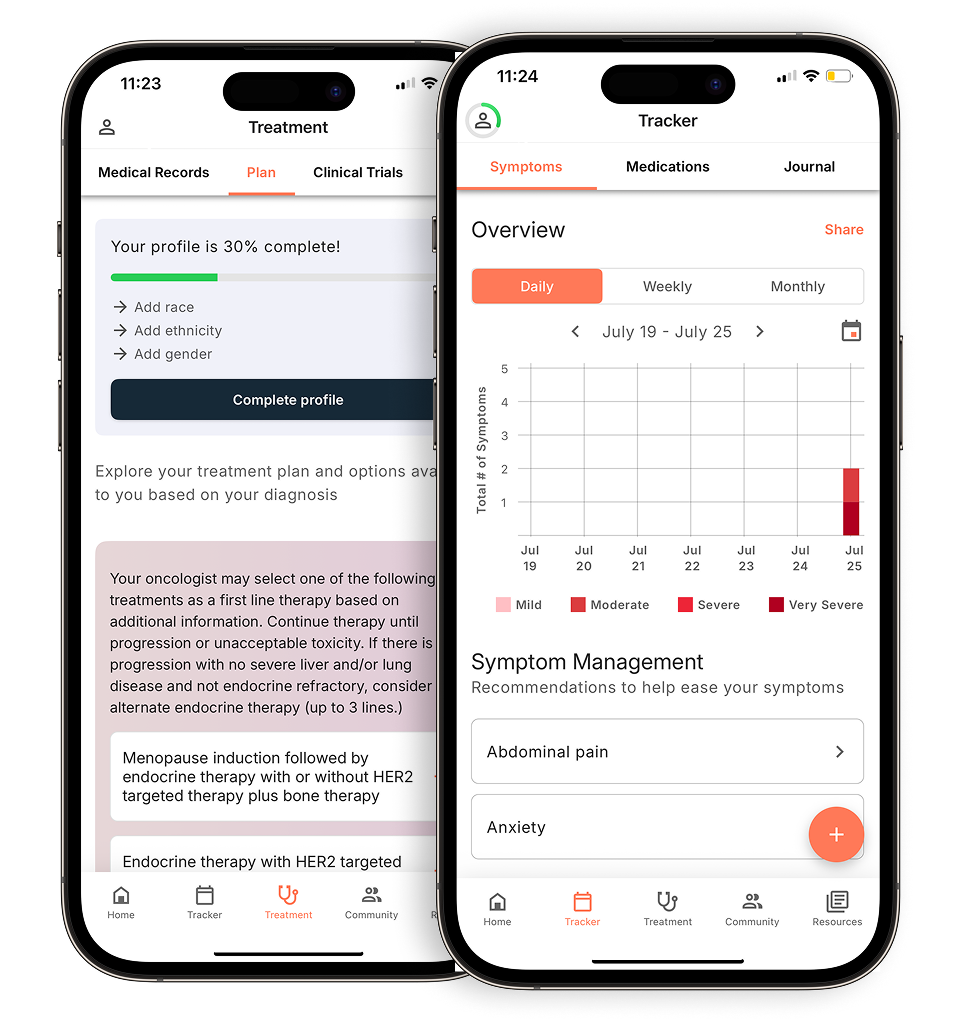
When you review your report, look closely for terms like “enhancing” (meaning the mass absorbs contrast dye, which signals abnormal blood flow) or “septated” (meaning it contains internal dividing walls). Either term signals your care team needs a closer look. And if the language feels overwhelming, that’s completely normal, bringing a printed copy of your report to your next appointment gives your care team a clear starting point for discussion.
Why early detection changes the survival equation
Early detection of renal cell carcinoma improves your odds and fundamentally transforms what treatment looks like and what’s possible afterward. The 5-year survival rate for localized kidney cancer is greater than 90%, compared to roughly 15% for metastatic (stage IV) disease. That gap reflects the difference between a conversation about personalized treatment for renal cell carcinoma and a conversation about managing a disease that’s already spread.
Incidental tumors are disproportionately caught at the earliest stages. Because they’re found during unrelated imaging, not because something feels wrong, they’re frequently classified as Stage T1a, meaning the tumor measures 4 cm or smaller and is contained entirely within the kidney. At this size, the kidney itself is doing its job, and you’re unlikely to notice any symptoms at all.
Symptomatic detection follows a different pattern. Warning signs like blood in the urine (hematuria), persistent flank pain, or an unexplained mass are more likely to appear once a tumor has grown significantly or started to affect surrounding tissue, often at a later stage, when treatment options narrow. Kidney cancer frequently causes no signs or symptoms in its early stages. By the time symptoms emerge, the window for the most straightforward intervention may already be smaller.
This is why cancer screening programs prioritize early detection above all else, even when that detection happens by accident. An incidentaloma finding is an opportunity to intervene before a tumor grows or spreads.
Management strategies. From active surveillance to robotic surgery
Your diagnosis opens a range of options you can actively navigate for renal cell carcinoma found incidentally, broader than most people expect.
Active surveillance. When watching is the right move
Not every small renal mass needs immediate treatment. Active surveillance is a structured program of regular imaging and clinical check-ins that is a safe, evidence-based choice for select patients, particularly older adults or those with significant health conditions that would make surgery risky. In practice, this means scheduled CT or MRI scans every three to six months initially, then annually if the mass remains stable. The goal is to act only when the data says you should. Masses growing faster than 5 mm per year typically prompt a reassessment of the watch-and-wait approach.
Cancer care guidance for every step of your journey
Get treatment options, clinical trials, and support tailored to your diagnosis--all in one place.
Get started
See treatment options, manage symptoms, and stay informed—all in the app
View treatment options and trials personalized to your diagnosis—plus track progress in real time.
Continue in appThermal ablation. A minimally invasive middle path
For patients who aren’t strong surgical candidates, thermal ablation offers an effective alternative. Both cryoablation (freezing the tumor) and radiofrequency ablation (using heat) destroy tumor tissue through image-guided needle probes, with no large incisions required. Recovery is significantly shorter than surgery, and the procedure can often be performed on an outpatient basis. A small percentage of patients who undergo ablation may need additional treatment within the first year, suggesting that ablation could have higher incomplete treatment rates compared to surgery.
Partial nephrectomy: preserving what matters
Partial nephrectomy, removing only the tumor while preserving healthy kidney tissue, is the gold standard surgical approach for small renal masses. Partial nephrectomy is preferred over radical nephrectomy because it protects long-term kidney function. Retaining more kidney tissue is thought to be beneficial for long-term kidney function and overall health, which is why your care team may discuss kidney-sparing approaches when they are an option for you.
Robotic-assisted surgery achieves greater precision in complex tumor locations for partial nephrectomies. Robotic-assisted partial nephrectomy patients typically experience less blood loss, fewer complications, and faster return to normal activity compared to open surgery. After partial nephrectomy surgery for kidney cancer, pain and discomfort at the surgical site are common and can usually be managed with medication, and patients typically spend a few days in the hospital during the initial recovery phase.
Your care team will match the right management strategy to your specific Bosniak classification, tumor size, and health baseline, and for some patients, eligibility for clinical trials for early-stage kidney cancer may also factor into that conversation, a dimension of personalized care we’ll explore in the next section.
The role of precision medicine and genomic profiling
Precision medicine for kidney cancer has moved from research theory to clinical reality, and it’s reshaping how early-stage patients and their care teams approach a diagnosis. Not all renal cell carcinomas are genetically identical, even when tumors look similar on imaging. Clear cell, papillary, and chromophobe are distinct renal cell carcinoma subtypes with distinct molecular signatures.
Genomic profiling can reveal whether a renal tumor carries mutations associated with aggressive behavior. That distinction directly informs whether active surveillance is appropriate or whether earlier intervention makes sense, turning what might otherwise be a judgment call into a data-driven decision.
For patients diagnosed at an early stage, the conversation doesn’t end at surgery. Clinical trials are actively enrolling early-stage kidney cancer patients for adjuvant therapy studies. Participating in these trials can expand your options while contributing to research that shapes the future of renal cell carcinoma care. Tracking your genetic data from the point of diagnosis means you’re not starting from zero if your situation changes years down the line.
Your next steps
An accidental kidney cancer finding is a genuine clinical advantage, and understanding what comes next helps you use it well.
- Incidental discovery is how most treatable kidney cancers are found, with the majority of early-stage diagnoses coming from imaging ordered for something else entirely.
- Small kidney cancers that are confined to the kidney are classified as stage 1, and these early-stage cancers are often candidates for active surveillance or surgery depending on individual circumstances.
- The Bosniak classification tells you how urgently to act. A cyst scored Bosniak I or II is almost always benign and monitored. A score of III or IV signals a higher likelihood of malignancy and typically prompts surgical evaluation.
- Preserving kidney function is a primary treatment goal. Partial nephrectomy and ablation techniques prioritize keeping healthy tissue intact.
- NCCN guidelines are the evidence-based standard your personalized care plan should align with. Your care team can help you match your specific diagnosis against those guidelines so nothing gets missed.
Download the Outcomes4Me app to access personalized, evidence-based resources that put you in control of navigating your condition — because better outcomes start with better information.
Disclaimer: The information provided in this article is for informational purposes only and is not intended to be a substitute for professional medical advice, diagnosis, or treatment. Outcomes4Me is not acting as your caregiver, and any suggestions or guidance offered should not replace the advice of your healthcare provider or qualified medical professional. Always seek the guidance of your physician or other qualified health provider with any questions you may have regarding a medical condition.
Personalized support for real care decisions
Understand your diagnosis, explore clinical trials, and track symptoms--all in one place.
Get started
Compare treatments, prepare for appointments, and track side effects—all in the app
Built for your diagnosis, Outcomes4Me gives you the tools to make confident, informed decisions—right when you need them.
Continue in app