
In the hours and days that follow a uterine (endometrial) cancer diagnosis, it’s completely natural to feel an urgent pull to do something, to schedule every appointment, research every treatment, and resolve the uncertainty as fast as possible. The most important thing after an initial diagnosis is to pause long enough to make sure you’re moving in the right direction.
Immediate action: Before booking any treatment appointments, confirm that a gynecologic oncologist, not a general OB-GYN, is leading your care team. Uterine (endometrial) cancer is highly treatable when caught early, and outcomes improve significantly when a specialist is at the center of your personalized care plan from day one.
Knowing when to see a gynecologic oncologist is one of the most consequential decisions you’ll make. The answer is as soon as possible after diagnosis, and certainly before any surgical or treatment planning begins. Gynecologic oncologists train specifically in cancers of the reproductive system. They understand the nuances of staging, surgical approach, and systemic therapy in ways a general practitioner simply can’t match.
Understanding what happens at your first oncology appointment can ease a lot of the anxiety. You’ll review your biopsy results, discuss imaging, and begin mapping out a diagnostic and treatment plan grounded in your specific situation.
One important caution. Resist researching your diagnosis online. General health forums and unverified websites can surface outdated or misleading information that amplifies fear rather than clarifying your options. Stick to evidence-based, NCCN-aligned sources and the guidance of your care team.
Decoding your pathology: endometrial carcinoma vs. sarcoma
One of the most disorienting first steps after uterine cancer diagnosis is staring at a pathology report written in language that feels foreign. Understanding two key terms, type and grade, can help that report start to make sense.
Type describes the origin of the cancer cells. The vast majority of uterine cancers are endometrial carcinomas, tumors that develop from the lining of the uterus. A much rarer category, uterine sarcoma, arises from the muscle or connective tissue of the uterine wall. Each type follows a different treatment path, responds differently to therapies, and carries its own prognosis.
Evidence-based guidance powered by NCCN Guidelines®
Personalized treatment plans shaped by the latest oncology standards—tailored to your diagnosis.
Get started
View your personalized treatment plan in the Outcomes4Me app
Use your diagnosis to unlock personalized NCCN Guidelines®-aligned recommendations.
Continue in app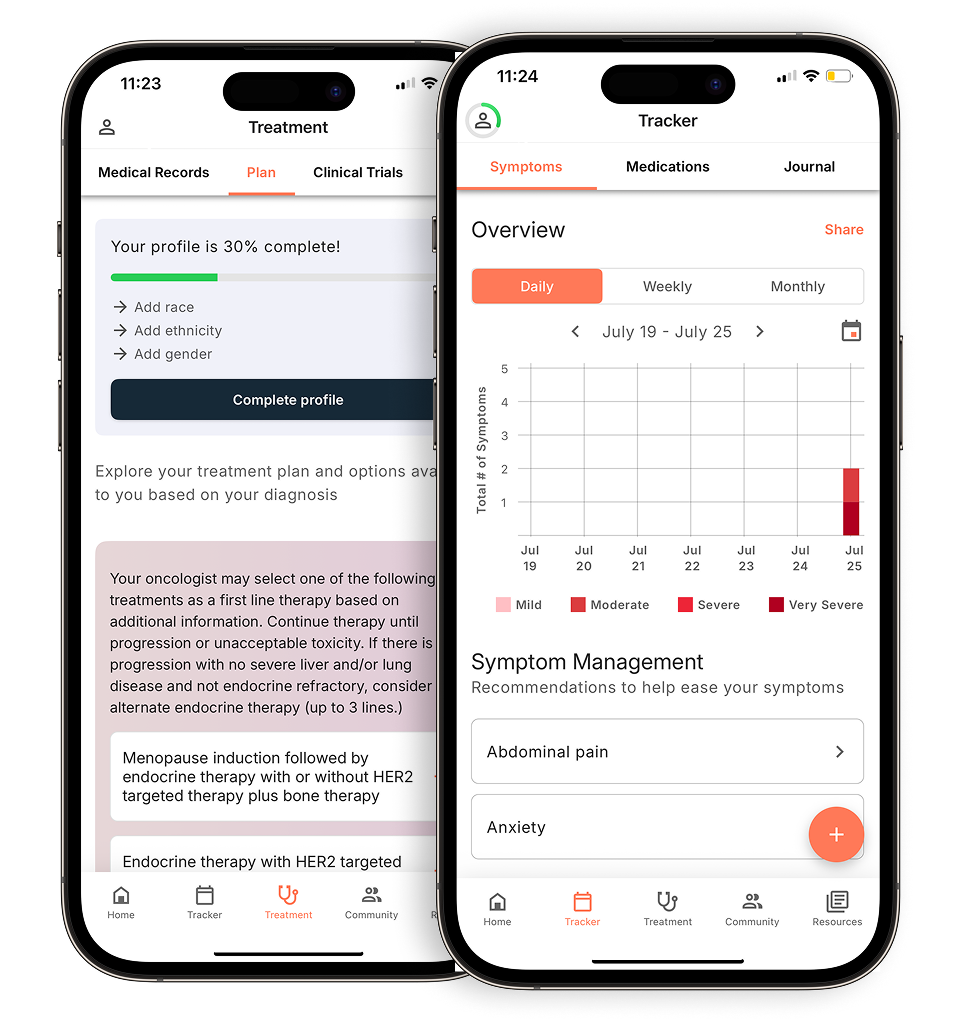
Grade (typically scored 1 through 3) tells you how aggressive the cancer cells appear under a microscope. Grade 1 tumors are well-differentiated, meaning the cells still closely resemble normal tissue. Grade 3 tumors are considered poorly differentiated, meaning the cells may appear and behave differently from normal uterine cells. Your care team can explain how your tumor’s grade relates to your individual diagnosis and treatment plan. Grade 3 endometrial cancers tend to be aggressive and grow and spread faster than lower-grade cancers, and they have a worse outlook, which is why your care team will factor this number into every conversation about your personalized care plan.
One detail that often surprises patients: staging for uterine cancer is surgical, meaning the final stage isn’t confirmed until after a hysterectomy and lymph node assessment. This is different from many other cancers, where imaging alone can determine the stage. Your pre-surgical scans provide important clues, but the definitive picture comes after the procedure.
And before any second opinion, request your physical pathology slides, not just the written report. You have the right to have those slides sent to another institution for independent review. Store the written reports digitally alongside any imaging disks. This groundwork matters especially as your next conversation with your care team turns to the molecular level of your disease, specifically what the biology of your tumor reveals about the treatments available to you.
The power of genomic profiling and biomarker testing
Genomic profiling is a standard part of care that directly shapes which treatments your care team can offer you.
When you’re newly diagnosed with uterine (endometrial) cancer, you’ll likely hear terms like MSI-H (microsatellite instability-high) and dMMR (mismatch repair deficient). These biomarkers reveal whether the cancer cells have a specific defect in their ability to repair DNA errors. And that detail matters enormously: tumors that test positive for MSI-H or dMMR may respond well to immunotherapy, opening a treatment path that wouldn’t otherwise apply. Adding this to any newly diagnosed uterine cancer checklist is essential.
Your biomarker results can unlock treatment options that standard staging alone cannot. One of the most important tests in this panel screens for Lynch Syndrome, a hereditary condition that significantly raises the risk of uterine and other cancers. Genetic testing for Lynch Syndrome is recommended for all uterine cancer patients to inform your personalized care plan and help your family members understand their own risk.
Cancer care guidance for every step of your journey
Get treatment options, clinical trials, and support tailored to your diagnosis--all in one place.
Get started
See treatment options, manage symptoms, and stay informed—all in the app
View treatment options and trials personalized to your diagnosis—plus track progress in real time.
Continue in appThese tests don’t happen automatically. Advocating for genomic and biomarker testing at your first oncology appointment is one of the most impactful steps you can take right now, before any treatment decisions are finalized.
Preparing for your first oncology appointment
Your first oncology appointment sets the tone for every decision that follows, so walking in prepared is essential.
Bring everything you have on paper. That means your imaging, CT scans, MRI reports, plus your pathology report and any notes from your referring physician. Bringing a trusted family member or friend can help you catch details you might miss when you’re processing difficult information in real time. If no one’s available, ask if you can record the conversation.
Once you’re in the room, the questions you ask shape the quality of care you receive. An important question to raise is: “What is the goal of this treatment, curative or management?” That single question reframes everything from how aggressively to pursue surgery to how you weigh side effects.
Don’t be afraid to ask specifically about the surgeon’s volume with minimally invasive hysterectomy; higher-volume surgeons consistently show better outcomes. Raise genetic testing for uterine cancer patients early; if Lynch syndrome is a possibility, knowing early can influence both your treatment and your family’s screening decisions.
Finally, ask about clinical trials before your first round of standard treatment begins, a topic the next section addresses in depth, because the timing of that conversation matters significantly.
Why clinical trials should be your plan A
Clinical trials for uterine (endometrial) cancer often offer access to the most effective, cutting-edge treatments available right now. Yet many patients hold back, worried they’ll be treated as test subjects rather than as individuals deserving the best possible care. Many clinical trials offer access to standard care alongside an investigational new therapy. Ask your care team whether a trial might be a good fit for your situation and what both the standard and experimental components would involve.
Timing matters significantly. Eligibility criteria for trials are frequently tied to specific biomarkers, genomic markers, and disease stage, which is exactly why the genomic profiling discussed earlier in this article is so critical. Waiting until later stages, after multiple treatment lines have narrowed your options, may close doors that were open at diagnosis. Clinical trials are actively investigating targeted therapies and immunotherapies, which may offer additional treatment options for advanced or recurrent disease, but those opportunities are often stage- and marker-dependent from the start.
Navigating your personalized roadmap
Taking action early and taking the right actions shapes everything that comes next after a uterine cancer diagnosis. Four evidence-based steps can meaningfully shift your outcomes from the very start.
- See a gynecologic oncologist immediately. General surgeons and OB-GYNs provide excellent routine care, but uterine (endometrial) cancer requires subspecialty expertise. A gynecologic oncologist specializes in treating reproductive system cancers and uses surgical findings, including tissue samples and imaging, to determine your cancer’s stage and guide your treatment plan.
- Advocate for genomic profiling for endometrial carcinoma. Biomarker and genomic testing, including MMR, POLE, and HER2 status, determines whether targeted therapies or immunotherapy are viable options for your personalized care plan. Molecular subtyping now guides treatment decisions at leading cancer centers. Without this data, critical options may never be offered.
- Centralize your medical records and pathology reports. Scattered paperwork creates gaps. Organizing everything into one accessible digital location means your care team always has the full picture, and so do you. It also makes it far easier to seek second opinions quickly.
- Evaluate clinical trials alongside standard treatment. As covered earlier in this article, trials often represent your best access to cutting-edge therapies. Treat them as a parallel track, not a last resort.
Taking control with Outcomes4Me
A uterine (endometrial) cancer diagnosis comes with a flood of information: pathology reports, staging details, and biomarker testing for uterine cancer. Making sense of it all on your own is hard. The Outcomes4Me app is built to translate complex clinical data into clear, personalized treatment paths so you can walk into every appointment informed and ready.
Disclaimer: The information provided in this article is for informational purposes only and is not intended to be a substitute for professional medical advice, diagnosis, or treatment. Outcomes4Me is not acting as your caregiver, and any suggestions or guidance offered should not replace the advice of your healthcare provider or qualified medical professional. Always seek the guidance of your physician or other qualified health provider with any questions you may have regarding a medical condition.
Personalized support for real care decisions
Understand your diagnosis, explore clinical trials, and track symptoms--all in one place.
Get started
Compare treatments, prepare for appointments, and track side effects—all in the app
Built for your diagnosis, Outcomes4Me gives you the tools to make confident, informed decisions—right when you need them.
Continue in app