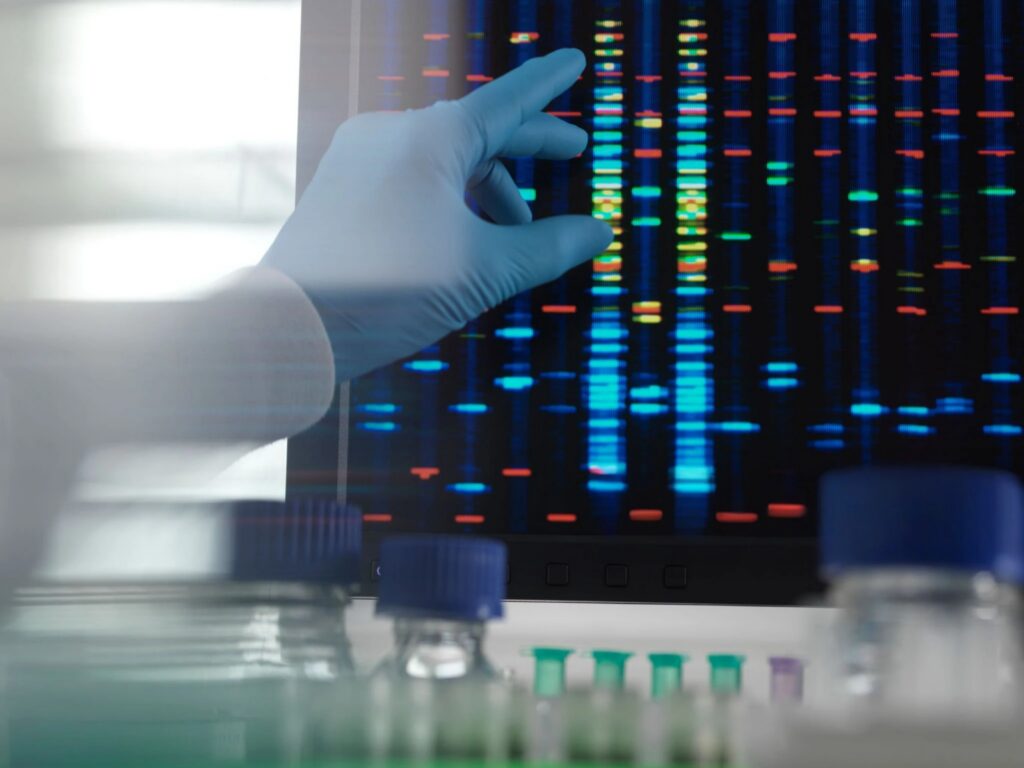
Some cancers run in families. About 5 to 10 out of every 100 cancers happen because of a gene change that is passed down from a parent. A gene change like this is called a “pathogenic variant”, which means a change in a gene that can raise your risk of getting cancer. When a cancer risk is passed down through families, it is called hereditary cancer.
Some of the most well-known genes tied to hereditary cancer are BRCA1 and BRCA2. Changes in these genes can raise the risk of breast, ovarian, pancreatic, and prostate cancer. Other genes can also raise these risks, including PALB2, ATM, CHEK2, PTEN, TP53, and the Lynch syndrome genes (MLH1, MSH2, MSH6, PMS2, and EPCAM).
Both men and women can inherit these gene changes. Men with a BRCA1, BRCA2, or PALB2 change have higher risks of male breast cancer, prostate cancer, and pancreatic cancer. Men can also pass the change on to their children, so male relatives are just as important to include in family testing as female relatives.
If your care team thinks you may have hereditary cancer risk, they may talk with you about two things: a cancer risk assessment and genetic testing. A risk assessment is a careful review of your personal and family health history. Genetic testing is a lab test (usually a blood or saliva sample) that looks for changes in certain genes.
Before and after testing, you will usually meet with a genetic counselor. A genetic counselor is a health professional trained to explain what the test can and cannot tell you, help you decide if testing is right for you, and go over what the results mean for you and your family.
Before genetic testing
Cancer risk assessment
A cancer risk assessment looks at your chance of getting cancer based on your personal and family health history. To do this well, your care team will ask about:
- The types of cancer you or family members have had on both your mother’s side and your father’s side.
- The age each person was when they were diagnosed.
- Any past genetic testing in your family.
- Any tests done on a tumor itself (called tumor or somatic testing).
- Any surgeries or steps taken to lower cancer risk (for example, removing both breasts or ovaries).
- Where your ancestors came from. Some gene changes are more common in certain groups. For example, people with Ashkenazi Jewish, French Canadian, Icelandic, or some African, Latino, or Asian backgrounds may carry specific gene changes that are more common in their community. Sharing this history helps your team choose the right test for you.
For some rare conditions, such as Cowden syndrome (also called PTEN hamartoma tumor syndrome), your care team may also do a physical exam to check for other signs.
In the past, most people who had genetic testing came from European backgrounds. That means the lab databases that interpret results have more information about changes seen in those groups. If your family came from other parts of the world, you may be more likely to get a “variant of uncertain significance” (VUS), a gene change we don’t fully understand yet. Labs are working to fix this by studying more diverse groups. If you get a VUS, ask about variant reclassification programs that can update your result over time.
Evidence-based guidance powered by NCCN Guidelines®
Personalized treatment plans shaped by the latest oncology standards—tailored to your diagnosis.
Get started
View your personalized treatment plan in the Outcomes4Me app
Use your diagnosis to unlock personalized NCCN Guidelines®-aligned recommendations.
Continue in app
Introduction to genetic testing
Genetic testing is a lab test that checks your DNA for changes that can raise your cancer risk. Most tests today use a “multi-gene panel.” This test looks at many genes at once, not just one. Panels are helpful because more than one gene can cause the same kind of cancer.
Multi-gene panels can find:
- High-risk genes (like BRCA1, BRCA2, PALB2, TP53, PTEN, CDH1, and the Lynch syndrome genes). Changes in these genes can greatly raise cancer risk. Finding one of these changes often changes the care you and your family are offered.
- Moderate-risk genes (like ATM and CHEK2). Changes here raise cancer risk, but by less than the high-risk genes. Your care team will weigh these results along with your family history.
- Variants of uncertain significance, or “VUS.” A VUS is a gene change where we don’t yet know if it raises cancer risk. Over time, labs often reclassify these as either a real risk or a normal change. A VUS should not be used to change your medical care or to test other family members.
Because of these possible results, it is important that testing is done along with genetic counseling. A genetic counselor can help you understand what the results mean for you.
Things to consider about genetic testing
- Testing usually makes the most sense when the results could change care. For example, if you have a BRCA1 or BRCA2 change, your doctor may offer more frequent breast screening, added MRI scans, or options to lower risk. For children under 18, testing is usually not done unless the results would change their care during childhood.
- Your family history affects how likely testing is to find something. If you don’t know much about your family’s health history or ancestry, it can be harder to predict. If you come from a family with few female relatives or few known cancers, the chance of finding a gene change may be lower.
- Tumor testing and germline (inherited) testing are different. Tumor testing looks at the cancer itself. Germline testing looks at the DNA you were born with. Sometimes tumor testing turns up a change that might also be inherited. If that happens, your team may recommend germline testing to confirm.
- If you have had a bone marrow or stem cell transplant from a donor, standard blood or cheek-swab tests may not give correct results. That’s because those samples can include your donor’s DNA. In that case, a skin sample (called a fibroblast culture) is the best option. If a skin sample isn’t possible, talk with your team about the limits of the test before using a cheek swab.
- Try to have testing done at a lab that is approved and experienced with hereditary cancer. A good test will look at the full gene and also check for larger changes that simple sequencing can miss.
- Genetic test results can also guide cancer treatment. For example, people with certain BRCA1, BRCA2, or PALB2 changes may be able to take drugs called PARP inhibitors. Your oncology team can explain how results may affect treatment choices for breast, ovarian, pancreatic, or prostate cancer.
Cost, insurance, and your legal rights
Cost and insurance are real worries for many people. Here is what to know before you decide.
Cancer care guidance for every step of your journey
Get treatment options, clinical trials, and support tailored to your diagnosis--all in one place.
Get started
See treatment options, manage symptoms, and stay informed—all in the app
View treatment options and trials personalized to your diagnosis—plus track progress in real time.
Continue in app- Many insurance plans cover genetic testing when you meet certain criteria. Your genetic counselor’s office can often check your coverage before you test and give you an estimate of any out-of-pocket cost.
- Medicare and many Medicaid plans cover germline genetic testing for people who meet certain criteria, such as a personal or family history of cancer that fits national testing guidelines.
- If cost is a barrier, help may be available. Some labs have financial assistance programs. Some nonprofits, patient registries, and research studies offer free or low-cost testing. Ask your genetic counselor about options in your area.
- A federal law called GINA, the Genetic Information Nondiscrimination Act, helps protect you. GINA prohibits most health insurance companies and employers from using your genetic test results to deny coverage, raise your rates, or take away your job. It applies whether your result is positive or negative.
- GINA has some important gaps. It does NOT cover life insurance, disability insurance, or long-term care insurance. That means these companies may ask about genetic test results or family history. If you are thinking about buying one of these policies, some people choose to apply before testing. A genetic counselor can help you think through the timing. Some states add extra protections beyond GINA, and federal programs like TRICARE may have different rules.
Planning a family: Reproductive options
- If you carry a gene change that raises cancer risk and you are thinking about having children, you have choices. You can talk with your team about options such as prenatal testing during pregnancy or pre-implantation genetic testing to test embryos before pregnancy. Your team can explain the benefits, the risks, and the limits of each option.
- Some gene changes, including BRCA1, BRCA2, ATM, and PALB2, can also be linked to rare conditions that appear only when a child inherits two changed copies (one from each parent). If you carry one of these changes and you are planning a family, your partner may also be offered testing. The goal is to help you make informed choices.
Who in your family should be tested first?
If more than one person in your family has had cancer, testing usually starts with the person most likely to have a gene change. That is often the family member who was diagnosed youngest, the person who had cancer in both breasts or both ovaries, someone who had more than one kind of cancer, or a close blood relative like a parent or sibling.
Don’t forget the men in your family. A gene change like BRCA1 or BRCA2 can be passed down through either parent. A male relative with breast, prostate, or pancreatic cancer may be the best person to test.
If the person with cancer has already passed away or is not available, relatives without cancer can still be tested. But the results have more limits in that case, so your team will explain what you can and cannot learn.
If no gene change is found in your family, you may still have a higher risk based on your family history alone. Ask about a referral to a genetics expert if you haven’t seen one yet. Your team may also suggest testing for genes linked to other inherited cancers.
If the only finding in your family is a variant of uncertain significance (VUS), it should not be used to guide treatment or to test other relatives. Instead, ask your team if there is a research study or “variant reclassification” program that can help learn more over time.
Telling your relatives
If your testing shows a gene change that raises cancer risk, it is important to let your blood relatives know. They may also carry the change, even if they have never had cancer. Knowing gives them the chance to:
- Meet with a genetic counselor.
- Have their own cancer risk assessment.
- Choose whether to be tested.
- Plan for earlier or more frequent screening if needed.
Your genetic counselor can give you a family letter you can share. This letter explains the finding and can make the conversation easier. Be sure to tell both male and female relatives; gene changes affect everyone in the family.
After genetic testing
Questions to ask when getting your results
- Do I have a gene change that raises my cancer risk? If so, which gene?
- Is the change a known risk (pathogenic), or is it a variant of uncertain significance (VUS)?
- Does this change raise my risk of other cancers?
- If I already have cancer, will this result change my treatment? For example, could I be a candidate for a PARP inhibitor?
- What are my screening and prevention options going forward?
- How does this result affect my family members? Who should be tested, and when?
- If I had a VUS, how will I find out if the lab learns more later?
- Is there a support group, patient registry, or research study I can join?
Taking care of your emotions and finding support
Genetic testing is not just about the science. It can bring up strong feelings for you and your family. Knowing what to expect can help.
- Waiting for results can feel stressful. Try to line up a person you trust to talk to while you wait.
- A positive result, one that shows a gene change, can bring worry, sadness, anger, or fear about the future. Some people also feel guilt, especially about the chance of passing the change on to their children. These feelings are normal.
- A negative result can feel complicated, too. If other people in your family tested positive and you did not, you may feel both relieved and guilty at the same time. This is sometimes called “survivor’s guilt.” It does not mean something is wrong with you.
- Family relationships can also feel the effect. Some relatives may want to know right away. Others may not be ready to hear the news. Give yourself and your family time. Your genetic counselor can help you share results in a way that feels right for you.
You don’t have to go through this alone. Support is available:
- Your genetic counselor can support you before, during, and after testing.
- Mental health professionals, especially those who work with cancer patients, can help you work through hard feelings. Ask your care team for a referral.
- Hereditary cancer support groups connect you with people who understand what you’re going through. Groups like FORCE (Facing Our Risk of Cancer Empowered) and Bright Pink offer peer support, helplines, and free educational resources.
- Many cancer centers have social workers, patient navigators, or clergy who can help you and your family.
Sources
NCCN Clinical Practice Guidelines in Oncology (NCCN Guidelines®) for Genetic/Familial High-Risk Assessment: Breast, Ovarian, Pancreatic, and Prostate (BOPP), Version 3.2026. Accessed February 19, 2026
National Cancer Institute. “Genetic Testing for Inherited Cancer Risk” (https://www.cancer.gov/about-cancer/causes-prevention/genetics/genetic-testing-fact-sheet, Accessed April 30, 2026)
American Cancer Society. “Understanding Genetic Testing for Cancer Risk” (https://www.cancer.org/cancer/risk-prevention/genetics/genetic-testing-for-cancer-risk/understanding-genetic-testing-for-cancer.html, Accessed April 30, 2026)
Personalized support for real care decisions
Understand your diagnosis, explore clinical trials, and track symptoms--all in one place.
Get started
Compare treatments, prepare for appointments, and track side effects—all in the app
Built for your diagnosis, Outcomes4Me gives you the tools to make confident, informed decisions—right when you need them.
Continue in app