
Before recommending a treatment plan for metastatic colorectal cancer, your oncology team needs to gather several pieces of information. Today, treatment decisions can be shaped by the cancer’s genetic and molecular characteristics, where it has spread, your overall health, and other factors unique to you.
We recently spoke with USC Norris Comprehensive Cancer Center medical oncologist Dr. Heinz-Josef Lenz about the information he considers most important when developing an initial treatment strategy and why getting the right tests early can help guide what comes next.
Biomarker and genetic testing can help guide treatment decisions
One of the first priorities, according to Dr. Lenz, is learning more about the biology of the tumor.
Genomic or biomarker testing looks for specific changes in a tumor that may help predict how the cancer will behave or whether certain treatments may be more effective. Depending on the results, testing may help identify opportunities for targeted therapies, immunotherapies, or clinical trials.
Dr. Lenz emphasized that these results can have an important impact on the direction of treatment. “These results determine, really, the direction where the treatment goes, and see if the patient would be eligible for potential clinical trials, testing new antibodies, new immunotherapies, etc.”
Because some test results can take time to come back, timing can also be an important consideration.
Why your doctor may order both tissue testing and a liquid biopsy
Traditionally, genomic testing is performed using a sample of tumor tissue. This approach can provide detailed information about the genetic makeup of the cancer, but results may take several weeks.
“The tissue testing for NGS or RNA-seq takes 2–3 weeks. That’s too long to make treatment decisions,” Dr. Lenz said. For this reason, he shares that he orders a blood-based test, often called a liquid biopsy, at the same time.
A liquid biopsy looks for circulating tumor DNA, small pieces of DNA released by cancer cells that can be detected in the bloodstream. In Dr. Lenz’s practice, this approach can provide important information more quickly.
Evidence-based guidance powered by NCCN Guidelines®
Personalized treatment plans shaped by the latest oncology standards—tailored to your diagnosis.
Get started
View your personalized treatment plan in the Outcomes4Me app
Use your diagnosis to unlock personalized NCCN Guidelines®-aligned recommendations.
Continue in app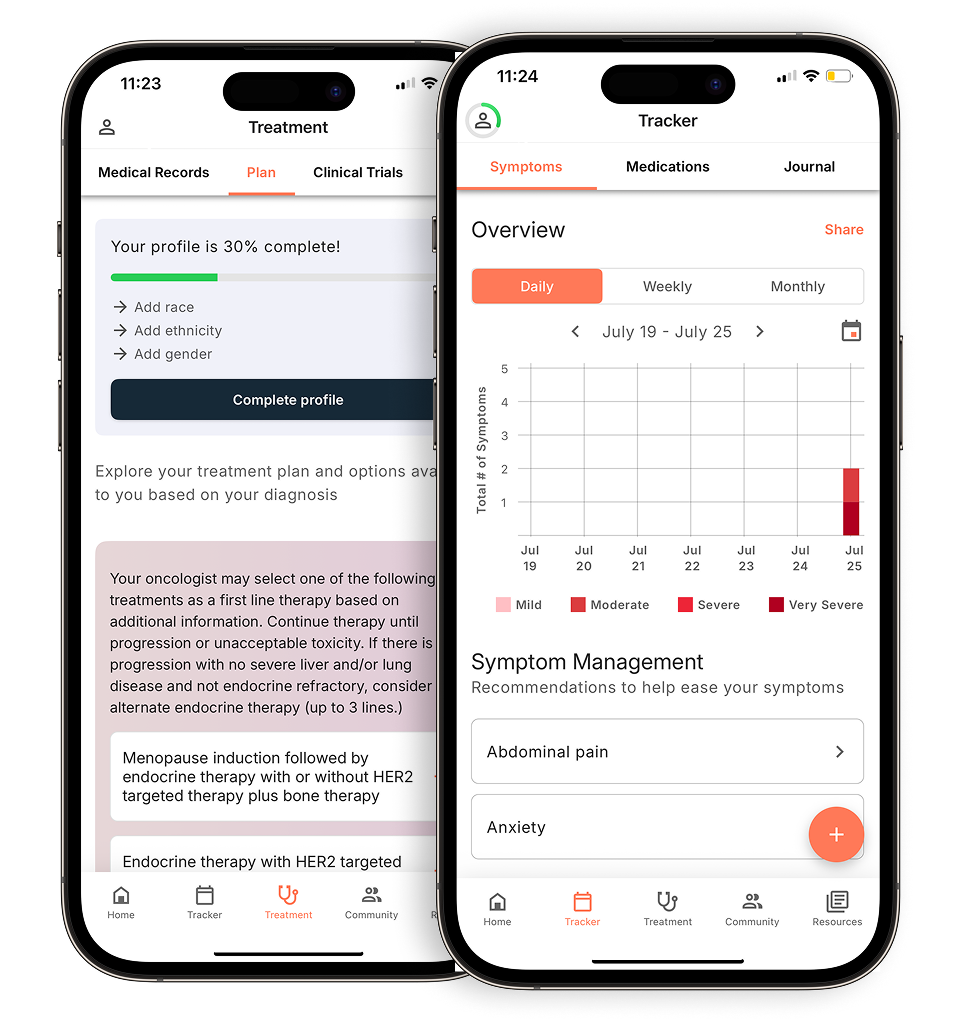
Using both approaches may help doctors gather information while avoiding unnecessary delays in starting an appropriate treatment plan. Tissue testing may provide a more extensive analysis, while a liquid biopsy can potentially deliver key information sooner.
Dr. Lenz explained, “I use both just on the timing that I can put patients in a timely manner on a treatment which is best for them, including a clinical trial.”
What types of biomarkers might be tested?
Every patient’s testing plan may be different. For Dr. Lenz’s practice, testing can include a broad search for genetic alterations.
“We do an NGS (next-generation sequencing), so we do over 600 genes. We also do RNA-seq, so the RNA, not the DNA, because it identifies better certain genetic alterations, like fusions,” he said.
Other testing may examine proteins or biomarkers that could be relevant to treatment options or clinical trial eligibility.
The goal is to build as complete a picture as possible of the cancer and identify characteristics that could influence treatment decisions.
For patients, this is an important reminder to ask their oncology team what testing is being performed and whether all appropriate biomarker testing has been completed before major treatment decisions are made.
Where the cancer has spread also matters
Biomarker testing is only one part of the picture. Your oncology team will also want to understand exactly where the cancer is located and how extensively it has spread.
“Obviously, it’s very critical to know where the metastases are. If it’s in one organ or a couple of organs, is it one lesion? Are there multiple lesions? Because the treatment goal may be different,” Dr. Lenz explained.
The location and extent of metastatic disease can influence whether the goal of treatment is to control the cancer, shrink tumors before a local treatment, or, in selected situations, potentially pursue treatment with curative intent.
Importantly, the presence of cancer in more than one organ does not automatically determine what may or may not be possible.
“Having liver and lung lesions does not mean you’re not curable,” Dr. Lenz said. “It depends where the lesions are and how many, not necessarily the number of organs.”
Cancer care guidance for every step of your journey
Get treatment options, clinical trials, and support tailored to your diagnosis--all in one place.
Get started
See treatment options, manage symptoms, and stay informed—all in the app
View treatment options and trials personalized to your diagnosis—plus track progress in real time.
Continue in appFor some people, a treatment plan may involve more than systemic therapy such as chemotherapy, targeted therapy, or immunotherapy. Depending on the location and extent of disease, doctors may consider surgery or radiation as part of a broader treatment strategy.
Dr. Lenz described this as a “combined modality” approach, where different treatments may be used together while the cancer’s response is closely monitored.
The location of the original tumor can also affect treatment choices
Colorectal cancer is not always treated exactly the same way in every part of the colon. Dr. Lenz noted that research has found important biological differences between tumors that originate on the right and left sides of the colon. These differences can affect whether certain treatments are likely to work.
This is another reason your oncology team will consider multiple pieces of information together rather than making decisions based on a single test result.
The location of the primary tumor, the location and extent of metastatic disease, and the tumor’s biomarkers can all contribute to a more individualized treatment strategy.
Your overall health is part of the treatment decision
The cancer itself is only one part of the equation. Your oncologist also needs to consider your overall health and whether your body is likely to tolerate a particular treatment.
Dr. Lenz highlighted factors including liver and kidney function, performance status, and other health conditions.
For example, certain chemotherapy drugs can cause or worsen nerve damage. “When somebody has already has a neuropathy because of diabetes, we are much more careful,” Dr. Lenz said.
This illustrates why two people with similar cancer diagnoses may not necessarily receive exactly the same treatment plan. Your existing health conditions, medications, organ function, symptoms, and ability to tolerate treatment all matter.
Don’t wait too long to start important testing
Although your care team may continue gathering information during the first weeks after diagnosis, Dr. Lenz believes genetic and biomarker testing should be prioritized early.
“The genetic testing needs to be right away to not lose time, because all the other information can be collected during the week before we see the patients again,” he said.
If you’re newly diagnosed or preparing to start a new line of treatment, consider asking your oncology team:
- Has comprehensive biomarker or genomic testing been ordered?
- Which biomarkers are being tested?
- Am I a candidate for a liquid biopsy?
- How long will my test results take?
- Could my results affect my treatment options?
- Should I consider a clinical trial?
A second opinion can help you feel more confident about your plan
Making treatment decisions can be difficult, particularly when there are multiple possible approaches. Dr. Lenz strongly encourages patients to seek a second opinion when it could help them feel more confident about their choices.
“I think it’s often just to be comfortable with the decisions, that you know you’re on the right strategy, on the right way. I only encourage that, because I think it only helps,” he said.
A second opinion does not necessarily mean that something is wrong with your current treatment plan. It can be an opportunity to confirm that plan, learn about additional options, or explore whether clinical trials may be available.
“There is so much misconception about clinical trials that [people] think it’s all about placebo, or it is only used clinically if it’s in the later lines when nothing else works,” Dr. Lenz said. “All the exciting trials are earlier, or not late.” That is why it can be helpful to ask about clinical trials early, even if you are also considering standard treatment options.
Dr. Lenz also encouraged patients to connect with patient advocacy and support communities, which can help people learn what questions to ask and feel more comfortable participating in treatment discussions.
The more you understand about the information guiding your treatment plan, the better prepared you may feel to have meaningful conversations with your care team and take an active role in decisions about your care.
Watch the full discussion with Dr. Lenz here.
Personalized support for real care decisions
Understand your diagnosis, explore clinical trials, and track symptoms--all in one place.
Get started
Compare treatments, prepare for appointments, and track side effects—all in the app
Built for your diagnosis, Outcomes4Me gives you the tools to make confident, informed decisions—right when you need them.
Continue in app