
A stage 4 colorectal cancer diagnosis can feel like the end of the conversation about cure. But for a growing number of patients, that’s no longer the whole story.
In a recent Outcomes4Me Ask the Expert webinar, Dr. Pashtoon Kasi, Medical Director of GI Medical Oncology at City of Hope, shared encouraging insights relevant to people living with metastatic colorectal cancer. Dr. Kasi discussed biomarkers, liquid biopsy, surgery for limited spread, and clinical trials. Here are the key takeaways for patients and caregivers.
What makes colorectal cancer stage 4
Colorectal cancer is considered stage 4, or metastatic, when it has spread beyond the colon or rectum and nearby lymph nodes to distant organs. “If a colon or rectal cancer has spread to the liver or the lungs, distant organs, kind of beyond the neighborhood, then it’s considered stage 4,” Dr. Kasi explained.
This matters more than ever because colorectal cancer is increasingly affecting younger adults. Dr. Kasi pointed to recent national headlines reporting that colorectal cancer is now the leading cause of cancer death in people under age 50. Younger patients, he noted, are “often diagnosed when it’s already advanced or metastatic.”
Real progress, and a bigger goal
Treatment for metastatic colorectal cancer has improved substantially. Dr. Kasi described the shift “from patients dying within months to then living for several years,” with median survival in some studies reaching 30, 40, or even 52 months.
He doesn’t consider that the finish line. “In the big scheme of things, that’s still 3-4 years,” he said. “At the end of the day, a patient or caregiver is looking for cures.”
Limited spread can still be curable
One of the most hopeful points Dr. Kasi made is that metastatic colorectal cancer isn’t always incurable. When cancer has spread to only a few places, a situation called oligometastatic disease, surgery and other local treatments may still offer a chance of cure.
Evidence-based guidance powered by NCCN Guidelines®
Personalized treatment plans shaped by the latest oncology standards—tailored to your diagnosis.
Get started
View your personalized treatment plan in the Outcomes4Me app
Use your diagnosis to unlock personalized NCCN Guidelines®-aligned recommendations.
Continue in app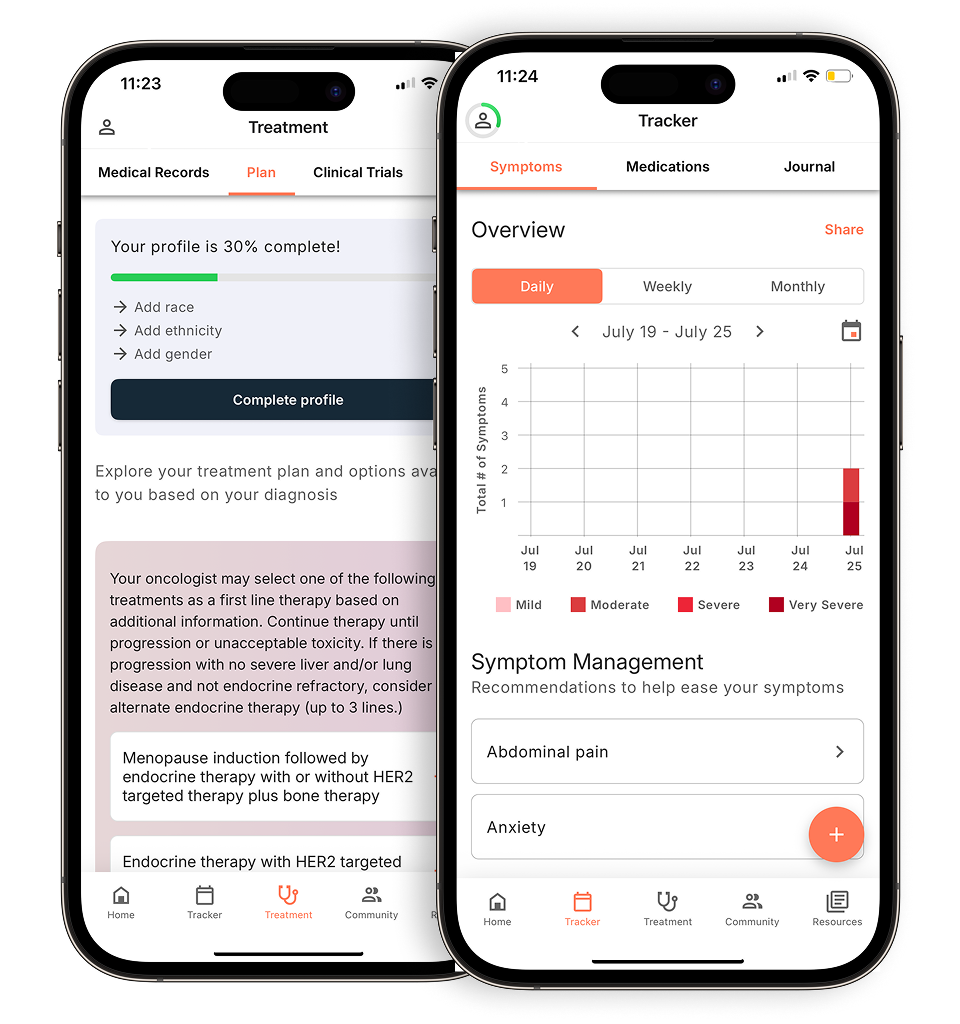
“Colon cancer is one of the few cancers where if you find it in one, two, or few places, as opposed to, let’s say, pancreas cancer or stomach cancer” a cure may remain possible, he explained. “You could argue that’s still a potentially curative situation, as long as it’s in one, two, a few places.”
He added that surgeons at major centers take on cases many people might assume are out of reach. “We operate on patients with few or even a dozen liver metastases. Even patients with lung metastases, or lymph node-only metastases,” he said.
That’s why finding a recurrence early can matter so much. “Finding cancer early so you can intervene early could still actually keep cure on the table,” he said.
ctDNA: an early warning system
Circulating tumor DNA (ctDNA) tests, a type of liquid biopsy, detect tiny fragments of tumor DNA in the blood. Dr. Kasi has studied these tests for years, and he sees them as an important tool for catching recurrence before it shows up on scans.
“It’s picking up cancer months before the scan picks it up,” he said. After curative treatment, ctDNA can answer a question that matters deeply to patients: “Today, is there cancer in my body or not?”
A positive ctDNA test after treatment means that their cancer is inevitably going to come back in a couple of years. By contrast, someone whose ctDNA is negative and stays negative has “over a 92% to 94% chance of being cancer-free at 2 years,” Dr. Kasi explained.
The test has limits. “Right now, when you get the blood test positive, it doesn’t tell you where the location is, so you’ve got to put things into clinical context and not jump to a conclusion,” Dr. Kasi said. When one of his patients tests positive after treatment, his approach is to order imaging. If a CT scan doesn’t find anything, he may add an MRI or PET scan “to get a better sense of where the cancer may be hiding.”
Cancer care guidance for every step of your journey
Get treatment options, clinical trials, and support tailored to your diagnosis--all in one place.
Get started
See treatment options, manage symptoms, and stay informed—all in the app
View treatment options and trials personalized to your diagnosis—plus track progress in real time.
Continue in appGuidelines on how to use ctDNA are still evolving, and he doesn’t view it as a replacement for standard care. Instead, he calls it “one additional lens, one additional tool” to support decision-making.
Biomarkers still matter in stage 4
Mismatch repair deficiency (dMMR), also called microsatellite instability-high (MSI-H), is less common in metastatic disease, but for those patients, it can be transformative.
Dr. Kasi said MSI-H was where he first began to hear the word cure in stage 4 colorectal cancer. “I was actually a little hesitant initially because I think I’m seeing cures,” he recalled. Then, as years of follow-up accumulated, experts began saying the same thing. “Even when they went for surgery, all the tumor was dead.”
That’s why MMR/MSI testing should be done for every colorectal cancer, at every stage.
New options for MMR-proficient tumors
Most metastatic colorectal cancers are mismatch repair proficient (pMMR), also called microsatellite stable (MSS). Standard immunotherapy hasn’t worked well for this group, but next-generation drugs are showing promise.
The combination of botensilimab and balstilimab, which Dr. Kasi is studying before surgery in early-stage colon cancer, was first tested in metastatic disease. There, he said, it showed “promise in a third of the patients with metastatic disease, stage 4 disease.”
He noted one striking difference between settings. In metastatic disease, “there’s no limit. It [can be] two years of ongoing therapy.” In his early-stage trials, by contrast, patients receive only a short course before surgery. That’s one reason he believes earlier treatment may hold so much potential.
Don’t wait until you’re out of options to ask about trials
Historically, new cancer drugs were tested mainly in people with stage 4 disease who had already tried other treatments. Dr. Kasi wants that to change. His work focuses on settings that people often don’t look at, including people who are ctDNA-positive after surgery.
The window between finishing treatment and seeing cancer on a scan is one of those settings. Dr. Kasi calls it molecular persistence or molecular recurrence. “There is this series of trials, a lot of them are vaccines, immunotherapies, novel targeted therapies,” he said. “All these are now options, and more will be available in the near future.”
His broader advice applies to every stage. “The best management of a patient at any step of the way lies in a clinical trial, because it gives you the opportunity of doing something that otherwise isn’t available,” he said.
The value of a second opinion
Dr. Kasi encourages anyone diagnosed with cancer to seek a second opinion. “It’s not about ego,” he said. “It’s about making sure that you do your due diligence, and there might be options that may or may not be present at all the institutions.”
A second opinion can also widen your access to trials, since each trial is only open at certain locations. “A second opinion is also about doubling your chances for access to trials as well,” he said.
Questions to ask your care team
- Has my tumor been tested for mismatch repair (MMR) or MSI status, along with other biomarkers?
- Is my cancer limited to a few spots, and could surgery or another local treatment be an option?
- Would a ctDNA test be helpful in my situation, now or after treatment?
- Are there clinical trials I qualify for, including trials outside my current center?
- Should I get a second opinion at a center that specializes in colorectal cancer?
Disclaimer: The information provided in this article is for informational purposes only and is not intended to be a substitute for professional medical advice, diagnosis, or treatment. Outcomes4Me is not acting as your caregiver, and any suggestions or guidance offered should not replace the advice of your healthcare provider or qualified medical professional. Always seek the guidance of your physician or other qualified health provider with any questions you may have regarding a medical condition.
Personalized support for real care decisions
Understand your diagnosis, explore clinical trials, and track symptoms--all in one place.
Get started
Compare treatments, prepare for appointments, and track side effects—all in the app
Built for your diagnosis, Outcomes4Me gives you the tools to make confident, informed decisions—right when you need them.
Continue in app