
Figuring out how to tell kids you have cancer may be one of the hardest conversations you’ll ever face, and the instinct to protect them by staying silent is completely understandable. But children are far more perceptive than most parents expect.
Secrecy doesn’t protect children. Without facts to hold onto, kids fill the silence with fear. Giving the experience a name, specifically the word “cancer”, is one of the most protective things you can do. Using the actual word prevents confusion and stops children from conflating a serious illness with a common cold or everyday ailment. Naming it makes it concrete, and concrete is less frightening than the unknown.
That clarity is the foundation of every productive conversation, regardless of your child’s age. A practical starting point is what experts often call the Three Cs:
- Cause, explain that nothing your child did caused this
- Catch, reassure them that cancer is not contagious
- Care, describe, simply, what treatment will look like
These three anchors address the fears children are most likely to carry silently. Learning about cancer treatment and its side effects can help you prepare for conversations with your kids about what to expect.
When is the best time to talk to your kids?
Timing this conversation thoughtfully, not perfectly, is a core principle of trauma-informed approach. The goal is to create the right conditions so you can speak calmly and clearly.
Children often pick up on stress and may feel excluded or anxious if they sense a secret, so don’t put it off too long. That said, a few practical markers can help you gauge when you’re ready:
- Your initial shock has settled. You don’t need all the answers, but you do need to be able to speak without breaking down completely. Give yourself a day or two after diagnosis to stabilize emotionally.
- A basic treatment plan is in place. Kids will ask “What happens next?” Having even a general outline, “I’ll be going to the hospital on Tuesdays for treatment”, gives them something concrete to hold onto.
- Physical changes haven’t started yet. Hair loss, surgical scars, or frequent hospitalizations can be frightening to witness without context. Telling kids before these changes begin means they’re prepared, not blindsided.
- The setting feels safe and unhurried. Choose a quiet, familiar space, the living room or the kitchen table, at a time when no one needs to rush off to school or an appointment.
These conditions work together. Getting each one in place, even roughly, sets up a conversation that informs rather than alarms. How you frame that conversation will also depend significantly on your child’s age, which is exactly what we’ll look at next.
Evidence-based guidance powered by NCCN Guidelines®
Personalized treatment plans shaped by the latest oncology standards—tailored to your diagnosis.
Get started
View your personalized treatment plan in the Outcomes4Me app
Use your diagnosis to unlock personalized NCCN Guidelines®-aligned recommendations.
Continue in app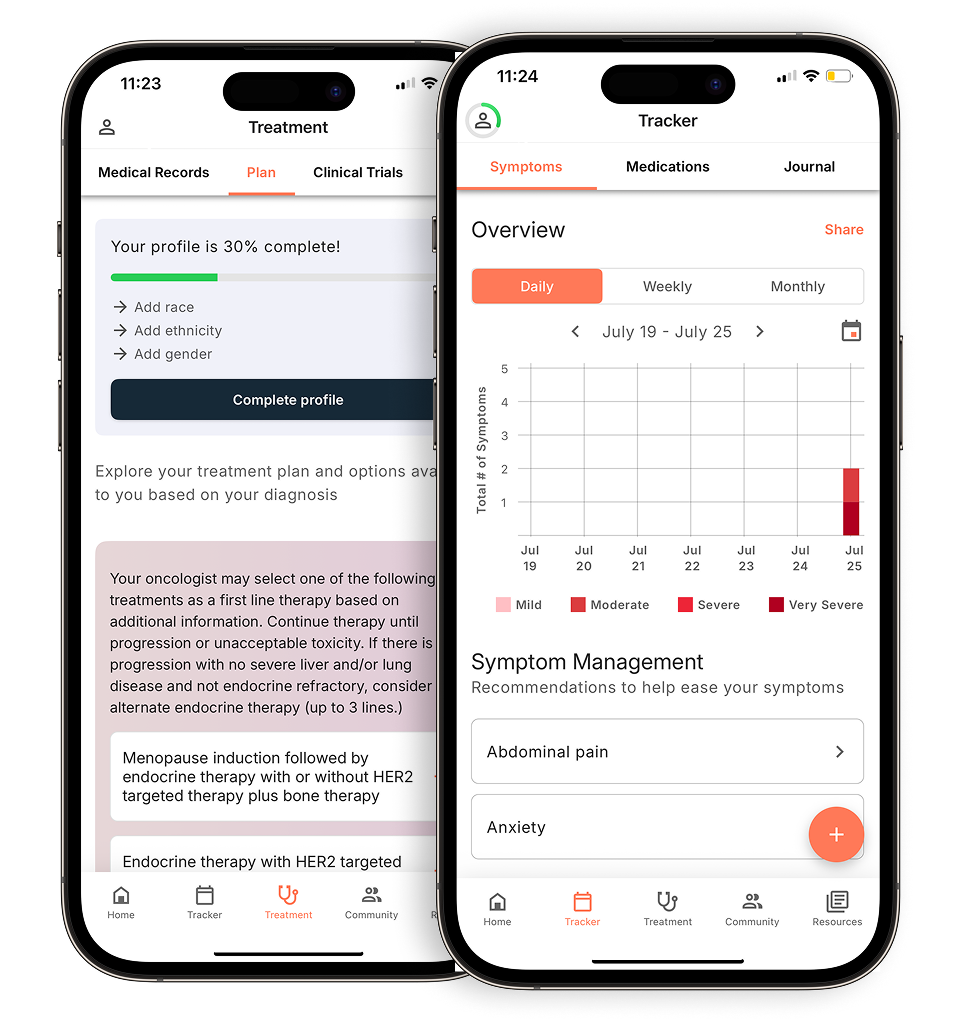
Ages 0–5: Focusing on routine and physicality
Young children experience the world through their senses, schedules, and the familiar faces around them, so keeping things simple and stable is the most protective thing you can do right now.
When it comes to figuring out when to talk to kids about cancer, toddlers and preschoolers present a unique challenge. Their understanding of illness, time, and cause-and-effect is still developing. For children ages 0–2, the focus should remain almost entirely on maintaining their daily routine and physical comfort. For slightly older children in the three-to-five range, a few honest, concrete words go a long way.
Key phrase to use: “Mommy has a boo-boo inside her body called cancer.”
That’s genuinely enough for many kids this age. You don’t need a medical explanation, you need language they can hold onto. Pair that with a practical statement about their world: “Daddy will pick you up from school instead of Mommy for a while.” Grounding the conversation in their daily schedule gives them something concrete when abstract concepts feel confusing.
A few specific behaviors and messages to keep in mind:
- Address contagion fears directly. Even young children may worry they’ll “catch” cancer like a cold. Cancer isn’t something they can get from a hug or a kiss.
- Expect repetitive questions. Kids this age process information by cycling back to it. If your child asks the same question 10 times, that’s normal, not a sign something’s wrong.
- Watch for play-acting. Don’t be alarmed if your child starts “playing cancer” with their toys. This is how young children make sense of difficult information on their own terms.
- Stick to routines wherever possible. Consistent mealtimes, bedtimes, and drop-off rituals communicate safety more powerfully than any words can.
As your child grows, these simple foundations become the building blocks for deeper conversations, which is exactly where school-age kids need a different approach entirely.
Ages 6–12: Explaining cause, effect, and treatment
School-age children are natural scientists, they want to understand why things happen, which makes explaining cancer to a child by age six through twelve both manageable and critically important to get right.
Children in this age group often secretly worry they caused the illness, through bad behavior, loud tantrums, or even a careless wish. Guilt prevention is one of the most important things you can do at this stage. Be explicit: “You did nothing to cause this. It’s not because you were messy or loud or anything you thought or said.” Say it plainly, and say it more than once.
Cancer care guidance for every step of your journey
Get treatment options, clinical trials, and support tailored to your diagnosis--all in one place.
Get started
See treatment options, manage symptoms, and stay informed—all in the app
View treatment options and trials personalized to your diagnosis—plus track progress in real time.
Continue in appWhen explaining the illness itself, match their developmental love of logic. Try something like: “Some cells in my body started growing the wrong way. Doctors are giving me strong medicine to stop them.” That framing, cause, problem, action, lands well with kids who are already learning how the world works in school.
Prepare them before they see changes. If fatigue or hair loss is likely, name it in advance: “I might lose my hair from the medicine, and it can grow back.” Surprises feel scary; forewarning feels like trust.
Finally, invite their questions, including the ones that came from a friend at recess or a video they stumbled across online. Children this age absorb information from many sources, and misinformation can take root quickly. Giving them a safe place to share what they’ve heard, without judgment, keeps you in the conversation.
As kids move into their teenage years, the dynamic shifts again. Adolescents need honesty at a different level entirely, one that respects their growing independence while still protecting them from carrying too much.
Ages 13–18: Respecting autonomy and complex emotions
Talking to teenagers about a cancer diagnosis demands a different approach, they’re capable of handling real information, and they’ll sense immediately if they’re being shielded from it.
Give them the full picture. Share the specific cancer type, its stage, and the planned treatment, whether that’s immunotherapy, radiation, or participation in a clinical trial. Teenagers process uncertainty worse than difficult facts, and vague reassurances tend to erode trust. Teenagers may react with anger or by pulling away; this is often a defense mechanism to protect their developing autonomy. Naming that reaction, “I get that you’re angry, and that’s completely okay,” can defuse it faster than any explanation.
Acknowledge what this disrupts for them. Teens are wired to be building independence, so the ripple effects of a parent’s illness feel especially personal. Saying something like, “I know this means I can’t drive you to practice, and I’m sorry for that,” validates their experience without minimizing yours. What typically happens when teens feel their needs are acknowledged is that they stay more engaged and less isolated.
Resist making them a caretaker. It can be tempting to lean on a mature teenager, but protecting their right to keep being a teenager is essential. Encourage them to keep up with school, friends, and activities, that stability is genuinely protective for their mental health.
No matter how well you prepare, some questions will still catch you off guard. The next section pulls together the five core rules that apply to every age and every conversation.
The bottom line: 5 rules for the conversation
Honest, age-appropriate conversations about cancer build trust, reduce anxiety, and help children feel like a valued part of the family, not a bystander to it. Many experts suggest that being honest with children during a family health crisis may help them feel more included and secure, rather than confused or scared by secrets.
Use the word “cancer.” Vague language like “a serious illness” or “something growing inside” creates space for worst-case imagination to fill in the gaps. Naming the disease gives children something concrete to process and reduces the long-term anxiety that uncertainty breeds.
Correct the guilt and the fear early. Children, especially younger ones, often assume they caused a parent’s illness or worry they might catch it. MD Anderson Cancer Center recommends explaining to children that nothing they did caused the cancer. The organization also suggests using the word “cancer” when talking with kids so they don’t confuse it with contagious illnesses like the flu or a cold.
Prepare them for physical changes. Hair loss, fatigue, and weight changes can be frightening to witness without warning. Explaining side effects before they happen gives children time to adjust emotionally rather than react in shock.
Protect routine wherever possible. Stability at school, with friends, and at home signals that life continues even when things are hard. Consistency is one of the most practical forms of reassurance a parent can offer.
It’s okay not to have every answer. Saying “I don’t know, but let’s find out together” models honesty without adding pressure. It keeps communication open for the many conversations still to come, because this isn’t a single talk, but an ongoing one.
Navigating the path forward together
Talking to your kids about cancer is an ongoing dialogue that evolves as your treatment progresses. There will be new questions, shifting emotions, and moments where you’ll need to revisit what you’ve already shared. That’s not a sign you did anything wrong. It’s simply how families process something this significant together.
The good news is that when you’re clear and consistent on the clinical side of your care, you free up more of your energy for the emotional side of parenting. Knowing your treatment options, understanding your eligibility for clinical trials, and having your records organized means you spend less time scrambling for answers and more time being present with your kids. That clarity matters, for you and for them.
The platform draws on evidence-based treatment guidelines that many oncologists use to help organize information about your diagnosis. You may find it helpful as one resource to discuss with your care team.
Download the Outcomes4Me app today and take one concrete step toward managing your care with confidence, so you can show up fully for the people who need you most.
Personalized support for real care decisions
Understand your diagnosis, explore clinical trials, and track symptoms--all in one place.
Get started
Compare treatments, prepare for appointments, and track side effects—all in the app
Built for your diagnosis, Outcomes4Me gives you the tools to make confident, informed decisions—right when you need them.
Continue in app