
The number you found in a search result is already out of date. That’s the honest starting point for anyone trying to understand stage 4 uterine cancer life expectancy right now.
Stage 4 endometrial cancer means the disease has moved beyond the uterus into the bladder or bowel wall, or spread to distant sites such as the lungs, liver, bone, or distant lymph nodes. That’s what metastatic endometrial cancer describes clinically, not how fast it’s growing, but how far it has traveled.
Population survival rates describe cohorts treated years ago. Your prognosis depends on tumor biology. Molecular sub-typing, POLE-ultramutated, mismatch repair deficient (dMMR/MSI-H), p53-abnormal, and no specific molecular profile, now sorts patients into groups with genuinely different outlooks, and that sorting has reshaped what advanced endometrial cancer life expectancy means.
Factors influencing survival and outlook
Grade 1 and 2 endometrioid tumors behave differently than serous or clear cell carcinomas, which are more aggressive at any stage. Performance status and age shape what treatment a body can tolerate, a fit patient at 70 may have more options than a frail patient at 55. Biomarkers determine whether targeted agents work at all.
The shift in treatment paradigms
Treatment of endometrial cancer has moved away from giving every advanced patient the same chemotherapy backbone. Molecular testing now happens up front in treatment of endometrial cancer, and immunotherapy enters the conversation in the first-line setting rather than after chemotherapy fails.
Grade 1 endometrial cancer involves well-differentiated tumor cells that closely resemble normal endometrium. Because early-stage endometrial cancer often causes vaginal bleeding, many cases may be detected before they advance to stage 4, though grade alone does not determine when a cancer will be found.
Innovations in treatment. Immunotherapy and targeted agents
Checkpoint inhibitors changed the arithmetic. Pembrolizumab and dostarlimab work by releasing the brakes immune cells put on themselves, letting T cells recognize and attack tumor tissue. In mismatch repair deficient tumors, which carry a heavy mutational load, checkpoint inhibitor recognition can be dramatic and lasting.
Evidence-based guidance powered by NCCN Guidelines®
Personalized treatment plans shaped by the latest oncology standards—tailored to your diagnosis.
Get started
View your personalized treatment plan in the Outcomes4Me app
Use your diagnosis to unlock personalized NCCN Guidelines®-aligned recommendations.
Continue in app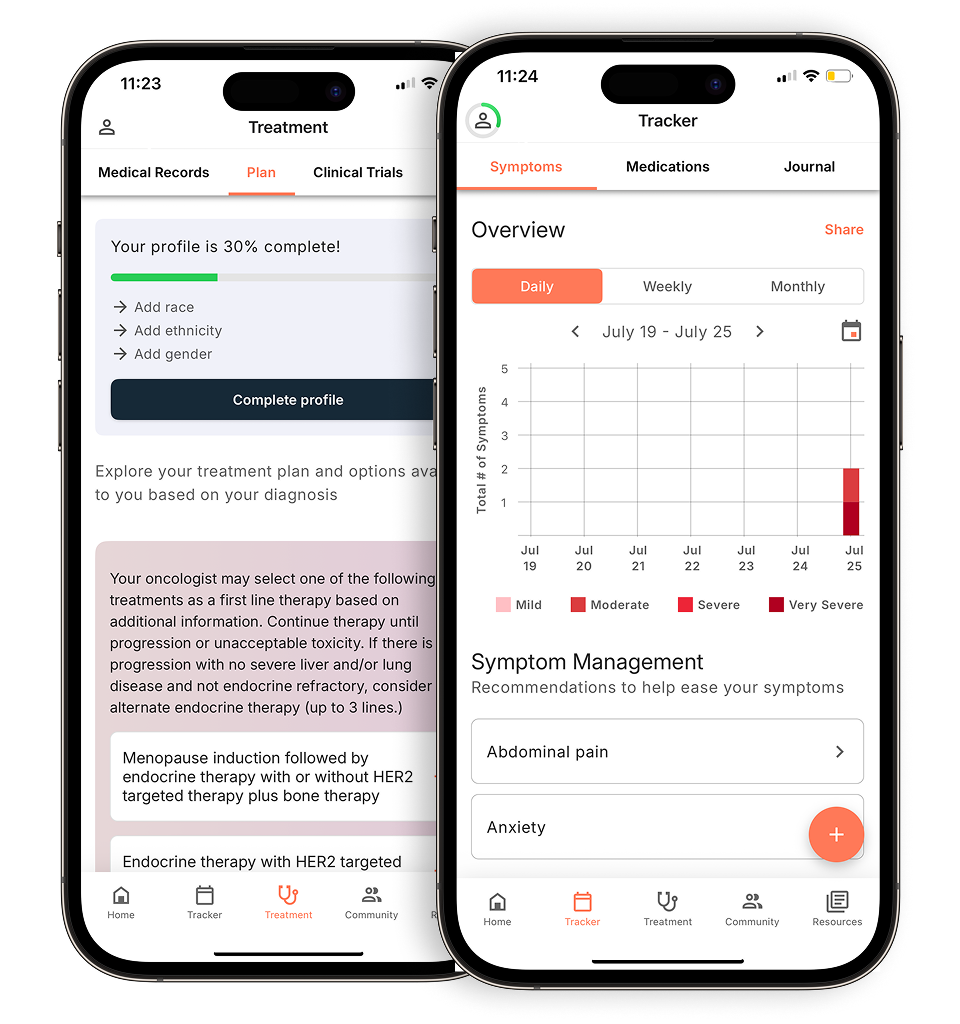
Antibody-drug conjugates are a type of targeted therapy that researchers are studying as a possible treatment option for recurrent endometrial cancer. Your care team can discuss whether this approach might be suitable for your situation. PARP inhibitors are being studied as a targeted therapy option for endometrial cancers that have specific DNA repair defects, as they may work by exploiting vulnerabilities in cancer cells’ repair mechanisms.
Clinical trials remain the main doorway to agents not yet broadly approved. Asking about trial eligibility at diagnosis, not at progression, keeps more doors open.
Immunotherapy success patterns
Patients with dMMR tumors sometimes achieve responses that persist long after treatment stops, which is the defining feature of immunotherapy and the reason survival curves for this group look different. For mismatch repair proficient tumors, pairing a checkpoint inhibitor with a tyrosine kinase inhibitor can extend progression-free survival by attacking both the immune evasion and the blood supply the tumor depends on.
Targeted therapy and hormonal approaches
Hormonal therapy, progestins, aromatase inhibitors, still has a place in low-grade, hormone receptor-positive metastatic disease where the goal is control with minimal toxicity. HER2-directed treatment has become relevant for serous carcinomas that overexpress HER2, a sub-type that historically had few options.
Side effect management isn’t secondary here. A regimen only extends life if a patient can stay on it.
Managing symptoms and quality of life in advanced stages
Postmenopausal bleeding remains the most common presenting sign of endometrial cancer, and any bleeding after menopause warrants evaluation. Metastatic endometrial cancer may cause a range of symptoms depending on where the cancer has spread, which can include pelvic pain, bloating, changes in bowel or bladder habits, shortness of breath if the lungs are affected, and bone pain if the cancer involves the skeleton. If you experience any of these symptoms, discuss them with your care team.
Monitoring for progression relies on cross-sectional imaging. Ultrasound can flag an abnormal endometrium but can’t map distant disease.
Cancer care guidance for every step of your journey
Get treatment options, clinical trials, and support tailored to your diagnosis--all in one place.
Get started
See treatment options, manage symptoms, and stay informed—all in the app
View treatment options and trials personalized to your diagnosis—plus track progress in real time.
Continue in appSupportive care, controlling nausea, pain, neuropathy, and fatigue, isn’t a consolation prize. Patients who stay comfortable stay on treatment, and staying on treatment is what produces the benefit the drug was designed for.
A stage 4 diagnosis brings emotional challenges that deserve the same attention as the cancer. Social work, psycho-oncology, and peer support belong on the care team from the start.
Diagnostic monitoring and ultrasound limitations
CT scans and PET scans may be used to help determine the stage of endometrial cancer. Transvaginal ultrasound can be used to measure endometrial thickness and evaluate the uterus for abnormalities, while a biopsy is needed to confirm whether cancer cells are present. During active immunotherapy, your care team may repeat scans at regular intervals to monitor how you’re responding to treatment and to watch for patterns that can sometimes occur early in immunotherapy.
Supportive and palliative care integration
Supportive care can help manage symptoms and improve quality of life whether you are receiving active cancer treatment or not. Hospice care is an option for people with advanced cancer who are expected to live less than 6 months and prefer to focus on comfort rather than continued treatment. Bone metastases may be treated with radiation and bone-modifying agents. Your care team can discuss whether these approaches might be appropriate for your situation. Visceral pain may need escalating systemic analgesia. Nutrition counseling and physical therapy address the fatigue and deconditioning that accumulate across months of therapy.
Limitations, considerations, and trade-offs in prognosis
Every published survival figure describes patients treated before the current regimens existed. That’s the central limitation of any stage 4 endometrial cancer prognosis discussion, the data trails the medicine.
Trial participation carries trade-offs. Access to agents not otherwise available, balanced against randomization, extra visits, and unknown toxicity. Standard of care offers predictability.
Financial toxicity is real. Novel targeted agents and genomic profiling can carry significant out-of-pocket costs, and coverage varies by plan and geography.
And “remission” needs defining. In metastatic disease, long periods of stable or undetectable disease are achievable, but stage 4 endometrial cancer treatment may include surgery, chemotherapy, radiation therapy, hormone therapy, targeted therapy, and immunotherapy, depending on how far the cancer has spread and individual patient factors. Some patients live years with disease that simply isn’t growing.
Understanding statistical lag
A five-year survival figure published today describes people diagnosed roughly five years ago, treated with the protocols of that era. Averages compress enormous variation into one number. Within every survival category there are patients who do far better than the median, and tumor biology, not the statistic, explains why.
Barriers to precision medicine
Comprehensive genomic profiling isn’t equally available everywhere, rural and under-resourced centers may not offer it routinely. Insurance coverage for off-label use of newer agents can require appeals. A second opinion from a gynecologic oncologist can be helpful in confirming your cancer grade and discussing treatment options, particularly when considering fertility-sparing approaches.
Key takeaways: Navigating stage 4 endometrial cancer
- POLE status, mismatch repair status, and p53 abnormality matter more to your outlook than the stage number alone. Request comprehensive testing on your initial specimen.
- Immunotherapy and antibody-drug conjugates have changed the outlook for metastatic disease, particularly for dMMR tumors where responses can be durable.
- Your numbers are not the population’s numbers. Ask your oncologist what your specific biomarkers mean for your treatment sequence, not what the average patient experiences.
- Supportive care belongs at the start. Symptom control keeps patients on effective therapy and protects quality of life.
- Clinical trials are a primary route to agents that aren’t yet standard. Ask about eligibility at diagnosis.
Disclaimer: The information provided in this article is for informational purposes only and is not intended to be a substitute for professional medical advice, diagnosis, or treatment. Outcomes4Me is not acting as your caregiver, and any suggestions or guidance offered should not replace the advice of your healthcare provider or qualified medical professional. Always seek the guidance of your physician or other qualified health provider with any questions you may have regarding a medical condition.
Personalized support for real care decisions
Understand your diagnosis, explore clinical trials, and track symptoms--all in one place.
Get started
Compare treatments, prepare for appointments, and track side effects—all in the app
Built for your diagnosis, Outcomes4Me gives you the tools to make confident, informed decisions—right when you need them.
Continue in app