
Beyond the diagnosis: why your NSCLC subtype matters
A lung cancer diagnosis is never just one disease — and understanding that distinction could be the most important step you take toward personalized treatment.
Non-small cell lung cancer (NSCLC) is the most common type of lung cancer, and understanding your pathology report is key to creating a personalized treatment plan. But “lung cancer” is an umbrella term. Beneath it sit several distinct non-small cell lung cancer types — each with its own biology, behavior, and treatment implications. What looks like the same diagnosis on the surface can require a very different clinical approach depending on the specific subtype involved.
Your subtype is what drives your initial treatment strategy. Oncologists don’t treat NSCLC as a single condition — they treat the specific disease variant you have. That’s why your pathology report isn’t just medical paperwork. It’s a clinical blueprint. It identifies the cell type driving your cancer, which directly shapes whether you’ll be considered for targeted therapy, immunotherapy, chemotherapy, or a combination of approaches.
Stage also plays a role here. Patients and families often ask about staging distinctions — for example, what is the difference between stage 3a and 3b lung cancer — because stage and subtype together inform how aggressively a treatment plan is designed. Understanding both gives you a fuller picture of where you stand.
Your pathology report puts that knowledge in your hands. Knowing how to interpret it — and what questions to ask your care team — is a form of empowerment that can shape your care. The first step is understanding exactly which subtype you’re dealing with, and what sets each one apart.
Adenocarcinoma vs. squamous cell: decoding the main types
Not all NSCLC tumors are built the same — and knowing what adenocarcinoma means for your specific diagnosis is the first step toward understanding your treatment options.
Adenocarcinoma is the most common type of lung cancer in the United States, and it is a type of non-small cell lung cancer (NSCLC) where the cells look like gland cells that secrete mucus in the lungs. Because of where it grows, it’s often caught incidentally on imaging before symptoms appear.
Squamous cell carcinoma, by contrast, typically originates near the bronchi — the large airways closer to the center of the chest. It has a strong association with smoking history and tends to behave differently at the molecular level, which directly affects which treatments are likely to work.
Large cell carcinoma is less common but notably aggressive. It can arise anywhere in the lung, grows quickly, and doesn’t share the defining features of the other subtypes — making it harder to categorize and, in some cases, harder to treat.
It’s also worth knowing that “mixed” tumors exist — where more than one cell type is present. In practice, your treatment plan typically follows the dominant cell type identified by your pathologist. If you’re unsure which subtype your report describes, this is worth asking your care team to clarify directly.
Evidence-based guidance powered by NCCN Guidelines®
Personalized treatment plans shaped by the latest oncology standards—tailored to your diagnosis.
Get started
View your personalized treatment plan in the Outcomes4Me app
Use your diagnosis to unlock personalized NCCN Guidelines®-aligned recommendations.
Continue in app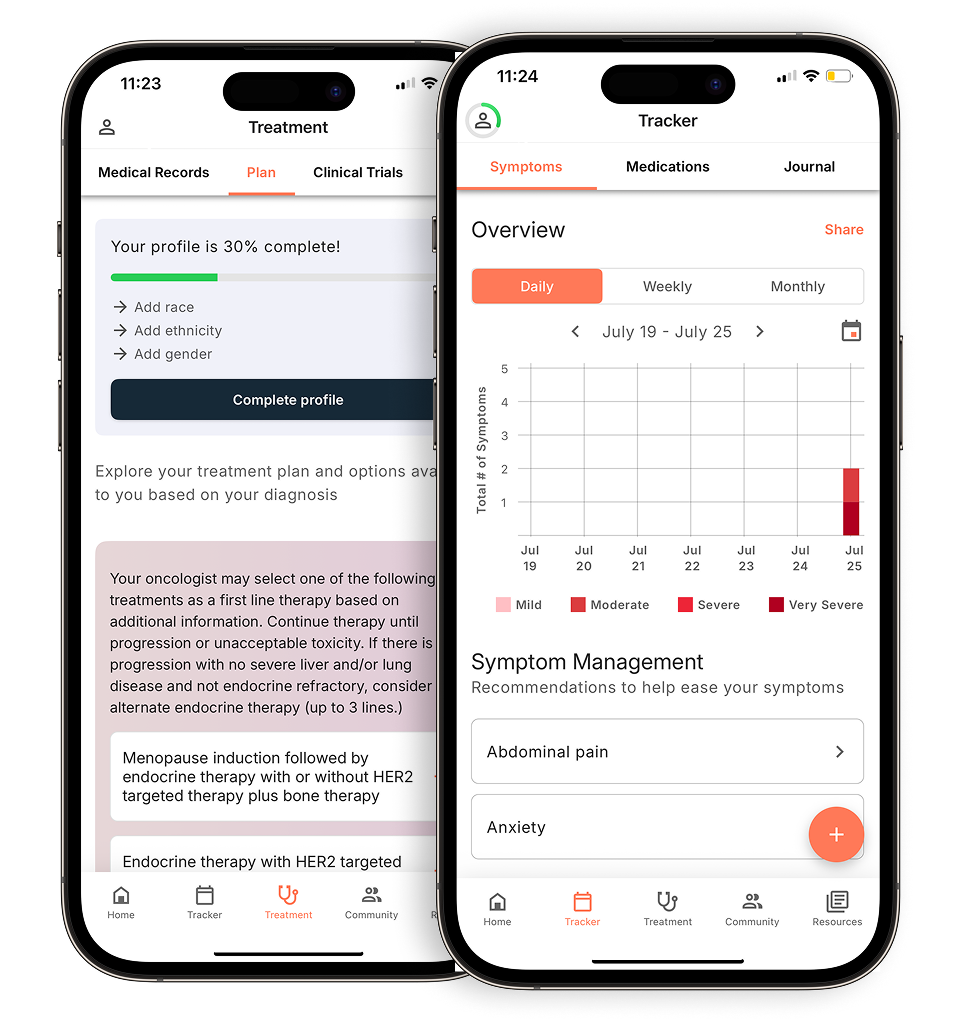
The subtype named in your report is your starting point — but it’s not the whole picture. The next layer of detail comes from the genetic and molecular characteristics of your specific tumor, which can open doors to highly targeted therapies.
Biomarkers: the genetic ‘lock and key’ of your tumor
Biomarkers are the genetic mutations and proteins found inside your tumor cells — and they’re arguably the most critical information your pathology report can contain. As one patient advocacy resource puts it, biomarkers are like the ‘lock’ and targeted therapy is the ‘key’ that can shut down cancer growth. That single analogy captures why this section of your report deserves your full attention.
Your tumor’s mutations determine which treatments can actually work for you. For NSCLC patients, certain genetic alterations open the door to highly effective oral targeted therapies. Key mutations to look for include:
- EGFR — EGFR mutations in adenocarcinoma can be targeted with several FDA-approved drugs, including options for specific EGFR variants like ex20 insertions or duplications
- ALK — ALK-positive NSCLC is a distinct molecular subset associated with distinctive disease presentations and prolonged survival in patients, making pathology testing for ALK status an important part of personalized treatment planning
- ROS1 — less common but similarly targetable with specific oral medications
- KRAS G12C — a historically “undruggable” mutation that now has approved targeted options
It’s worth noting that while these mutations appear more often in adenocarcinoma, comprehensive biomarker testing is recommended for every NSCLC patient — including those with squamous cell lung carcinoma.
PD-L1 expression levels are the other results you need. This protein measurement determines whether immunotherapy — such as pembrolizumab (Keytruda) — may be a viable option for you. Higher PD-L1 expression generally correlates with a stronger response, though the relationship isn’t absolute, according to published biomarker research.
If your report doesn’t include these markers, ask your care team specifically for Comprehensive Biomarker Testing or biomarker testing that can look for multiple mutations and other changes in the DNA, RNA, and proteins of your tumor cells to help guide your treatment options. This testing can examine dozens of mutations simultaneously — a critical advantage given how much treatment eligibility depends on these results. Once you have your biomarker profile in hand, the next piece of the puzzle is understanding your stage — which tells your team how far the disease has spread.
Understanding staging: from localized to metastatic
Staging is the single framework that translates tumor biology into a treatment goal — and your pathology report is where that framework begins.
The TNM system — Tumor size, Node involvement, and Metastasis spread — is the universal language oncologists use to describe how far NSCLC has progressed. “T” describes the primary tumor’s size and local reach. “N” captures whether nearby lymph nodes are involved. “M” confirms whether cancer has spread to distant organs. Together, these three factors produce a stage from I to IV, and that stage largely determines what your care team is trying to achieve.
Stages I and II represent localized disease. The tumor hasn’t spread significantly beyond the lung, and surgery — often followed by targeted therapy or radiation — is frequently the primary approach. Outcomes at these stages tend to be more favorable because the cancer remains contained.
Cancer care guidance for every step of your journey
Get treatment options, clinical trials, and support tailored to your diagnosis--all in one place.
Get started
See treatment options, manage symptoms, and stay informed—all in the app
View treatment options and trials personalized to your diagnosis—plus track progress in real time.
Continue in appStage III is where things become more nuanced. It’s broadly labeled “locally advanced,” but the distinction between 3A and 3B matters enormously. Treatment approaches for NSCLC vary based on the tumor stage and other patient factors, with clinical stage III disease requiring consultation among multiple specialists including medical oncology, radiation oncology, and thoracic surgery to determine the optimal combined treatment approach. That difference of a few centimeters and one lymph node cluster can redirect an entire treatment plan.
Stage IV means the cancer has metastasized — spread to the other lung, fluid around the heart, or distant organs like the brain or liver. At this point, the goal shifts from cure to systemic control, and biomarker results become the most critical variable. An EGFR mutation lung cancer diagnosis opens the door to targeted oral therapies that can be far more effective and better tolerated than traditional chemotherapy. You can explore locally advanced and metastatic treatment options in more detail to understand how staging and biomarkers intersect in practice.
Staging defines the “where.” But there’s another layer of the pathology report — one that speaks to the tumor’s behavior and aggressiveness — that’s equally important for shaping your treatment plan.
Reading between the lines: margins, grade, and LVI
Your pathology report contains more than subtype and biomarker data — several additional findings directly shape your recurrence risk and next treatment steps.
These secondary details are easy to overlook, but they carry real clinical weight.
- Histologic grade describes how closely the cancer cells resemble normal lung cells. Well-differentiated (low grade) cells look nearly normal and tend to grow more slowly. Your pathology report’s grade (how differentiated or abnormal your cells appear) is an independent predictor of recurrence risk — patients with poorly differentiated tumors have significantly worse disease-free survival.
- Surgical margins tell you whether the surgeon removed all visible cancer. When an entire tumor is removed during surgery, a pathologist may coat the outer edges of the tissue with ink and examine them under the microscope to determine if cancer cells are present at the margins, which is known as a positive margin and may indicate that some cancer has been left behind.
- Lymphovascular invasion (LVI) indicates whether cancer cells have entered nearby lymph or blood vessels — essentially, whether the disease has started moving through the body’s internal transport system. LVI-positive findings can influence both staging conversations and decisions about adjuvant chemotherapy.
- Visceral pleural invasion notes whether the tumor has broken through the lung’s outer lining. This finding can push a tumor into a higher stage and affect prognosis.
These details sit alongside biomarker findings like PD-L1 expression levels to give your oncologist a complete picture of your tumor’s behavior. Knowing how to interpret each term — and what questions to ask — puts you in a much stronger position at your next appointment.
The bottom line: 5 questions for your oncologist
Your pathology report only delivers its full value when you know which questions to bring to your next appointment. You and your doctor should discuss whether comprehensive biomarker testing is right for you, as this testing is usually necessary for your doctor to provide personalized treatment recommendations for NSCLC — and that means walking in prepared.
These five questions cut through the complexity and get you the answers that matter most:
- Confirm your subtype. Ask your oncologist directly: “Is my cancer adenocarcinoma, squamous cell carcinoma, or another subtype?” The answer changes everything about which treatments are even on the table.
- Demand comprehensive biomarker testing results. Ask: “Have I had comprehensive biomarker testing for EGFR, ALK, ROS1, and other actionable mutations?” If testing is still pending or was never ordered, ask your team about speeding up tissue testing — delays can push back your entire treatment plan.
- Get your PD-L1 percentage. Ask: “What is my PD-L1 expression level?” Whether it’s below 1%, between 1–49%, or 50% and above determines your immunotherapy eligibility and whether you’ll need chemotherapy alongside it.
- Clarify your exact stage. Stage III isn’t a single category. Ask: “Is my Stage III classified as 3A, 3B, or 3C?” That distinction shapes whether surgery, concurrent chemoradiation, or another approach is your primary path.
- Ask about clinical trials for your specific biomarkers. If you carry ROS1 positive lung cancer or another targetable alteration, trials may offer more precise options than standard chemotherapy. Ask: “Based on my biomarker profile, are there active trials I should consider?”
Knowing your subtype, biomarkers, PD-L1 score, and exact stage isn’t optional — it’s the foundation of a treatment plan built specifically for you. The next step is finding a platform that helps you organize all of this information and act on it.
Taking control of your care with Outcomes4Me
Your NSCLC pathology report is dense, technical, and easy to feel overwhelmed by — but it’s also the most precise map available to your personalized treatment path. Every biomarker result, margin notation, and grade contributes to a clearer picture of which therapies are most likely to work for you. When you understand what that report is saying, you’re better positioned to have more productive conversations with your care team and advocate for options that match your specific disease profile. That matters because The NSCLC survival rate by stage varies significantly — and catching actionable mutations early, then acting on them, can meaningfully shift the outlook.
Outcomes4Me is the only direct-to-patient digital platform integrated with National Comprehensive Cancer Network® (NCCN®) treatment guidelines, using AI to translate oncologist-level clinical evidence into language you can actually use. Rather than leaving you to parse complex guidelines on your own, Outcomes4Me does that work for you — surfacing personalized treatment options based on your exact diagnosis, subtype, and biomarker profile.
Disclaimer: The information provided in this article is for informational purposes only and is not intended to be a substitute for professional medical advice, diagnosis, or treatment. Outcomes4Me is not acting as your caregiver, and any suggestions or guidance offered should not replace the advice of your healthcare provider or qualified medical professional. Always seek the guidance of your physician or other qualified health provider with any questions you may have regarding a medical condition.
Personalized support for real care decisions
Understand your diagnosis, explore clinical trials, and track symptoms--all in one place.
Get started
Compare treatments, prepare for appointments, and track side effects—all in the app
Built for your diagnosis, Outcomes4Me gives you the tools to make confident, informed decisions—right when you need them.
Continue in app