The 28-session strategy. Why this specific schedule matters
The 28-session radiation schedule for prostate cancer delivers higher daily doses than traditional long-course treatment, with fewer side effects than conventional approaches and stronger evidence behind it than ultra-short regimens.
Moderate hypofractionation means delivering a higher radiation dose per session than the older standard, but spread across a moderate number of treatments rather than compressed into just a handful. The traditional course ran 40 or more sessions over roughly eight weeks, using smaller daily doses. At the opposite end sits stereotactic body radiation therapy (SBRT), which completes treatment in approximately five sessions.
The goal for each is to calibrate each daily dose to destroy cancer cells effectively while protecting the surrounding rectum and bladder from cumulative radiation damage. Your care team will develop a personalized radiation therapy plan based on mapping scans of your prostate, and they may recommend different treatment schedules depending on your individual circumstances. Moderate hypofractionation (20–28 treatments over 4–6 weeks) is considered the current standard of care for many patients with localized prostate cancer, though your doctor can help determine which option is best for you.
Mapping your 6-week commitment
This moderate hypofractionation prostate cancer protocol follows a structured, predictable schedule of 5.5 to 6 weeks, designed so you can plan your life around it without putting it on hold.
Treatment week rhythm: The schedule typically involves 28 fractions delivered once per day, five days a week, for approximately six weeks. That means Monday through Friday appointments, with weekends off. Those two days give healthy surrounding tissue time to recover between doses, which is a core reason the protocol maintains its strong safety profile.
Week 0: the simulation. Before a single dose of radiation is delivered, you’ll complete a dedicated planning session known as the simulation. This is where your care team maps the exact geometry of your prostate using imaging, and places small gold markers called fiducial markers inside the gland. These markers act as internal GPS points, allowing the team to confirm precise positioning at every subsequent session. Many patients also receive SpaceOAR gel during this phase, a hydrogel spacer injected between the prostate and rectum to create a small buffer zone that protects rectal tissue from radiation exposure. The simulation visit is foundational, everything that follows depends on the accuracy established here.
Evidence-based guidance powered by NCCN Guidelines®
Personalized treatment plans shaped by the latest oncology standards—tailored to your diagnosis.
Get started
View your personalized treatment plan in the Outcomes4Me app
Use your diagnosis to unlock personalized NCCN Guidelines®-aligned recommendations.
Continue in app
Since treatment plans are shaped by clinical evidence, it’s worth knowing that national guidelines consider moderate hypofractionation (20–28 treatments) to be the current standard of care for many patients with localized prostate cancer. Once Week 0 is complete, the daily rhythm of your treatment weeks begins, and what actually happens inside that 30-minute appointment window is worth understanding in detail.
What happens during those 30 minutes
For prostate cancer external beam radiation, the actual treatment beam time is much shorter than most patients expect, which can make the whole process feel far less daunting.
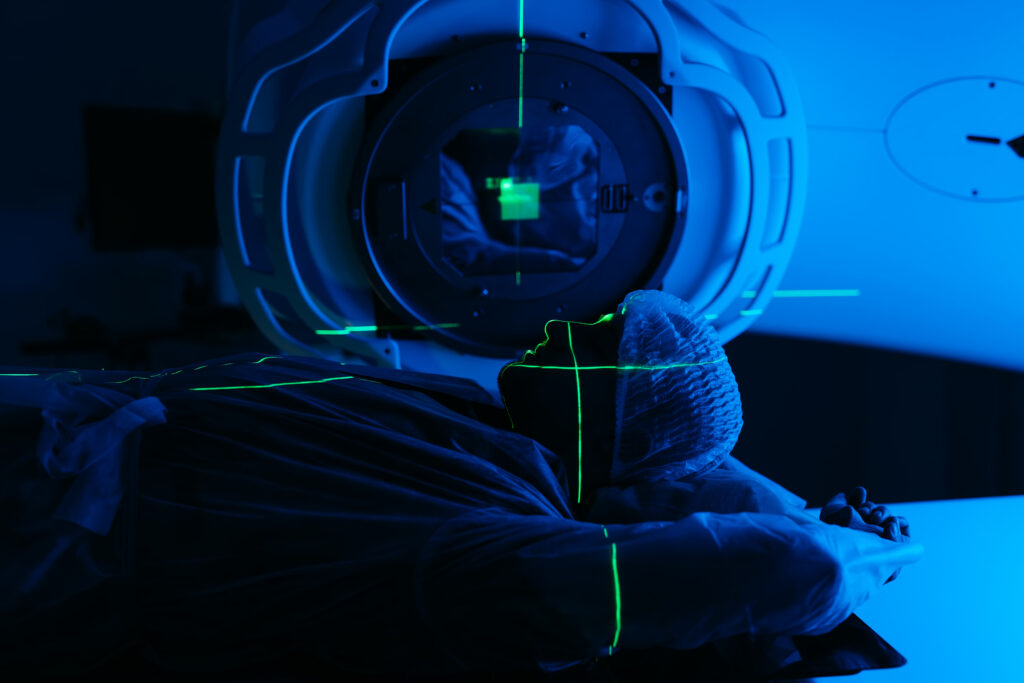
The appointment itself typically runs 20 to 30 minutes from check-in to completion, but that time divides unevenly. You’ll spend roughly 5 to 10 minutes on prep, changing into a gown, reviewing any instructions from your care team, and settling onto the treatment table. Positioning then takes another 10 minutes or so, and this is where the precision work really begins.
Positioning is the most time-consuming element of the visit for a deliberate reason. Every session, technicians use onboard imaging, essentially a mini-CT scan built directly into the machine, to compare your anatomy against the reference images captured during your initial simulation scan. Any small shift in how you’re lying is corrected before the beam ever activates. That level of daily verification is what allows clinicians to deliver higher doses with confidence, protecting the healthy tissue surrounding the prostate.
The radiation itself is painless and completely invisible. You won’t feel heat, pressure, or any sensation when the beam is active. And that active window is remarkably brief, the beam is only on for 2 to 5 minutes out of the entire 20-to-30-minute appointment. Most of what you experience as “treatment time” is actually careful setup, not radiation delivery.
That consistency in anatomy, session to session and week to week, is as important as the radiation itself. Which is exactly why your care team will give you very specific preparation instructions before each visit.
The ‘full bladder, empty rectum’ rule
Consistent pelvic anatomy is one of the most important, and most patient-controlled, variables in daily radiation for prostate cancer.
Each session must target the same tissue with precision. But soft-tissue organs shift. The bladder and rectum can move the prostate by several millimeters depending on how full they are, which is why your care team will give you very specific prep instructions before every appointment.
The two core requirements work together to keep your anatomy stable:
Cancer care guidance for every step of your journey
Get treatment options, clinical trials, and support tailored to your diagnosis--all in one place.
Get started
See treatment options, manage symptoms, and stay informed—all in the app
View treatment options and trials personalized to your diagnosis—plus track progress in real time.
Continue in app- Full bladder: A full bladder helps position your organs during treatment and protects nearby healthy tissue from radiation. A full bladder during radiation treatment helps push your small intestine out of the treatment area to help keep side effects from starting or getting worse.
- Empty rectum: An empty rectum helps keep your prostate in the same position between treatment sessions, which allows your radiation team to target it accurately and protect nearby healthy tissue.
Dietary consistency supports the empty-rectum requirement just as much as timing does. Gas-producing foods like beans, cruciferous vegetables, and carbonated drinks can cause bloating and unpredictable rectal filling. A low-gas diet during your treatment weeks helps keep your pelvic anatomy as consistent session to session as possible.
And while these instructions may feel like small logistical details, they directly affect treatment accuracy. Skipping preparation or eating something that causes bloating on a given day can create variability that compounds over 28 sessions. That’s why your care team will reinforce these habits at each visit, not to be repetitive, but because the cumulative effect of consistent prep is significant. Speaking of cumulative effects, what actually happens inside your body as those sessions stack up is worth understanding in detail.
Understanding the cumulative effect. Sessions 1 to 28
Urinary side effects from prostate cancer radiation, such as frequent urination or blood in the urine, typically begin within 2 to 3 weeks of starting treatment and generally resolve within three months after finishing radiation.
Early sessions (1–10): Most patients feel little to nothing during the first two weeks. The body absorbs each dose without an immediate, noticeable response, which can be reassuring, but also misleading. Radiation is working at the cellular level throughout this window, even when symptoms haven’t surfaced yet.
Mid-to-late sessions (15–28): Some patients may experience fatigue, urinary urgency, and increased urinary frequency as radiation treatment progresses, particularly during the later sessions. What started as a manageable routine in week one may feel notably more demanding by weeks five and six. That’s a predictable biological response to a sustained course of treatment.
What many patients don’t expect is that side effects don’t simply stop when treatment ends. Radiation continues affecting cells for days after the final session, and side effects often peak around 7–10 days after treatment before the body begins to recover. This post-treatment peak catches many patients off guard, especially those expecting immediate relief the moment they leave the treatment center.
Understanding this arc, early calm, mid-course buildup, and a brief post-treatment peak, gives you a realistic framework for what to expect. It also reinforces why consistent preparation, including the bladder and bowel protocols covered earlier, protects long-term tissue health across all 28 sessions. The following section brings these threads together into a clear bottom line for anyone weighing this treatment schedule.
What you need to know: the bottom line
The 28-session moderate hypofractionation schedule represents a carefully calibrated balance. Efficient enough to fit into your life and rigorous enough to deliver lasting results.
As this article has outlined, the details matter at every step. Here’s what to carry forward:
- Time commitment is real but manageable. Each session runs Monday through Friday for roughly six weeks. The actual beam delivery takes fewer than five minutes, but expect to spend 20 or more minutes on-site once preparation and positioning are factored in. Planning your schedule around that window, not just the beam time, makes the commitment easier to sustain.
- Prep protocol is your most powerful lever. Strict bladder and bowel preparation before each session is the single most patient-controlled variable in minimizing long-term side effects. Consistency here protects healthy tissue session after session, and its importance compounds across all 28 fractions.
- Shorter schedules don’t always produce better outcomes. Clinical evidence supports that the 28-session moderate schedule maintains high cure rates with low toxicity for intermediate-risk patients, but whether it’s the right fit over shorter or longer alternatives depends on your genetic risk profile, tumor characteristics, and overall health picture.
- Personalized data drives the decision. Your care team weighs a combination of factors, including Gleason score, PSA levels, and imaging, to determine whether the 28-session path is genuinely superior for you, or whether another protocol better matches your specific biology.
Understanding these fundamentals puts you in a stronger position to have an informed conversation with your care team about which radiation schedule may be best for your individual situation.
Disclaimer: The information provided in this article is for informational purposes only and is not intended to be a substitute for professional medical advice, diagnosis, or treatment. Outcomes4Me is not acting as your caregiver, and any suggestions or guidance offered should not replace the advice of your healthcare provider or qualified medical professional. Always seek the guidance of your physician or other qualified health provider with any questions you may have regarding a medical condition.
Personalized support for real care decisions
Understand your diagnosis, explore clinical trials, and track symptoms--all in one place.
Get started
Compare treatments, prepare for appointments, and track side effects—all in the app
Built for your diagnosis, Outcomes4Me gives you the tools to make confident, informed decisions—right when you need them.
Continue in app