Funding for the Lung Health Hub is provided by AstraZeneca. All content is developed independently by Outcomes4Me; AstraZeneca has no influence on the content of the site.
If you’ve ever had a chest X-ray or CT scan, you might have heard the term “lung nodule.” These small spots in the lungs can have many causes, and knowing the basics about lung nodules is an important first step in managing your lung health. In this module, you’ll learn what causes lung nodules, the different types of nodules, and symptoms.
What causes lung nodules?
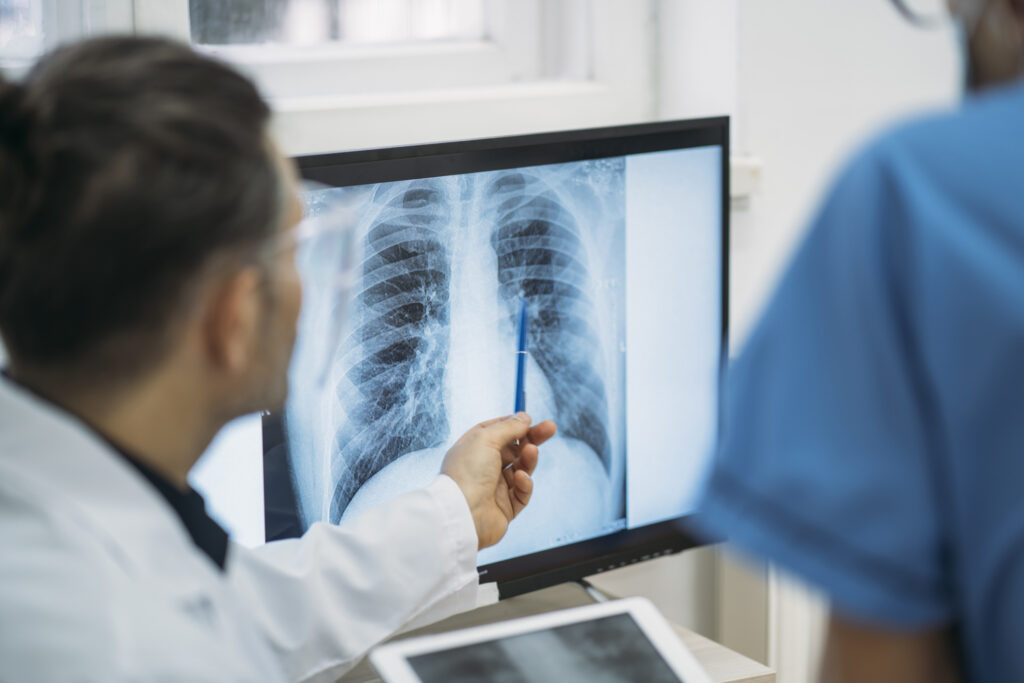
Lung nodules are common and are seen in about a third of CT scans. Palomar Health Medical Group’s Dr. Hardeep Phull says, “A lot of patients show up with lung nodules from prior lung injuries, whether infections or other causes, and these nodules don’t grow or change over time. Those can be monitored and often are not cancer.”
Lung nodules can be classified as solid or subsolid based on their density. Solid nodules appear dense on scans, while subsolid nodules may contain a mix of both high and low density, or have low density only. Density helps doctors to decide how suspicious a nodule is, helping them determine how frequently to monitor the nodule with scanning and if a biopsy is warranted.
Do lung nodules have symptoms?
If you have a small lung nodule, you’re unlikely to experience any symptoms. Oftentimes, lung nodules are found incidentally since X-rays and CT scans aren’t typically conducted on a routine basis. “ We have a lot of patients who go in and say, ‘Oh, I was having an X-ray for an employment physical,’ or ‘I was in the ER,’ and they happen to find something,” Dr. Phull shares.
If a nodule is cancerous and growing, Dr. Phull notes it could present with chest pain, shortness of breath, coughing, or coughing up blood. However, Dr. Phull emphasizes, “Not everything with those symptoms is lung cancer. A viral infection, like COVID or pneumonia, can mimic the symptoms of lung cancer.”
Is my lung nodule cancerous?
A scan itself is not enough to determine whether or not a lung nodule is cancerous “because a picture is just a picture,” says Dr. Phull. “I’ve had patients show up with scans that look worse than cancer, but they weren’t cancer. It could be an infection or granulomas, which are nonspecific nodules related to rheumatologic or infectious causes,” he adds.
If you have a lung nodule, the NCCN Guidelines have different recommendations depending on the density of the nodule, nodule size, and your risk factors. View our next module where we go over some of the differences between benign and suspicious nodules.
Personalized support for real care decisions
Understand your diagnosis, explore clinical trials, and track symptoms--all in one place.
Get started
Compare treatments, prepare for appointments, and track side effects—all in the app
Built for your diagnosis, Outcomes4Me gives you the tools to make confident, informed decisions—right when you need them.
Continue in app