
In clinical settings, you’ll often hear your care team use the shorthand R/R, standing for relapsed/refractory. This term covers patients with relapsed/refractory chronic lymphocytic leukemia (CLL) who either saw their disease return after a period of remission or whose CLL never adequately responded to treatment in the first place. The term “relapsed/refractory” is frequently used as a single category in clinical trials because both groups represent an unmet need for new therapeutic interventions.
CLL is, for most patients, a long-term condition. Treatment changes are a common and anticipated part of that experience. Knowing what “R/R” actually means, and why it matters, puts you in a stronger position to have informed conversations with your care team and evaluate what comes next.
Relapsed vs. refractory: The difference in timing
These two terms are often used in the same breath, but they describe different situations.
The relapse timeline
According to the American Society of Clinical Oncology, relapsed CLL is defined as disease that returns after a period of complete or partial remission lasting at least six months. In other words, your treatment worked; it pushed the disease back, but CLL eventually found a way to return. A remission of six months or more signals that your cancer was, at least temporarily, responsive to that therapy. Relapse is a sign that the disease has evolved, but not necessarily that the drug class itself has been defeated.
Evidence-based guidance powered by NCCN Guidelines®
Personalized treatment plans shaped by the latest oncology standards—tailored to your diagnosis.
Get started
View your personalized treatment plan in the Outcomes4Me app
Use your diagnosis to unlock personalized NCCN Guidelines®-aligned recommendations.
Continue in app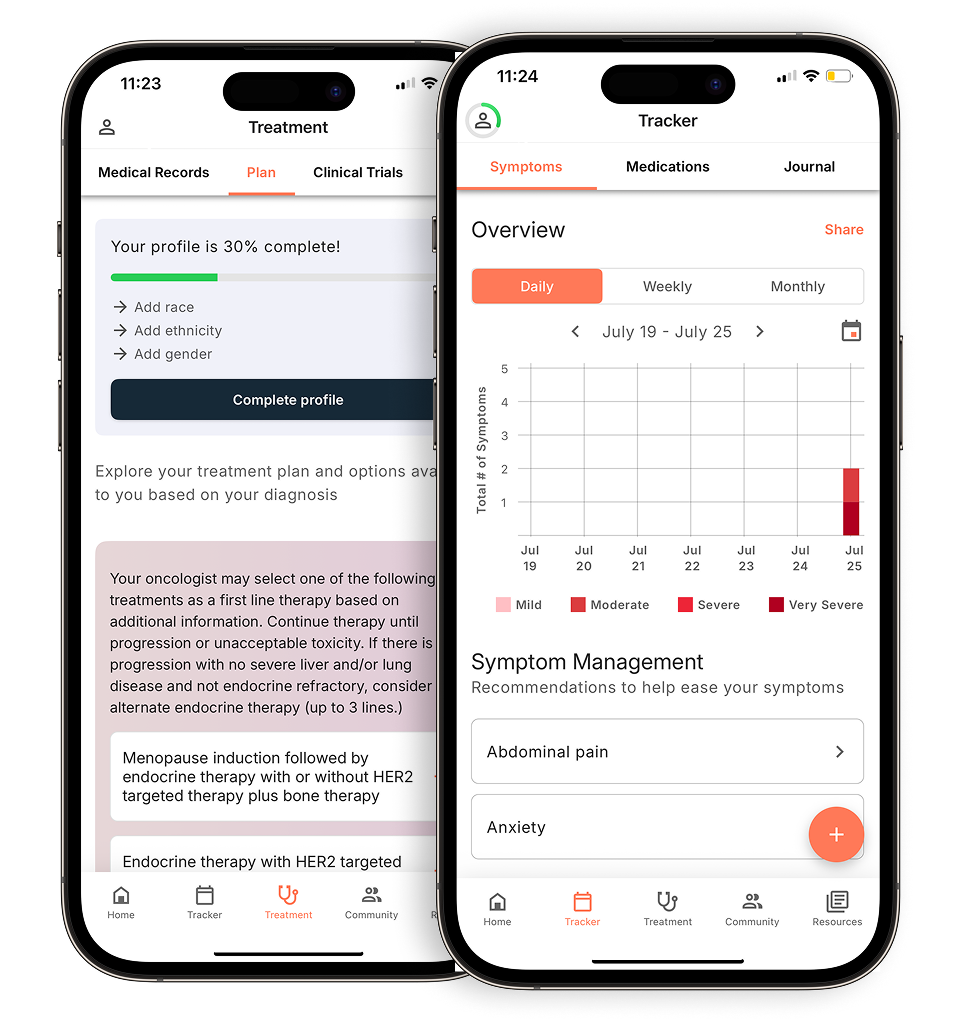
The refractory timeline
Refractory CLL tells a different story. Refractory disease either fails to respond to treatment at all or progresses within six months of the last dose. When CLL doesn’t respond, or responds only briefly, it suggests a higher level of biological resistance to a specific drug or drug class. The disease has developed mechanisms to survive despite treatment.
Understanding where you fall on this spectrum is a meaningful first step.
Why researchers group them together
Understanding the relapsed vs. refractory distinction matters clinically, but from a drug development standpoint, both groups share one critical need: better options. That’s why researchers and trial designers typically combine them into a single R/R CLL category when evaluating next-generation therapies.
The logic is straightforward. Whether your disease returned after a period of remission or never responded in the first place, the underlying challenge is the same: the disease has found a way to resist standard treatment. That shared reality drives the search for therapies that work through entirely different mechanisms.
What is “double-refractory” disease?
A particularly high-need subset within R/R CLL is what researchers call double-refractory or double-exposed disease. This describes patients whose CLL has stopped responding to both covalent BTK inhibitors (like ibrutinib or acalabrutinib) and BCL2 inhibitors (like venetoclax), two cornerstone drug classes in modern CLL care. Emerging approaches, including CAR-T cell therapy and bispecific antibodies, are being studied specifically for this population.
Recognizing the signs: Symptoms of progression and Richter transformation
Knowing what to watch for between appointments can make a real difference. Understanding the signs of progression helps you act quickly and advocate for yourself more effectively.
Common signs that CLL may be progressing include:
- Persistent fatigue that doesn’t improve with rest
- Drenching night sweats
- Swollen lymph nodes, particularly in the neck, armpits, or groin
- Unintentional weight loss
- Fever without an obvious infection
Richter transformation: A rare but urgent shift
A small percentage of patients with CLL experience Richter transformation, where CLL converts into an aggressive large-cell lymphoma. It’s rare, but it’s a scenario that warrants immediate attention.
Symptoms that may suggest Richter transformation include rapid lymph node enlargement (often within days or weeks), high fevers, significant weight loss, and profound fatigue. The pace and intensity distinguish it from typical CLL activity.
According to research published in PMC, Richter transformation carries a significantly different prognosis and requires a fundamentally different treatment approach.
Navigating next steps: Treatment options for R/R CLL
The landscape of CLL treatment options has expanded significantly, giving care teams more tools than ever before.
Switching drug classes
If your first-line therapy was a BTK inhibitor (such as ibrutinib or acalabrutinib), your provider may recommend switching to a venetoclax-based regimen. When resistance develops to one treatment pathway, targeting a different pathway may help regain disease control. The reverse applies too: patients who started on venetoclax-based therapy may move toward BTK inhibitor-based treatment at relapse.
Cellular therapies and newer agents
For patients who’ve progressed through multiple lines, options are expanding further. CAR-T cell therapy is an emerging approach being studied in R/R CLL, with research suggesting it may offer durable responses in heavily pre-treated patients. Non-covalent BTK inhibitors like pirtobrutinib are also showing promise for patients who developed resistance to earlier BTK inhibitors, according to recent research on R/R CLL.
The role of genetics
Here’s where it gets highly individualized. TP53 mutations and IGHV mutation status directly shape which therapies are most appropriate. For example, patients with TP53-mutated or deleted CLL typically don’t respond well to chemoimmunotherapy and are prioritized for targeted agents. Genetic markers aren’t a one-time test — they can evolve with the disease, which is why retesting at relapse is standard practice.
What works best ultimately depends on your specific disease biology.
Your specific genetic markers, prior therapy history, and whether you’re managing relapsed, refractory, or even double-refractory CLL all shape which options are actually right for you.
For more insights on treatment options and living with CLL, watch Stanford University’s Dr. Bita Fakhri’s full webinar recording.
Personalized support for real care decisions
Understand your diagnosis, explore clinical trials, and track symptoms--all in one place.
Get started
Compare treatments, prepare for appointments, and track side effects—all in the app
Built for your diagnosis, Outcomes4Me gives you the tools to make confident, informed decisions—right when you need them.
Continue in app