
For decades, a breast cancer diagnosis came with a simple HER2 label: positive or negative. That binary shaped treatment decisions for millions of patients, but it left a significant middle ground unrecognized.
HER2-low breast cancer treatment is redefining the understanding of “HER2-negative.” Approximately 50–60% of patients previously labeled “HER2-negative” are actually HER2-low, a classification defined by low but detectable levels of the HER2 protein on the surface of cancer cells.
The old framework didn’t capture every shade of HER2 expression. It was a functional tool for identifying patients who would respond to HER2-targeted therapies and ruling out everyone else. Understanding requires looking beyond that binary. What we now recognize as HER2-low sits in that previously overlooked space between the two categories, and it’s turning out to be a gateway to precision medicine for a large subset of breast cancer patients.
Decoding your pathology report: IHC scores explained
Understanding your HER2 status starts with immunohistochemistry (IHC), and knowing how to read it can shape your personalized care plan.
IHC measures how much HER2 protein is present on the surface of cancer cells, scoring results on a scale from 0 to 3+. Each score carries a different clinical meaning, and the distinction between them is now more consequential than ever.
| IHC Score | What It Means |
|---|---|
| 0 | No HER2 protein detected; HER2-negative |
| 1+ | Faint HER2 expression; now classified as HER2-low |
| 2+ | Moderate expression; requires a follow-up FISH test |
| 3+ | High HER2 expression; HER2-positive |
When a result comes back as IHC 2+, your care team will order a secondary test called fluorescence in situ hybridization, or FISH, to confirm whether the HER2 gene itself is amplified. HER2-low is a distinct subtype that includes tumors with IHC scores of 1+ and 2+, representing a more precise classification than the previous HER2 positive or negative categories. The distinction between HER2-low and HER2-negative determines which therapies you can access.
Researchers have also identified HER2-ultra-low breast cancer as an area of focus. While this category is still under active clinical investigation, it signals that the field is moving toward even greater precision in how HER2 expression is measured and acted upon.
Evidence-based guidance powered by NCCN Guidelines®
Personalized treatment plans shaped by the latest oncology standards—tailored to your diagnosis.
Get started
View your personalized treatment plan in the Outcomes4Me app
Use your diagnosis to unlock personalized NCCN Guidelines®-aligned recommendations.
Continue in app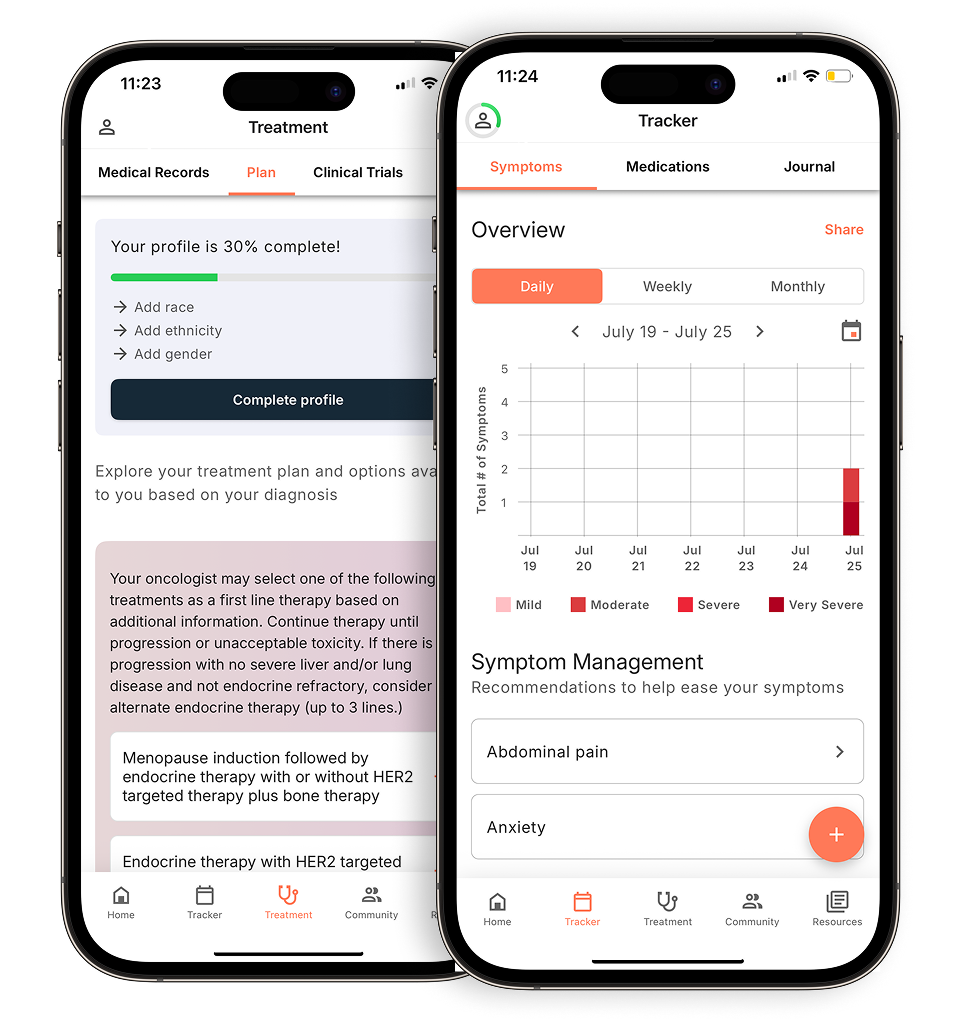
How targeted therapy works
Antibody-drug conjugates (ADCs) represent one of the most significant shifts in breast cancer treatment by delivering chemotherapy precisely where it’s needed while largely sparing healthy tissue.
An ADC functions like a “trojan horse.” The antibody component acts as the delivery vehicle, engineered to recognize and bind to a specific protein on the surface of cancer cells, in this case HER2. Once it locks on, the cancer cell pulls the entire package inside, not realizing it’s carrying a potent chemotherapy payload. That chemo then activates, killing the cell from within.
This is where trastuzumab deruxtecan (Enhertu) for HER2-low becomes a compelling part of the conversation. Traditional HER2-targeted therapies required high levels of the protein to be effective. But because ADCs are so precisely engineered, even the modest HER2 expression seen in HER2-low tumors with an IHC score of 1+ or 2+ gives the antibody enough of a “target” to find the cell and do its work. The threshold for action is simply lower. This expands who can benefit from this class of treatment.
With ADCs, low HER2 expression can be targeted effectively.
It’s worth noting that this approach isn’t limited to breast cancer. How ADCs are reshaping treatment across cancer types reflects just how versatile the mechanism is. For patients with HER2-low breast cancer, understanding this science matters, because it’s the foundation of the clinical evidence that followed, including the landmark trial that moved this from theory to approved therapy.
The evidence: how the DESTINY-Breast04 trial changed care
The DESTINY-Breast04 trial delivered results that fundamentally reshaped how oncologists think about HER2-low breast cancer and which patients qualify for targeted treatment.
A major study on HER2-low breast cancer treatment has been widely discussed in the medical community and published in prominent journals. The trial enrolled patients with HER2-low metastatic breast cancer, including those with IHC 1+ breast cancer and IHC 2+/ISH-negative tumors. These were patients who, under the old binary classification, would have been treated as simply “HER2-negative” with standard chemotherapy. The trial compared trastuzumab deruxtecan (T-DXd), the ADC discussed in the previous section, against physician’s choice of chemotherapy.
Cancer care guidance for every step of your journey
Get treatment options, clinical trials, and support tailored to your diagnosis--all in one place.
Get started
See treatment options, manage symptoms, and stay informed—all in the app
View treatment options and trials personalized to your diagnosis—plus track progress in real time.
Continue in appThe trial results were striking. Patients receiving T-DXd saw a median progression-free survival (PFS) of 9.9 months, compared to 5.1 months in the chemotherapy group. Overall survival also improved significantly, with T-DXd extending median overall survival to 23.4 months versus 16.8 months for standard chemotherapy, a meaningful improvement for a patient population that previously had no targeted options.
The FDA recently approved trastuzumab deruxtecan (T-DXd) as the first treatment specifically targeting HER2-low metastatic breast cancer, based on results from the DESTINY-Breast04 clinical trial. This was the first time the HER2-low patient group had been recognized as a distinct, treatable category. That regulatory shift effectively created a new classification in oncology, and it validated years of research into ADC technology.
What the trial also confirmed is that HER2 status exists on a spectrum with real clinical significance. And that raises an important question. If testing criteria matter this much, what happens when a tumor’s HER2 status changes over time or wasn’t accurately classified to begin with?
Why you might need a new biopsy or re-testing
Re-testing for HER2-low status could directly expand your metastatic breast cancer treatment options, and it’s a conversation worth having with your care team today.
HER2 status can change over time. Tumors can evolve biologically over time, meaning a result from an earlier biopsy may no longer reflect what’s happening at a metastatic site. Research has confirmed that primary tumors classified as HER2-negative can express low HER2 levels at metastatic locations, a discordance that matters enormously when determining eligibility for targeted therapies like Enhertu.
There’s also a technical dimension to consider. Older pathology reports may have used broader testing criteria that predate the HER2-low classification. A score of IHC 1+ or IHC 2+ (FISH negative) now carries real clinical significance, but earlier assessments may have simply recorded “HER2-negative” without capturing that nuance. Precise diagnosis can lead to a personalized care plan, and patients should ask whether their last biopsy was tested specifically for HER2-low status.
If your diagnosis was made several years ago, or before 2022 when HER2-low became a defined category, re-testing is worth discussing. Your care team can evaluate whether a new biopsy from a metastatic site, or a re-analysis of existing tissue, is appropriate. The difference between “HER2-negative” and “HER2-low” may determine which therapies you can access, making this one of the most practical questions you can raise at your next appointment. The next section pulls together the key takeaways to help you navigate these conversations with clarity.
What you need to know
Understanding your HER2 status requires looking beyond the simple positive-or-negative question. It’s a classification that can directly shape your personalized care plan.
HER2-low is now a clinically meaningful category, covering patients with IHC scores of 1+ or IHC 2+ with a FISH-negative result. Previously, these scores were grouped under the broad “HER2-negative” label, which meant patients missed out on targeted treatment options. That distinction matters enormously today.
Here’s what to carry forward from everything covered in this article:
- HER2-low classification opens doors. If your pathology report shows IHC 1+ or IHC 2+ (FISH negative), you may now qualify for targeted antibody-drug conjugates, a category of treatment that didn’t apply to you before.
- T-DXd is the primary option. Trastuzumab deruxtecan (Enhertu) is an FDA-approved targeted therapy for HER2-low metastatic breast cancer that cannot be removed by surgery or has spread to other parts of the body, offering a treatment path that simply didn’t exist a few years ago.
- Re-testing is worth pursuing. If your diagnosis predates the HER2-low era, or if your original report only says “HER2-negative,” ask your care team about re-testing. Genetic testing for breast cancer and updated IHC analysis could reveal a classification that changes your options entirely.
- Tumor biology can shift. As discussed earlier, HER2 expression can change between initial diagnosis and metastatic recurrence, making re-biopsy a genuinely worthwhile conversation.
If you’re wondering whether emerging therapies could be right for you, clinical trial matching is one of the most practical next steps you can take. The next generation of HER2-low treatments is actively being studied, and trials represent real access to drugs that haven’t yet reached standard care.
Download the Outcomes4Me app and explore clinical trials that you may be eligible for.
Personalized support for real care decisions
Understand your diagnosis, explore clinical trials, and track symptoms--all in one place.
Get started
Compare treatments, prepare for appointments, and track side effects—all in the app
Built for your diagnosis, Outcomes4Me gives you the tools to make confident, informed decisions—right when you need them.
Continue in app