
The following questions and responses have been lightly edited for grammatical purposes.
What treatment options are available for patients whose CLL has progressed?
Dr. Fakhri: There is a patient population in CLL that is on the rise, often referred to as the “double-exposed” or “double-refractory” population.
What does that mean? These are patients who have already been treated with, and benefited from, the two most effective classes of therapies we use in CLL. First, BCL-2 inhibitors: patients have received these treatments, but their disease has eventually progressed or returned after some time. Second, BTK inhibitors: patients may have been treated with acalabrutinib, ibrutinib, or zanubrutinib, and again, their disease has come back.
This double-exposed, double-refractory group represents an area of unmet need, because these patients have already exhausted the most effective treatment options currently available. As a result, the field is now focusing on novel therapies.
Evidence-based guidance powered by NCCN Guidelines®
Personalized treatment plans shaped by the latest oncology standards—tailored to your diagnosis.
Get started
View your personalized treatment plan in the Outcomes4Me app
Use your diagnosis to unlock personalized NCCN Guidelines®-aligned recommendations.
Continue in app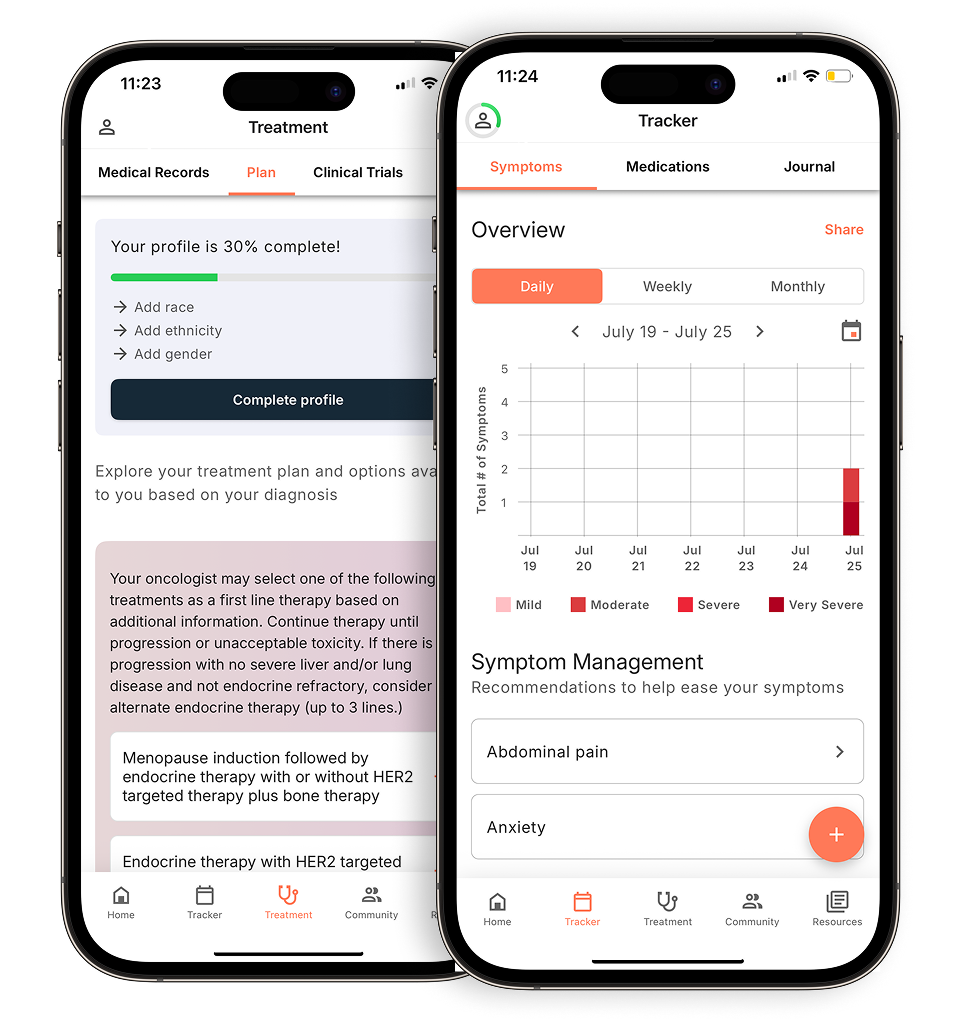
One example is pirtobrutinib, the first non-covalent BTK inhibitor. You may notice that drugs like ibrutinib, acalabrutinib, and zanubrutinib sound similar, they are all covalent BTK inhibitors. Pirtobrutinib, however, works differently and is specifically used for this patient population.
There are also BTK degraders showing very promising outcomes. To explain: traditional BTK inhibitors block the enzyme, but over time, the enzyme can develop ways to escape that inhibition. Covalent BTK inhibitors form a strong, fixed bond with the receptor, but patients may still eventually develop resistance.
Pirtobrutinib, as a non-covalent BTK inhibitor, works more flexibly. It can bind, unbind, and rebind without requiring a strict receptor shape. This means that even if a patient develops a resistance mutation, they may still respond to pirtobrutinib—for a time. Eventually, however, resistance can develop again.
This is where BTK degraders come in. Instead of just inhibiting the enzyme, these therapies aim to destroy it altogether.
Beyond this, cell-based therapies are also an important area of focus. CAR T-cell therapy is now approved for patients with double-exposed, double-refractory CLL.
CAR T-cell therapy is essentially a way of creating “supercharged” T cells. T cells are the body’s natural cancer-fighting immune cells. In this process, a patient’s T cells are collected using a machine similar to dialysis, which separates these cells based on specific immune markers and returns the rest of the blood to the patient.
The collected T cells are then sent to a specialized facility, where they are engineered to better recognize and attack cancer cells. This modification, called chimeric antigen receptor (CAR) T-cell therapy, adds a kind of “extra eye” that helps the T cells avoid being fooled by cancer.
The manufacturing process takes about four weeks. After that, the engineered CAR T cells are returned to the treatment center, where the patient is admitted and the cells are infused back into their body to begin fighting the cancer.
While this may sound like science fiction, there are challenges. Patients with CLL often have inherently dysfunctional T cells. So even when these cells are engineered to be more effective, their underlying limitations can still impact outcomes.
To address this, researchers are studying combinations of CAR T-cell therapy with BTK inhibitors, which can help improve immune function and lead to a more effective final product.
Another promising approach is bispecific T-cell engagers. These are engineered molecules with two binding sites. One side attaches to a marker on the CLL cell, such as CD20, while the other attaches to CD3-positive T cells—the immune cells responsible for killing cancer.
By bringing the T cells directly next to the cancer cells, these therapies help ensure the cancer cannot escape detection, allowing for a more effective immune response.
Bispecific T-cell engagers are still under investigation in CLL, and while many of these therapies are in earlier stages of research, CAR T-cell therapy is already FDA-approved.
It’s important to note that CAR T-cell therapy can be associated with significant side effects, and it may not be appropriate for every patient. However, it is an important option for certain individuals. Similarly, bispecific T-cell engagers are being actively studied, and their future role in treatment is still being determined.
Overall, these emerging therapies represent important and evolving options for patients with CLL.
For more insights on treatment options and living with CLL, watch Dr. Fakhri’s full webinar recording.
Personalized support for real care decisions
Understand your diagnosis, explore clinical trials, and track symptoms--all in one place.
Get started
Compare treatments, prepare for appointments, and track side effects—all in the app
Built for your diagnosis, Outcomes4Me gives you the tools to make confident, informed decisions—right when you need them.
Continue in app