
The end of trial-and-error: how organoids change the CRC narrative
For too long, colorectal cancer treatment has been shaped by what works for most patients, not what works for you.
Standard chemotherapy protocols are built on population averages. When a regimen fails, your care team adjusts, waits, and tries again. That cycle of uncertainty carries real costs: lost time, added toxicity, and the emotional challenges of hoping a treatment will work without any way to know in advance.
That’s where patient-derived tumor organoids for colorectal cancer are beginning to reshape the conversation. A patient-derived organoid (PDO) is a miniaturized, three-dimensional replica of your actual tumor, grown from a small biopsy sample in a lab. Think of it as a living avatar of your cancer that replicates intricate human tumor structures with remarkable biological fidelity.
The shift this enables is fundamental. Oncology has traditionally been reactive, monitoring how a patient responds to treatment after the fact. PDOs make it possible to move toward predictive oncology, testing how your tumor behaves before any drug enters your body. This represents a different way of thinking about personalized care altogether.
The question is how, exactly, that prediction works, and that starts with what happens to a biopsy once it leaves the operating room.
Predicting chemotherapy response with patient-derived organoids
Patient-derived organoids give oncologists a live, testable replica of your tumor, making personalized medicine for stage 4 colon cancer a biological reality.
The process begins with a standard biopsy. Once tumor tissue is collected from patients, researchers establish organoid models that retain the molecular and cellular features of the original tumors. Over two to four weeks, cancer cells self-organize into three-dimensional structures, miniature tumors that retain the genetic and behavioral characteristics of the original cancer. What you end up with is a living model that responds to treatment the same way your cancer does.
Drug sensitivity testing is where the technology delivers its most immediate clinical value. Rather than selecting a treatment based on population-level data, researchers are exploring the potential to expose organoids to multiple drug combinations at once, which may help identify which treatments could work best for an individual’s cancer. Each combination is monitored for how effectively it kills the cancer cells, giving the care team a ranked picture of which therapies are likely to work and which aren’t.
Critically, this approach is backed by evidence. Patient-derived organoids can reliably predict treatment response in metastatic colorectal cancer, meaning results from the dish translate meaningfully to what happens in the patient. That correlation is what makes this approach so significant for building a truly personalized care plan.
And that predictive power has a consequence worth exploring. If you can identify which drugs will work, you can identify which ones won’t, sparing patients from treatments that carry real toxicity with no clinical benefit.
Evidence-based guidance powered by NCCN Guidelines®
Personalized treatment plans shaped by the latest oncology standards—tailored to your diagnosis.
Get started
View your personalized treatment plan in the Outcomes4Me app
Use your diagnosis to unlock personalized NCCN Guidelines®-aligned recommendations.
Continue in app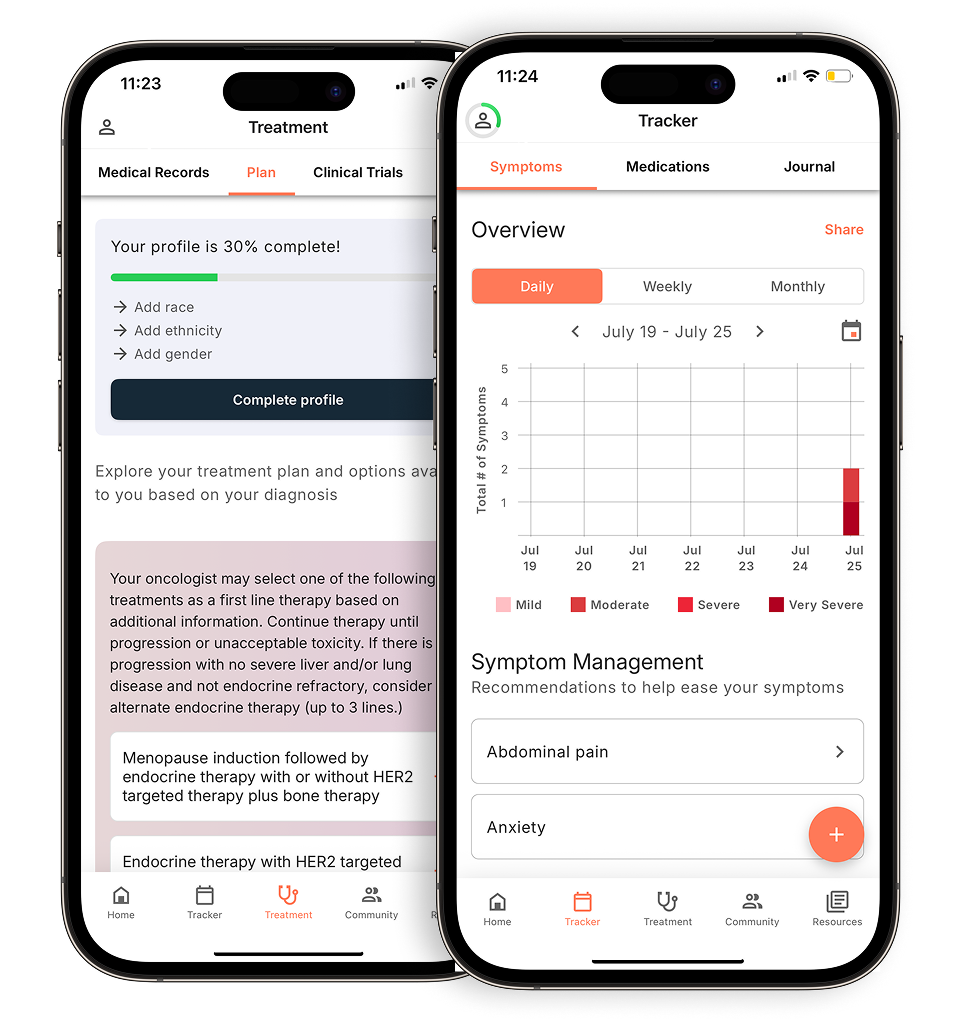
Reducing toxicity: a benefit of precision testing
Organoid testing identifies what might work and filters out treatments that would expose you to serious harm without meaningful benefit.
This distinction matters more than it might first appear. Stage 4 colorectal cancer treatment typically involves aggressive regimens, chemotherapy combinations, targeted agents, and immunotherapy, each carrying its own risk profile. When your care team administers a drug that your tumor won’t respond to, you absorb the full burden of side effects while gaining nothing therapeutically. Organoid-based testing can help predict which patients will respond to chemotherapy, potentially guiding more personalized treatment decisions for colorectal cancer.
Quality of life is often the quietest casualty of ineffective treatment. Nausea, neuropathy, immunosuppression, and fatigue compound quickly during stage 4 care, and weeks spent on the wrong therapy are weeks of diminished function that can’t be recovered. Precision screening through organoids gives your care team the confidence to pursue an effective personalized care plan from the start, preserving your energy and resilience for treatments that are actually working.
Common CRC treatments that organoid testing can help evaluate include:
- Chemotherapy drugs, including components of standard treatment combinations like 5-fluorouracil
- Bevacizumab, an anti-VEGF targeted therapy used in colorectal cancer treatment, and organoid testing may help identify which patients could be candidates for this type of drug
- Cetuximab and panitumumab, EGFR inhibitors used in colorectal cancer treatment, and organoid testing may help identify which patients could be candidates for these drugs
- Pembrolizumab, an immunotherapy agent used in some colorectal cancer cases, and organoid testing may help your care team explore whether it could be worth considering for your tumor
There’s also a compelling economic argument. These therapies carry significant costs, often tens of thousands of dollars per treatment cycle, and insurance coverage doesn’t always absorb the full impact. Ruling out ineffective options early through organoid testing reduces wasted expenditure on high-cost drugs that wouldn’t have helped. For patients exploring colorectal cancer clinical trials matching, this kind of upfront clarity can also sharpen which trials represent a realistic fit. That same precision, it turns out, extends well beyond the lab dish, as emerging tools like liquid biopsies are beginning to show.
Liquid biopsies and the role of ctDNA
Organoids aren’t the only precision tool reshaping colorectal cancer care. Liquid biopsies are emerging as a powerful companion technology that catches what tissue testing alone can miss.
Circulating tumor DNA (ctDNA) refers to fragments of cancer DNA shed by tumors directly into the bloodstream. A liquid biopsy captures these fragments from a standard blood draw, giving your care team a real-time window into tumor activity without requiring surgery or additional tissue sampling. One of its most significant applications is minimal residual disease (MRD) detection, identifying microscopic traces of cancer that persist after treatment, often months before those traces become visible on a scan. That early warning window can be critical for patients with stage 4 colon cancer, where recurrence speed matters.
Cancer care guidance for every step of your journey
Get treatment options, clinical trials, and support tailored to your diagnosis--all in one place.
Get started
See treatment options, manage symptoms, and stay informed—all in the app
View treatment options and trials personalized to your diagnosis—plus track progress in real time.
Continue in appOrganoids and liquid biopsies serve different purposes. Organoids answer a forward-looking question. Can organoids predict chemotherapy response before you begin treatment? Liquid biopsies answer an ongoing surveillance question: is the cancer still active, or coming back? Tissue-based organoid models give oncologists a live, testable replica of the tumor, while blood-based liquid biopsies offer continuous monitoring across the full treatment timeline. Neither approach alone delivers the complete picture.
Together, these tools form a more complete diagnostic loop. Your care team can use organoid data to build a personalized care plan at diagnosis, then layer in regular ctDNA testing to track whether that plan is working and adapt quickly if it isn’t. That combination represents a meaningful shift toward truly dynamic, responsive cancer care. As promising as this integrated approach is, accessing both technologies reliably comes with real-world hurdles that are worth understanding.
Navigating the bottlenecks: time, cost, and access
Organoid-based drug sensitivity testing holds real promise, but several practical barriers still stand between this technology and routine clinical care.
Timing is the most urgent concern. Organoids can be grown from a patient’s tumor tissue to create a miniaturized version of their tumor that behaves like the real thing, a window that can feel impossibly long for someone with late-stage colorectal cancer who needs to start treatment now. In practice, care teams often have to make an initial treatment decision before organoid results are even available. That doesn’t eliminate the test’s value, but it does shape how it fits into a personalized care plan.
Cost and coverage add another layer of complexity. Insurance rarely covers functional precision oncology testing as a standard benefit, leaving many patients to navigate out-of-pocket expenses or appeal processes that require significant time and documentation. And even when coverage is available, it’s inconsistent across payers and states.
Access may be the most unequal barrier of all. Academic medical centers and NCI-designated cancer centers are currently the primary entry points for organoid testing programs, often through clinical trials. Community oncology practices, which serve the majority of colorectal cancer patients, typically don’t yet offer these tools. That gap matters.
What to ask your care team:
- Is organoid testing available through a clinical trial at your center or an affiliated academic hospital?
- What is the expected turnaround time, and how will my initial treatment plan be managed in the interim?
- Does my insurance cover functional precision oncology testing, and is there a patient assistance program if it doesn’t?
- Would a referral to an academic medical center be appropriate for my case?
Knowing the right questions brings you closer to the answers that matter, and to a clearer picture of everything this technology can and can’t do for you right now.
Summary: what you need to know about CRC organoids
Patient-derived tumor organoids represent one of the most significant shifts in colorectal cancer care, moving treatment decisions away from population-level assumptions and toward testing that reflects your individual biology.
Here’s what the research, and the sections above, distill into four core takeaways:
- 3D models from your own cells. Organoids are grown directly from a patient’s tumor tissue, creating a living replica that responds to drugs the same way your cancer does, without putting your body at risk during the testing phase.
- Meaningful predictive accuracy. These models can indicate with high accuracy whether a specific chemotherapy or targeted therapy is likely to work for you, helping your care team avoid ineffective treatments before they’re prescribed.
- Access is still limited. This technology is primarily available through clinical trials at major cancer centers. That means actively seeking out those trials is currently the most direct path to benefiting from it.
- Organoids plus liquid biopsies. Combining tumor organoid testing with ctDNA liquid biopsies gives your care team the most complete, real-time picture of your cancer, what it looks like structurally and how it’s behaving genetically. Organoids bridge the gap between lab research and clinical bedside application, and that gap is closing faster than many expect.
Understanding these tools is only part of the equation. Knowing how to actually access them, and who to talk to, is where a personalized care plan starts to take shape.
Taking control. How to access precision CRC research
The most important step you can take right now is to actively seek out precision medicine instead of waiting for it to find you.
Research into patient-derived tumor organoids is advancing, but access to these technologies often happens through clinical trials before they reach standard care. That means proactively searching for trials that match your diagnosis, tumor biology, and genetic profile is a meaningful part of your personalized care plan.
Discuss organoid sensitivity testing and biomarker-matched trials directly with your oncologist, your surgeon, and any specialists involved in your treatment. Ask whether these options are appropriate for your situation. Your care team is your partner in evaluating whether advanced options fit your specific diagnosis, and the more informed you arrive, the more productive that conversation becomes.
Disclaimer: The information provided in this article is for informational purposes only and is not intended to be a substitute for professional medical advice, diagnosis, or treatment. Outcomes4Me is not acting as your caregiver, and any suggestions or guidance offered should not replace the advice of your healthcare provider or qualified medical professional. Always seek the guidance of your physician or other qualified health provider with any questions you may have regarding a medical condition.
Personalized support for real care decisions
Understand your diagnosis, explore clinical trials, and track symptoms--all in one place.
Get started
Compare treatments, prepare for appointments, and track side effects—all in the app
Built for your diagnosis, Outcomes4Me gives you the tools to make confident, informed decisions—right when you need them.
Continue in app