
If you’ve started searching for colorectal cancer (CRC) survival statistics, you may already be feeling overwhelmed by numbers that seem confusing to interpret. That’s completely understandable, but here’s something important to hold onto: statistics describe populations, not people.
When you see a 5-year relative survival rate, it means the percentage of people with a given diagnosis who are alive five years after diagnosis compared to people without cancer. It does not predict what will happen to you specifically. These figures come from large population datasets — like the American Cancer Society’s CRC data — that pool outcomes across thousands of patients with different ages, health histories, and treatment responses.
Statistics are a starting point, not a verdict. Understanding CRC survival rates by stage gives you context, but your individual outcome depends on factors no database can fully capture, including your overall health, your treatment plan, and how your body responds to care.
The numbers can feel scary. What they can’t do is account for advances in treatment, your specific tumor biology, or options like clinical trials that may be available to you.
How CRC is staged
Before survival statistics can make sense, it helps to understand what stage actually means because the CRC survival rate varies significantly depending on where the cancer is in your body when it’s found.
Providers use the AJCC (American Joint Committee on Cancer) staging system, which classifies CRC from stage I through stage IV based on three key factors: tumor size and depth, whether nearby lymph nodes (small glands that are part of your immune system) are involved, and whether the cancer has metastasized (spread to distant organs like the liver or lungs).
Evidence-based guidance powered by NCCN Guidelines®
Personalized treatment plans shaped by the latest oncology standards—tailored to your diagnosis.
Get started
View your personalized treatment plan in the Outcomes4Me app
Use your diagnosis to unlock personalized NCCN Guidelines®-aligned recommendations.
Continue in app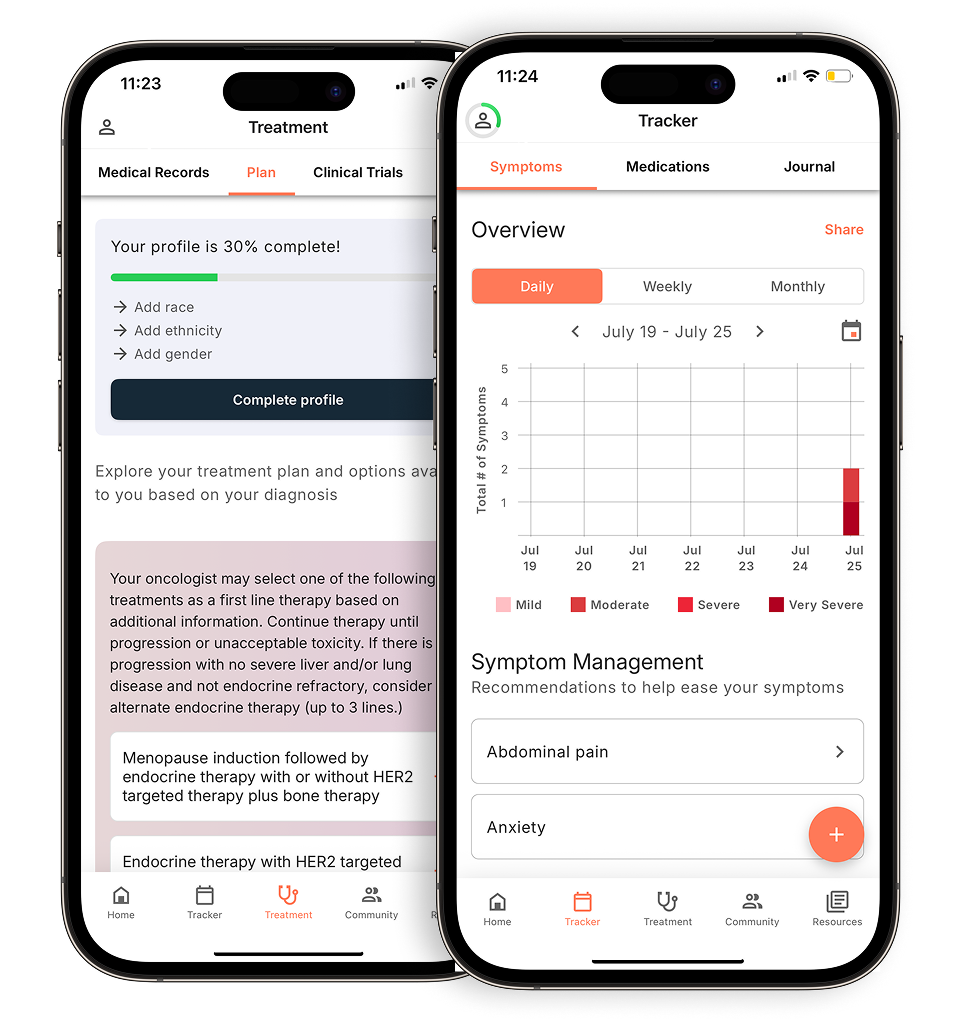
Here’s a plain-language breakdown:
- Stage I: The tumor is contained within the inner layers of the colon or rectum wall — it hasn’t spread
- Stage II: The tumor has grown through the wall but hasn’t reached lymph nodes
- Stage III: Cancer has spread to nearby lymph nodes
- Stage IV: Cancer has spread to distant organs
CRC survival rates by stage
CRC prognosis shifts depending on when the cancer is caught.
The statistics below come from the American Cancer Society’s CRC Facts & Figures 2023–2025, which draws on NCI SEER database data. One important caveat: because 5-year survival rates track patients over five years, these figures reflect people who were diagnosed at least five years ago. They don’t yet capture the impact of newer treatments available today.
Stage I
The 5-year relative survival rate is approximately 90%. When CRC is found while it’s still confined to the inner layers of the colon or rectum wall, outcomes are generally very favorable.
Stage II
The 5-year relative survival rate ranges from roughly 70–85%, depending on specific sub-stage. The cancer has grown through the bowel wall but hasn’t spread to nearby lymph nodes.
Stage III
Here, the cancer has reached nearby lymph nodes. Survival rates range from approximately 40–70% — a wider spread that reflects how much the lymph node involvement varies at this stage.
Stage IV
This is the stage that often causes the most fear. The 5-year relative survival rate is currently around 15–20%. However, this number is actively improving as targeted therapies and immunotherapy become more widely used.
Statistics can measure populations, but they cannot predict what happens to any one person. The stage you’re diagnosed at is just one piece of a much larger picture — and that’s exactly what the next section explores.
Why your survival rate isn’t just a number
The statistics reflect averages across thousands of people. Averages, by definition, don’t describe any single person. If reading those percentages left you feeling reduced to a data point, that’s understandable. But here’s what the numbers can’t capture:
- Age and overall health: Younger patients and those without other significant health conditions often tolerate more aggressive treatment, which can meaningfully affect outcomes.
- Molecular markers: Testing your tumor’s genetic profile matters enormously. Markers like RAS, BRAF V600E, and MSI-H (microsatellite instability-high) don’t just affect prognosis — they directly determine which treatments are likely to work for you.
- Treatment response: How well your cancer responds to initial therapy is one of the strongest real-world indicators of what happens next.
This is especially important for stage IV CRC, where the stage IV CRC survival rate has been climbing in recent years. According to CRC Facts & Figures 2023–2025, advances in treatment are shifting outcomes for metastatic disease in ways that older statistics don’t yet fully reflect.
What’s driving these shifts in survival? Newer therapies are changing the picture significantly.
How treatment advances are changing the picture
The survival statistics were largely shaped by treatments used years ago. Here’s what’s genuinely encouraging: across all CRC stages, the treatment landscape is evolving, and that means today’s numbers are already becoming more optimistic.
Immunotherapy has been one of the most significant breakthroughs for a specific group of patients. If your tumor is classified as MSI-H (microsatellite instability-high) or dMMR (mismatch repair deficient) — terms your provider can explain through biomarker testing — checkpoint inhibitor therapies have shown remarkable results, particularly in later-stage disease. These treatments essentially help your immune system recognize and attack cancer cells more effectively.
Targeted therapies have also expanded options for people with specific gene mutations. Mutations in KRAS, NRAS, and BRAF V600E can now guide providers toward treatments designed to block the specific pathways driving your cancer’s growth. According to a recent review in PMC, advances in molecularly targeted therapies are actively reshaping treatment outcomes for CRC patients.
Clinical trials are another option worth knowing about and they’re available at every stage of diagnosis, not just as a last resort. Trials give you access to emerging therapies before they’re widely available.
Questions to ask your care team about your prognosis
The right questions can move you from feeling overwhelmed by numbers to feeling like an active participant in your own care.
Here are four questions worth bringing to your next appointment:
- “What is my cancer stage, and how does it shape my treatment options?”
- “Should I have biomarker testing and how will results guide my cre?”
- “What clinical trials are currently open for someone with my diagnosis?”
- “How do recent treatment advances apply specifically to me?”
Taking control of your care
Shared decision-making is one of the most meaningful steps you can take. Patients who ask questions and advocate for themselves are better positioned to explore every available option.
You deserve care that goes beyond the percentages. Take the next step by starting that conversation with your provider today.
As always, if you would like to connect with an Outcomes4Me oncology nurse practitioner at no charge through the Outcomes4Me app, just use the “Ask Outcomes4Me” button.
Personalized support for real care decisions
Understand your diagnosis, explore clinical trials, and track symptoms--all in one place.
Get started
Compare treatments, prepare for appointments, and track side effects—all in the app
Built for your diagnosis, Outcomes4Me gives you the tools to make confident, informed decisions—right when you need them.
Continue in app