
A stage IV breast cancer diagnosis carries real weight, and if you’ve landed here searching for numbers, that search makes complete sense. The overall 5-year survival rate for stage IV breast cancer by age is approximately 32%, according to National Cancer Institute SEER data. But that single number requires far more context than it typically gets.
Relative survival measures how likely patients with a specific diagnosis are to be alive at a given point compared to people in the general population who don’t have cancer. It’s a population-level benchmark, not a personal prediction. When it comes to the 5-year survival rate for stage IV breast cancer by age, the picture shifts considerably depending on tumor biology, treatment history, and when a patient was diagnosed.
Here’s the caveat. SEER data may reflect survival trends from several years earlier, so current treatment advances might not yet be fully captured in published statistics. Modern treatment options for breast cancer, including targeted therapies and immunotherapy approaches, continue to evolve and improve outcomes beyond what historical survival statistics may reflect.
Increasingly, oncologists describe metastatic breast cancer as a condition of chronic management, one where the goal is long-term disease control alongside quality of life. The statistics are a starting point for understanding, not a ceiling on what’s possible. What shapes survival most meaningfully, including how age factors in, is where we turn next.
How survival rates shift across the lifespan
Research suggests that survival patterns in metastatic breast cancer may vary across different age groups, and your care team can help discuss what factors might be most relevant to your individual situation.
Younger women under 40 with metastatic breast cancer may face different survival outcomes than older patients, and individual prognosis can vary widely based on tumor characteristics and other factors. Your care team can discuss what current data suggest for your specific situation. Women aged 65–74 with metastatic breast cancer may have survival outcomes that vary based on individual factors such as hormone receptor status, HER2 status, and treatment received, which can be estimated using prognostic calculators that incorporate both age and genomic information. Then, for women 75 and older, survival dips to around 22–25%. The relationship between age and survival follows a curve rather than a straight line, with a meaningful peak in the middle.
Evidence-based guidance powered by NCCN Guidelines®
Personalized treatment plans shaped by the latest oncology standards—tailored to your diagnosis.
Get started
View your personalized treatment plan in the Outcomes4Me app
Use your diagnosis to unlock personalized NCCN Guidelines®-aligned recommendations.
Continue in app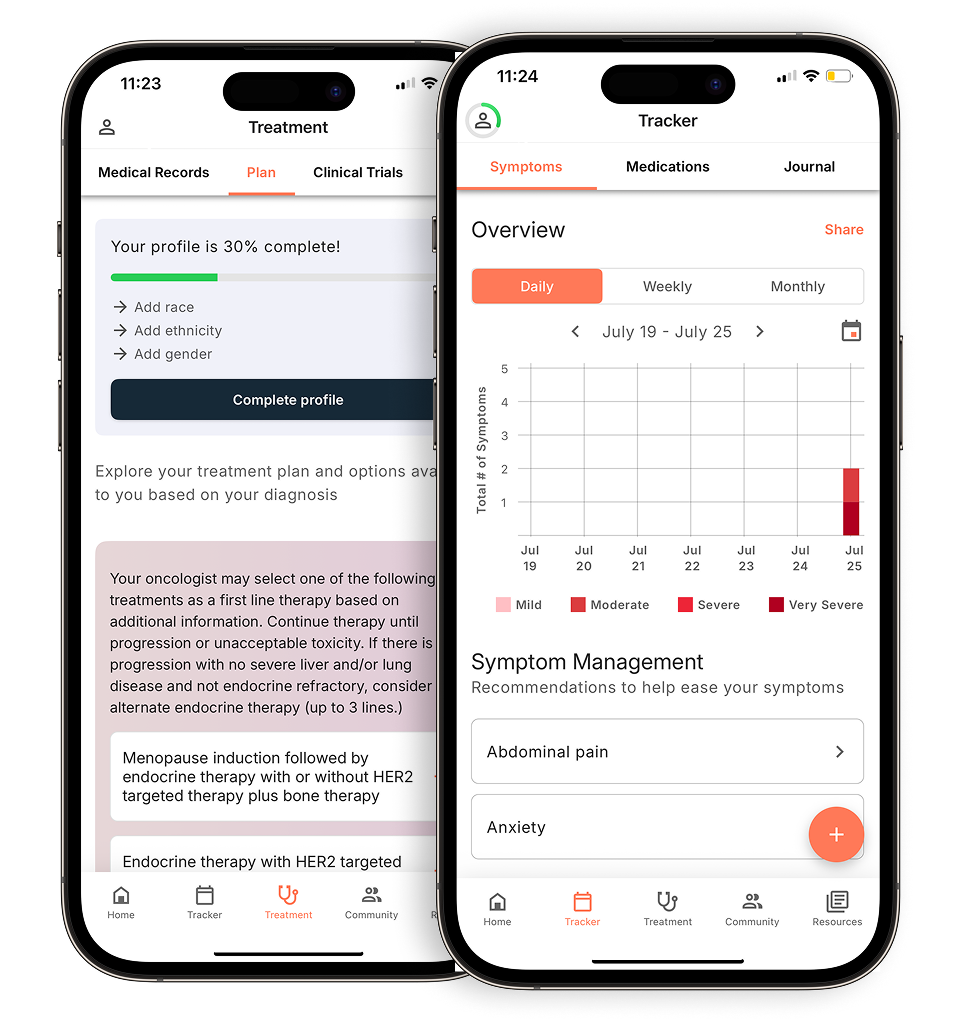
Age, in this context, is really a proxy for tumor biology. Younger women are disproportionately diagnosed with faster-growing subtypes, HER2+ and triple-negative breast cancer, which spread more aggressively and respond differently to treatment. If you’re navigating a breast cancer diagnosis at a younger age, your care team will consider the characteristics of your tumor, such as whether it’s aggressive or harder to treat, as part of developing your treatment plan.
The 65–74 advantage stems from tumor characteristics, not age alone. Women in this cohort are far more likely to have hormone receptor-positive (HR+) tumors, slower-growing cancers that respond well to long-term hormone therapies. Screening history also plays a role; decades of routine mammograms often mean these patients have more treatment exposure and documented response patterns before metastatic disease develops.
Comorbidities and treatment toxicity become significant variables in women over 75. Older patients may be unable to tolerate the same treatment intensity, and existing health conditions can limit therapeutic options, affecting outcomes independent of the cancer’s behavior. Breast cancer in women 65 and older shows distinct genetic features, including differences in treatment-resistance mutations, which highlights the importance of genomic profiling for personalizing treatment in this population.
Why your subtype matters more than age
Tumor biology drives metastatic breast cancer outcomes more decisively than age alone, and understanding your subtype is one of the most important steps toward building a realistic view of cancer and what treatment can achieve.
HR+/HER2- breast cancer typically has more established treatment options available, with hormone therapy combined with targeted drugs as the standard first-line approach. CDK4/6 inhibitors combined with endocrine therapy have extended median progression-free survival significantly for HR+/HER2- tumors. This subtype also tends to progress more slowly, giving patients and their care team more time to adjust and optimize a personalized care plan.
HER2+ breast cancer has seen some of the most dramatic survival gains of any subtype. Targeted monoclonal antibodies, such as trastuzumab, pertuzumab, and newer antibody-drug conjugates, have fundamentally changed outcomes for HER2+ breast cancer. What was once considered a particularly aggressive subtype now has an improved prognosis in the metastatic setting, driven entirely by precision-targeted therapy rather than broad chemotherapy.
Cancer care guidance for every step of your journey
Get treatment options, clinical trials, and support tailored to your diagnosis--all in one place.
Get started
See treatment options, manage symptoms, and stay informed—all in the app
View treatment options and trials personalized to your diagnosis—plus track progress in real time.
Continue in appTriple-negative breast cancer (TNBC) remains the most biologically aggressive subtype, with fewer targeted options and a faster disease course. But the landscape is shifting. Immunotherapy has opened meaningful new doors for triple-negative breast cancer, particularly for patients whose tumors express PD-L1. If you’re navigating treatment decisions for triple-negative breast cancer, several systemic therapy options are now available, including immunotherapy, chemotherapy, targeted therapy, and antibody-drug conjugates, often used in combination. The growing impact of genomic testing on stage 4 survival is most visible here; identifying specific tumor mutations is now central to determining which therapies are worth pursuing.
The impact of genomic testing on modern survival
Genomic testing has fundamentally changed what stage IV means, because two tumors that look identical under a microscope can behave in completely different ways and respond to entirely different treatments.
To understand why, it helps to distinguish between two types of mutations. Germline mutations are inherited and present in every cell of the body and include changes like BRCA1 and BRCA2. Somatic mutations develop inside the tumor itself over time. These acquired alterations, including PIK3CA and ESR1 mutations, are often the most actionable for treatment decisions, because they reveal the tumor’s specific vulnerabilities right now.
PIK3CA mutations make certain hormone receptor-positive tumors eligible for alpelisib. ESR1 mutations may emerge after prolonged estrogen-blocking therapy and could be associated with reduced response to standard endocrine treatments. Your care team can help determine whether testing for ESR1 mutations might be relevant to your treatment plan. Genomic testing can identify specific mutations that make a patient eligible for FDA-approved targeted therapies like CDK4/6 inhibitors, a class of drugs that has dramatically extended progression-free survival for many patients. Precision medicine for metastatic breast cancer patients is a dynamic process of escalating or de-escalating treatment intensity based on what the tumor’s biology reveals.
Genomic science isn’t standing still. The mutations being studied in current research are pointing directly toward a new generation of treatments, which is precisely why asking about clinical trials early is becoming one of the most important questions any patient can raise.
Clinical trials as a first-line strategy
Clinical trials are one of the most strategic moves available when building a personalized treatment for metastatic breast cancer, not a fallback option. Yet many patients only ask about trials after two or three lines of treatment have stopped working.
Many current phase II and phase III trials for stage IV breast cancer are designed to study new treatment options alongside standard care rather than replacing established approaches.
Eligibility criteria have also shifted significantly. Trials are now more inclusive of older adults and patients with stable brain metastases, populations that were historically excluded. The timing of when you ask matters most. Asking your care team about trial options at diagnosis, not at progression, keeps more doors open.
What you need to know: navigating your diagnosis
Statistics are population-level snapshots of the past and cannot predict what happens to you as an individual moving forward. When you look at 5 year survival rate for stage IV breast cancer by age, you’re seeing aggregated data from patients treated years ago, under treatment protocols that may no longer apply. Two stage IV diagnoses that look identical on paper can behave in completely different ways depending on molecular subtype, mutation status, and receptor expression.
Age shapes how your body tolerates treatment, but it doesn’t determine your outcome. Here are the four practical priorities to carry into every conversation with your care team:
- Know your genomics. Push for full biomarker testing if you haven’t had it, the results directly shape your personalized care plan.
- Evaluate clinical trials continuously. Not just at diagnosis. At every line of treatment.
- Track NCCN guidelines in real-time. Many patients and their care teams find that treatment approaches aligned with clinical guidelines may support more coordinated care. Ask your oncologist whether guideline-informed strategies could be relevant to your situation.
- Revisit your data regularly. New trial eligibility, updated biomarker results, and shifting treatment goals all affect what the right next step looks like.
Personalized support for real care decisions
Understand your diagnosis, explore clinical trials, and track symptoms--all in one place.
Get started
Compare treatments, prepare for appointments, and track side effects—all in the app
Built for your diagnosis, Outcomes4Me gives you the tools to make confident, informed decisions—right when you need them.
Continue in app