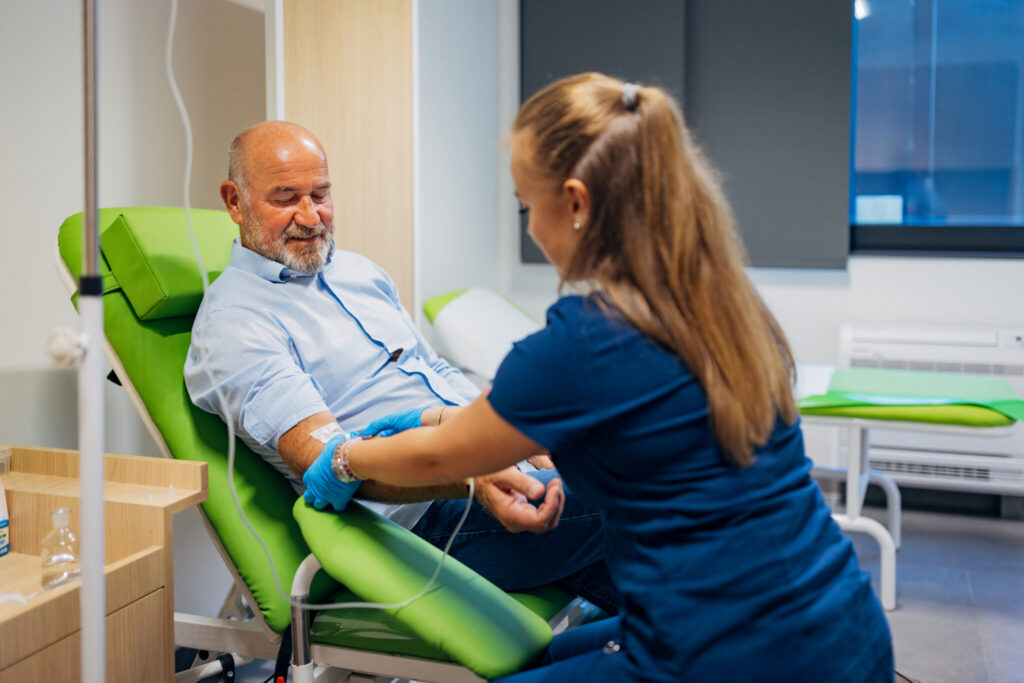
The first 48 hours: navigating the initial shock
Having just been diagnosed with ovarian cancer can make the world feel like it’s stopped — and that response is completely normal. What you’re experiencing isn’t weakness; it’s a well-documented physiological stress response that affects your ability to process information, make decisions, and think clearly. Give yourself permission to feel it.
That said, a few grounded actions in these early hours can make a real difference:
- Pause before scheduling surgery. Ovarian cancer is a cancer where surgery is used to stage the disease, scans alone can’t tell the full story. That makes your choice of surgeon and timing critically important.
- Write down every question as it surfaces. You won’t remember them later. Keeping a running note on your cell phone works well. Bring it to every appointment.
- Ask for a patient navigator or social worker. Most cancer centers offer this support immediately. They help you cut through logistics so you can focus on what matters.
Getting a second opinion at a high-volume, NCI-designated cancer center isn’t an insult to your current provider — it’s standard oncology practice. Ovarian cancer treatment is complex, and outcomes are directly tied to specialist experience. Spending a few days confirming your diagnosis and staging won’t jeopardize your care; it could significantly improve it. Resources like the Society of Gynecologic Oncology patient guide provide information to help patients better understand ovarian cancer and current treatment options.
The most impactful decision you’ll make in these first 30 days is choosing who operates on you — and that starts with building the right expert team.
Building your expert team: why a gynecologic oncologist is non-negotiable
Seeing a gynecologic oncologist for ovarian cancer isn’t just a recommendation — it’s one of the most important decisions you’ll make in the first 30 days. Once the initial shock begins to settle (as covered in the previous section), the most urgent practical step is confirming that the right specialist is leading your care.
A gynecologic oncologist (Gyn-Onc) is a physician who has completed additional fellowship training — beyond a standard OB-GYN residency — specifically in cancers of the female reproductive system. That distinction matters enormously when it comes to ovarian cancer treatment, which typically requires a complex surgical procedure called debulking (also known as cytoreductive surgery). The goal of debulking is to remove as much tumor tissue as possible, and the precision with which it’s performed directly affects survival outcomes. It is important that your staging and/or debulking surgery be performed by a gynecologic oncologist, a physician with special training in the care of ovarian cancers. Studies show that patients treated by gynecologic oncologists at high volume centers have improved outcomes.
The surgeon performing your procedure matters as much as the procedure itself. A Gyn-Onc has the training to navigate complex pelvic anatomy, handle unexpected intraoperative findings, and achieve what’s called “optimal debulking” — leaving behind minimal residual disease. This level of skill isn’t something a general gynecologist or general surgeon can reliably replicate, no matter how experienced they are in other areas.
Evidence-based guidance powered by NCCN Guidelines®
Personalized treatment plans shaped by the latest oncology standards—tailored to your diagnosis.
Get started
View your personalized treatment plan in the Outcomes4Me app
Use your diagnosis to unlock personalized NCCN Guidelines®-aligned recommendations.
Continue in app
To verify whether your surgeon is board-certified, check the American Board of Obstetrics and Gynecology directory or ask your care team directly. Gynecologic oncology specialists can help guide your treatment plan, which may include surgery, chemotherapy, and targeted therapies based on your specific diagnosis and genetic makeup. Don’t hesitate to ask a potential surgeon how many ovarian cancer debulking procedures they perform each year — volume and experience are legitimate, important questions.
Understanding who’s on your team sets the foundation for the staging workup and treatment planning that your Gyn-Onc will guide you through.
Understanding the roadmap: staging, grading, and first-line treatment
Once your gynecologic oncologist is on board, the immediate priority is understanding exactly what you’re dealing with — how far the cancer has spread and how aggressive it is.
Staging and grading aren’t just labels; they’re the clinical foundation every treatment decision is built on. Your team will use imaging — typically a CT scan and sometimes a PET scan — to see whether cancer has spread beyond the ovaries to nearby tissues, lymph nodes, or distant organs. Alongside imaging, a CA-125 blood test is standard. CA-125 is a protein that’s often elevated in ovarian cancer patients. Your medical team will use CA-125 levels to track how your cancer responds to treatment over time, monitoring changes in these levels to assess treatment effectiveness. Together, these tools paint a clearer picture before a single treatment decision is made.
Surgery first vs. chemotherapy first
One of the most significant early decisions your team will make is whether to operate first or start chemotherapy first. In a surgery-first approach, the goal is to remove as much tumor as possible — a procedure called debulking — before any systemic treatment begins. However, when the cancer is too widespread to remove safely upfront, providers may recommend neoadjuvant chemotherapy: delivering chemotherapy before surgery to shrink the tumor and make the operation more feasible and effective. According to MD Anderson, standard first-line treatment typically involves six rounds of chemotherapy, most often a platinum-based and taxane combination such as carboplatin and paclitaxel.
It’s worth noting that “first-line treatment” is the term used for this initial course of therapy — the primary attack on the cancer. Understanding where targeted therapy for ovarian cancer fits into this picture, beyond standard chemotherapy, depends heavily on your tumor’s specific biology. That’s where your genetic data becomes critical — and it’s exactly what the next section explores.
The power of genetic data: targeted therapy and PARP inhibitors
Genetic testing at the time of diagnosis — not months later — is one of the most consequential steps in shaping your ovarian cancer treatment plan.
Understanding your tumor’s genetic profile influences which therapies you’re eligible for, and waiting can delay access to treatments that may improve outcomes. A genetic counselor may be part of your care team to discuss genetic testing for BRCA mutations, as ovarian cancer can have a genetic connection to this gene. Genetic testing for BRCA mutations runs in parallel with ovarian cancer staging and prognosis mapping, because what’s found in your DNA can change the entire treatment strategy.
Cancer care guidance for every step of your journey
Get treatment options, clinical trials, and support tailored to your diagnosis--all in one place.
Get started
See treatment options, manage symptoms, and stay informed—all in the app
View treatment options and trials personalized to your diagnosis—plus track progress in real time.
Continue in appBRCA mutations and HRD status are not just background data — they are treatment eligibility criteria.
Here’s why that matters: patients with BRCA1 or BRCA2 mutations, or a broader genetic profile called homologous recombination deficiency (HRD), are candidates for a class of targeted drugs called PARP inhibitors. PARP inhibitors work by exploiting a weakness in cancer cells that already struggle to repair their own DNA, effectively blocking a repair pathway the cancer depends on. According to Compass Oncology, a genetic counselor may be included on your ovarian cancer care team to discuss genetic testing for BRCA mutations as part of your initial evaluation.
The other critical concept your team will introduce is maintenance therapy — a strategy used after initial chemotherapy to keep the cancer from returning. PARP inhibitors are often prescribed in this phase, taken daily to suppress any remaining cancer activity. It’s a meaningful shift in how ovarian cancer is managed: after chemotherapy ends, your care team will continue to monitor you for potential blood clots and other complications, with ongoing assessments and treatment as needed.
Getting these results organized — alongside pathology reports and imaging — becomes the practical backbone of your care. That’s exactly where preparation systems, which we’ll cover next, make a real difference.
Practical preparation: the ‘binder system’ and home logistics
Getting organized before your first line treatment for ovarian cancer begins can make an overwhelming process feel far more manageable. A simple binder — physical or digital — is one of the most practical tools you can build right now.
Start by gathering every document your care team generates: pathology reports, imaging discs, surgical notes, and insurance correspondence. Keep a running log of every prior authorization request, claim number, and appeal deadline. If you’re working with a patient navigator or social worker — and you should ask your care team about this resource — they can take on much of the insurance pre-authorization work directly, freeing you to focus on your health. Many cancer centers assign navigators specifically to help patients cut through administrative red tape.
Home logistics matter just as much. After completing ovarian cancer treatment, developing a survivorship care plan with your doctor can help guide your next steps, including follow-up appointments and strategies for maintaining your health during the recovery period. Practically, that means:
- Meal prep: batch-cook or arrange meal delivery before your admission date
- Comfortable clothing: loose, high-waisted garments that won’t press on your incision site
- Pet care: arrange coverage for walking, feeding, and vet visits in advance
- Support schedule: map out who is helping on which days so nothing falls through
The decisions being made now — about staging, surgery, and systemic therapy — are the ones that shape everything ahead. Knowing exactly what to ask your oncologist about those decisions is the next step.
5 questions to ask your oncologist today
Walking into your first oncology appointment armed with the right questions can fundamentally change the quality of care you receive. The single most important thing you can do in the first 30 days is ask targeted, specific questions — not general ones.
Here are five questions that cut straight to what matters most:
- What is the suspected stage and grade? Stage tells you how far the cancer has spread; grade tells you how aggressive the cells appear. Both directly shape your treatment plan and timeline.
- Is a gynecologic oncologist leading my surgical team? Research consistently shows that patients treated by a specialist in gynecologic cancers have better outcomes. This isn’t a routine question — it’s an essential one.
- Will I have surgery first or chemotherapy first? The sequencing of treatment varies by case. Understanding the reasoning behind your specific plan helps you prepare physically and logistically.
- Should I undergo genetic testing for BRCA mutations now? As covered earlier, BRCA mutation affects eligibility for PARP inhibitors for ovarian cancer, a class of targeted therapy that can meaningfully extend remission. Don’t wait to ask.
- What is the goal of this treatment — curative or palliative? Your healthcare team will discuss your treatment options with you, which may include surgery, chemotherapy, targeted therapy, or a combination of these approaches, tailored to your specific situation.
Print this list, add it to your binder, and bring it to your next appointment. The next section pulls everything together so you can move forward with clarity and confidence.
Taking control of your care path
Being an active participant in your care is one of the most meaningful steps you can take after an ovarian cancer diagnosis. The first 30 days can feel disorienting, but patients who navigate this period effectively tend to treat knowledge as a clinical tool, not just a comfort.
Evidence-based information is the foundation of informed decision-making. That means looking beyond general health websites and grounding your questions in guidelines developed by leading oncology specialists. The National Comprehensive Cancer Network® (NCCN®) sets the standard for treatment protocols, and understanding where your care plan aligns with those guidelines gives you a stronger basis for conversations with your care team. Outcomes4Me is the only direct-to-patient digital platform that integrates with NCCN® treatment guidelines — putting that clinical depth directly in your hands.
As you move through your first appointments and toward treatment decisions, practical steps matter. Organize your medical records and pathology reports now, before the pace of care accelerates. If surgery is part of your treatment plan, ask your team specific questions about ovarian cancer surgery recovery time so you can prepare your home environment and support network in advance. And don’t wait to explore clinical trial eligibility — many trials have enrollment windows tied to treatment timing, and early awareness keeps your options open.
You don’t have to figure this out alone. With the right tools, the right questions, and a care team you trust, you can move forward with clarity.
Disclaimer: The information provided in this article is for informational purposes only and is not intended to be a substitute for professional medical advice, diagnosis, or treatment. Outcomes4Me is not acting as your caregiver, and any suggestions or guidance offered should not replace the advice of your healthcare provider or qualified medical professional. Always seek the guidance of your physician or other qualified health provider with any questions you may have regarding a medical condition.
Personalized support for real care decisions
Understand your diagnosis, explore clinical trials, and track symptoms--all in one place.
Get started
Compare treatments, prepare for appointments, and track side effects—all in the app
Built for your diagnosis, Outcomes4Me gives you the tools to make confident, informed decisions—right when you need them.
Continue in app