
The first appointment after a diagnosis rarely feels like a conversation, with information arriving faster than anyone can absorb. Your initial visits are the foundation of your personalized care plan. A gynecologic oncologist has subspecialty training in cancers of the reproductive organs and typically performs the surgery as well as directing chemotherapy, while a general medical oncologist treats cancers across the body. Both may sit on your care team.
Shared decision-making only works if the information flows both directions. Preparation ensures that happens.
Establishing the basics: type, stage, and spread
Start with the facts that shape everything else.
1. What specific type and subtype of ovarian cancer do I have? Most cases are epithelial, arising from the surface lining of the ovary; germ cell tumors originate in the egg-producing cells, behave differently, and often occur in younger patients. Different subtypes of ovarian cancer, including high-grade serous, clear cell, mucinous, and endometrioid types, have distinct characteristics that may affect treatment options and outcomes.
2. What is the stage, and has it spread beyond the ovaries? Inquire specifically about the peritoneum, lymph nodes, and distant organs.
3. How does the grade influence how aggressive my treatment needs to be? Grade describes how abnormal the cells look under the microscope and helps determine your treatment plan and how quickly the cancer is expected to grow and spread.
Analyzing treatment pathways and success metrics
Sequencing matters enormously. Debulking surgery, removing as much visible disease as possible, may come before chemotherapy or after several cycles, depending on how widespread the disease is and how well you’d tolerate a major operation.
Ovarian cancer treatment is complicated by recurrence. Ovarian cancer often responds well initially to treatment, but the disease frequently returns, which is why your doctor may recommend maintenance therapy after your initial treatment.
Inquire directly whether the intent is curative or focused on controlling disease and symptoms. Both are legitimate goals, and knowing which one guides your plan changes how you weigh every trade-off.
Evidence-based guidance powered by NCCN Guidelines®
Personalized treatment plans shaped by the latest oncology standards—tailored to your diagnosis.
Get started
View your personalized treatment plan in the Outcomes4Me app
Use your diagnosis to unlock personalized NCCN Guidelines®-aligned recommendations.
Continue in app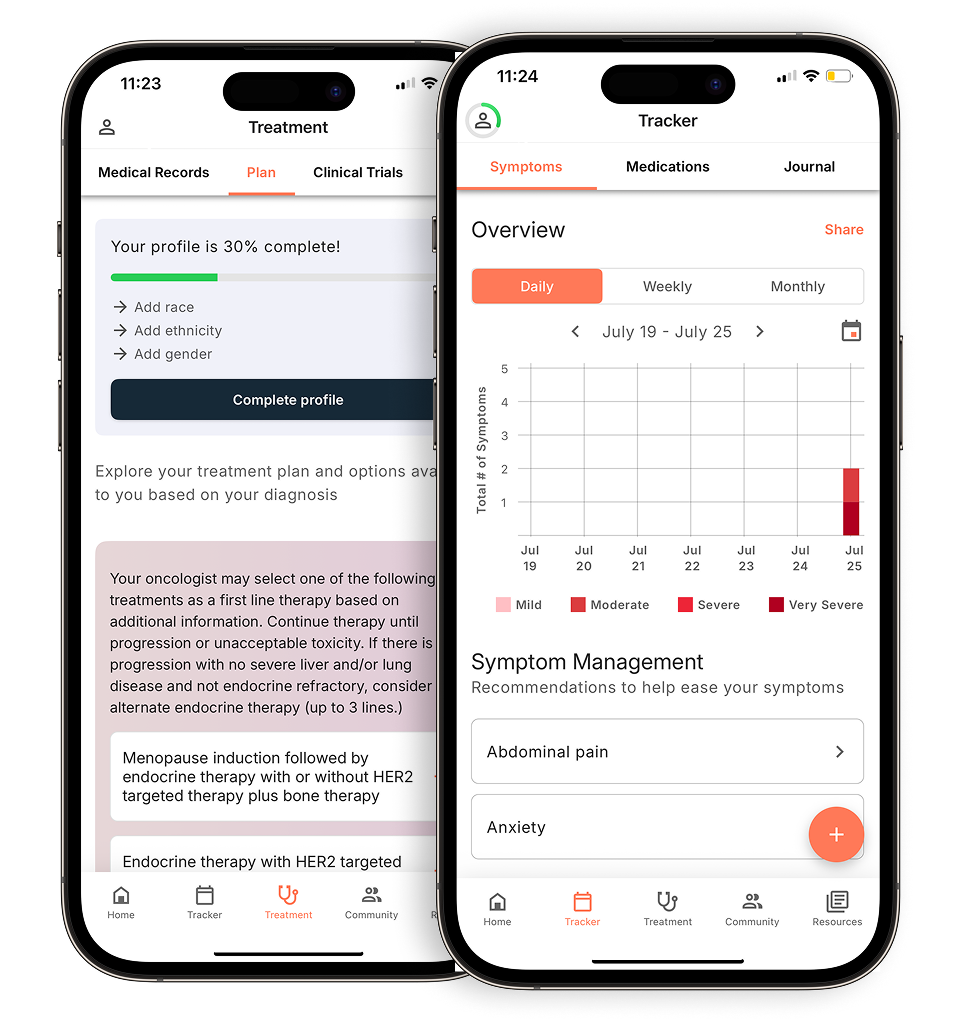
Comparing surgical and systemic options
4. What are my immediate options, and in what order will they happen?
5. Am I a candidate for minimally invasive surgery or will this require a laparotomy? Extent of disease usually decides.
6. What are the specific side effects of the recommended chemotherapy regimen and are there complementary therapies that I can pursue to help? Inquire about neuropathy, fatigue, and blood counts.
Neoadjuvant chemotherapy is given before surgery to shrink tumors and improve the odds of removing all visible disease. Adjuvant chemotherapy follows surgery to eliminate what remains. The choice of therapy for ovarian cancer depends on tumor burden and your overall health.
Genetics, trials, and quality of life
Genetic and genomic testing is no longer optional background information. BRCA1 and BRCA2 mutations, along with broader homologous recombination deficiency (HRD) status, determine eligibility for PARP inhibitors, targeted drugs that exploit a tumor’s inability to repair its own DNA. Results also carry implications for blood relatives.
Clinical trials deserve consideration at diagnosis, not after every standard option is exhausted. Clinical trial eligibility may depend on your treatment history, so it’s worth asking your oncologist which trials are available to you based on whether you’ve already started certain treatments.
For younger patients, fertility preservation has to be raised before surgery, since the conversation becomes moot afterward.
Finally, ask what surveillance looks like once active treatment ends, which tests, how often, and what triggers a scan.
Evaluating long-term prognosis and specialized testing
7. Should I undergo genetic testing, and how would the results change my treatment? Inquire whether testing covers tumor tissue, germline, or both.
8. Are there clinical trials open here or at a nearby center? If your facility has few, ask for a referral pathway.
9. Will this treatment affect my fertility or trigger immediate menopause? Surgical removal of both ovaries causes abrupt menopause regardless of age.
Cancer care guidance for every step of your journey
Get treatment options, clinical trials, and support tailored to your diagnosis--all in one place.
Get started
See treatment options, manage symptoms, and stay informed—all in the app
View treatment options and trials personalized to your diagnosis—plus track progress in real time.
Continue in app10. What is the likelihood of recurrence years down the road? The prognosis of ovarian cancer depends heavily on subtype, stage, and treatment response, and whether ovarian cancer is curable in your specific case is a question worth asking.
Logistics and survivorship
A survivorship care plan is a written document summarizing what you received, what late effects to watch for, and who monitors what going forward. Be sure to request one, they aren’t always offered automatically.
The emotional challenges of this period are real and separate from the physical ones. Oncology social workers handle insurance appeals, transportation, work leave, and counseling referrals, and they’re usually underused.
Advanced-stage patients in particular benefit from disease-specific support organizations that understand recurrent ovarian cancer symptoms and long-term maintenance therapy.
Setting expectations for monitoring and support
11. How will we know whether the treatment is working? Response is typically tracked with CA-125 blood levels alongside CT imaging. Ask which one drives decisions, since the two can disagree.
You will likely have follow-up visits with your doctor for many years after treatment ends to check for signs of cancer recurrence or treatment side effects.
During remission, report new symptoms of ovarian cancer such as bloating, pelvic pressure, early satiety, and changes in bowel habits without waiting for the next appointment. Patients who reach long-term ovarian cancer survival after advanced-stage disease frequently describe having flagged something small early.
Additional considerations to keep in mind
Any survival rate ovarian cancer figure you encounter describes a population studied years ago, under treatment protocols that have since changed. It can’t tell you what will happen to you. Statistics are useful for framing decisions, but unreliable for predicting your individual outcome.
There’s also a genuine trade-off between aggressive treatment and daily quality of life. More intensive regimens may extend disease control while costing you months of function. That calculation is yours to make, and your care team should present it as a choice rather than a default.
Second opinions are standard practice in oncology, not an insult. Most gynecologic oncologists expect them, and many arrange them.
Remission means no detectable disease. It’s worth celebrating. It isn’t identical to cure, and the ovarian cancer prognosis conversation should acknowledge that distinction honestly.
When Standard Protocols May Not Apply
Age, kidney function, heart health, and existing conditions all influence chemotherapy dosing. Your oncologist may discuss reduced-intensity treatment regimens as an option tailored to your individual situation rather than as a step down in care. Ask your care team how such an approach might fit your specific diagnosis and health needs.
Key Takeaways for your first oncology appointment
- Lead with stage, subtype, and genetic markers. These three answers determine which treatments are even on the table, including whether maintenance PARP therapy applies to you. Maintenance PARP therapy decisions depend on genetic markers, including BRCA mutation status and homologous recombination deficiency (HRD), as well as your prior treatment history and individual tolerance.
- Bring someone to take notes, or ask permission to record the conversation. Retention under stress is poor, and that’s expected.
- Treat the plan as a living document. Regimens get adjusted based on imaging, tumor markers, and how your body tolerates treatment. A change isn’t a failure.
- Get a name and a number for after-hours side effects. Know which symptoms warrant a call, which warrant the emergency room, and who answers on weekends.
- Ask what happens next and when. Every appointment should end with a defined next step.
Disclaimer: The information provided in this article is for informational purposes only and is not intended to be a substitute for professional medical advice, diagnosis, or treatment. Outcomes4Me is not acting as your caregiver, and any suggestions or guidance offered should not replace the advice of your healthcare provider or qualified medical professional. Always seek the guidance of your physician or other qualified health provider with any questions you may have regarding a medical condition.
Personalized support for real care decisions
Understand your diagnosis, explore clinical trials, and track symptoms--all in one place.
Get started
Compare treatments, prepare for appointments, and track side effects—all in the app
Built for your diagnosis, Outcomes4Me gives you the tools to make confident, informed decisions—right when you need them.
Continue in app