
New treatments are changing the outlook for many people with ovarian cancer, and one of the most promising advances is a type of targeted therapy called an antibody-drug conjugate (ADC).
The concept is simple: ADCs are designed to deliver powerful chemotherapy directly to cancer cells while limiting damage to healthy tissue.
During an Outcomes4Me webinar, gynecologic oncologist Dr. Kari Hacker explained how these innovative therapies work, why they’re generating excitement, and what patients should know about their benefits and side effects.
What is an antibody-drug conjugate?
Dr. Hacker describes an ADC as having “three major components.”
“The first is the antibody,” she explains. “That’s traditionally a protein that’s engineered or selected to recognize a specific protein or antigen that a cancer makes or overexpresses.”
Attached to that antibody is a highly potent chemotherapy drug, connected by a specialized linker. Together, these three parts create a treatment that seeks out cancer cells based on the proteins they display.
“The idea is that you can infuse these antibody-drug conjugates through the bloodstream,” Dr. Hacker says. “They preferentially go to the tumor because they have expression of the target protein that the antibody recognizes.”
Evidence-based guidance powered by NCCN Guidelines®
Personalized treatment plans shaped by the latest oncology standards—tailored to your diagnosis.
Get started
View your personalized treatment plan in the Outcomes4Me app
Use your diagnosis to unlock personalized NCCN Guidelines®-aligned recommendations.
Continue in app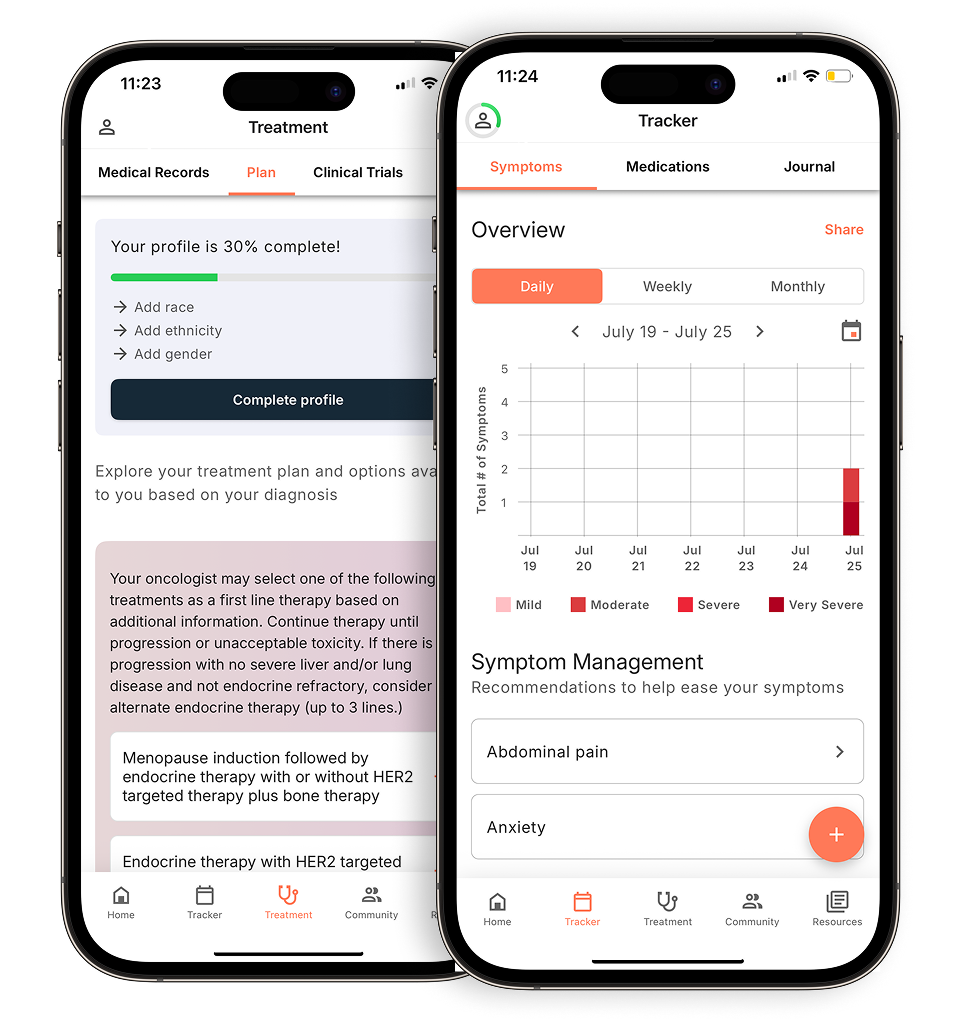
Once the ADC reaches the cancer cell, it’s pulled inside, where it releases its chemotherapy payload.
She explains, “Once they get there, they get internalized by the cancer cell, and they release their highly potent chemotherapy.”
Unlike traditional chemotherapy, which circulates throughout the body, ADCs concentrate much of their effect where the cancer is located. In some cases, the chemotherapy can even destroy nearby cancer cells after being released.
Dr. Hacker says, “In addition to killing the cell that internalizes that antibody, that chemotherapy may kill cells in the local vicinity.” This is often referred to as the bystander effect and may help eliminate neighboring cancer cells that don’t express as much of the target protein.
ADCs already making a difference in ovarian cancer
Several antibody-drug conjugates have already shown meaningful benefits for patients with ovarian cancer. Dr. Hacker notes, “We’ve had some success stories with antibody-drug conjugates in ovarian cancer and other cancer types.”
One example is mirvetuximab soravtansine, an FDA-approved treatment for certain patients with platinum-resistant ovarian cancer whose tumors have high levels of folate receptor alpha (FRα).
“That antibody-drug conjugate recognizes folate receptor alpha, which is expressed on a certain subset of ovarian cancers,” she explains.
Another promising ADC is trastuzumab deruxtecan (T-DXd), which targets the HER2 protein. While it’s been used across multiple cancer types, it’s also showing encouraging results in gynecologic cancers.
Dr. Hacker shares, “For those of us who treat both endometrial and ovarian cancer patients, that has been very exciting for us to see.”
Understanding the side effects
Although ADCs are designed to target cancer cells more precisely than traditional chemotherapy, they still carry risks.
Dr. Hacker says, “Antibody-drug conjugates, because of the way they’re engineered and the way that they work, do have a unique set of toxicities that we don’t always see with traditional chemotherapy or immunotherapy.”
Some ADCs can cause side effects such as eye problems, low blood counts, nausea, fatigue, or, more rarely, inflammation in the lungs. The specific side effects depend on the particular ADC being used.
Because of these potential risks, Dr. Hacker emphasizes the importance of ongoing monitoring. “We have to be thoughtful, and it requires very close monitoring in order to make sure patients aren’t developing the side effects that can sometimes be associated with them.”
What’s next for antibody-drug conjugates?
Researchers are actively studying many new ADCs that target different proteins found on ovarian cancer cells. Clinical trials are evaluating these therapies both alone and in combination with other treatments, with the goal of improving outcomes for even more patients.
“There are lots of different trials ongoing looking at lots of different targets,” Dr. Hacker says. “There’s a lot of excitement about that.”
She believes this is only the beginning. “I think we’ll have some approvals over the next few years of different antibody-drug conjugates in both ovarian and other gynecologic malignancies.”
The bottom line
Antibody-drug conjugates represent one of the fastest-growing areas of cancer treatment. By combining the precision of targeted therapy with the power of chemotherapy, they’re offering new options for some patients with ovarian cancer today, and many more may become available in the years ahead.
If you’re interested in whether an antibody-drug conjugate or a clinical trial studying one might be appropriate for you, talk with your oncology team. Biomarker testing can help determine whether your tumor expresses the proteins these therapies are designed to target and whether you may be eligible for currently approved treatments or ongoing clinical trials.
Tune into our full webinar discussion where Dr. Hacker shares additional insights on the latest ovarian cancer findings.
Personalized support for real care decisions
Understand your diagnosis, explore clinical trials, and track symptoms--all in one place.
Get started
Compare treatments, prepare for appointments, and track side effects—all in the app
Built for your diagnosis, Outcomes4Me gives you the tools to make confident, informed decisions—right when you need them.
Continue in app