
Understanding the shift: when frontline therapy stops working
A multiple myeloma diagnosis doesn’t follow a single, linear path — and for most patients, the question isn’t whether the disease will evolve, but how to respond when it does. Understanding what that shift looks like and knowing your options are powerful tools.
Many patients with relapsed or refractory multiple myeloma experience periods of remission followed by disease progression, which may require changes in treatment strategy. Remission — even a deep one — is best understood as a period of effective management rather than a permanent cure. That’s not cause for despair; it’s a clinical reality that your care team plans for from the start.
Two terms you’ll encounter as your treatment evolves are relapsed and refractory. Relapsed myeloma means the cancer returned after a period of improvement or undetectable disease. Refractory myeloma means the cancer stopped responding to a treatment that was previously working — or never responded at all. These aren’t interchangeable, and understanding what happens if myeloma returns after treatment can help you ask sharper questions at your next appointment.
This is where the concept of lines of therapy becomes essential. Each line represents a distinct treatment strategy — first-line, second-line, and beyond — forming a strategic roadmap that your oncologist builds with your specific disease profile in mind. According to published treatment algorithms, second- and third-line strategies are increasingly effective, with newer drug classes expanding options significantly.
Recognizing the early signs and symptoms of multiple myeloma progression — fatigue, bone pain, or changes in lab values — puts you in a stronger position to act quickly when a transition between lines becomes necessary. The following sections explain what those signals look like.
The numbers: recognizing biochemical progression via lab markers
Lab results often tell the story of relapse before your body does. Understanding a handful of key markers can help you spot a pattern early — and have a more informed conversation with your care team about whether it’s time to explore second-line treatment for multiple myeloma.
A single abnormal result rarely tells the whole story; consistent upward trends across multiple markers signal true progression.
Here are the four lab values worth watching closely:
- M-protein spike. Myeloma cells produce this abnormal protein, detectable in blood or urine. A single elevated reading can reflect lab variability, but a confirmed rise of 25% or more above a prior baseline — seen across two or more consecutive tests — is a recognized relapse criterion. Trends matter more than any single number.
- Free Light Chain (FLC) ratio. The serum free light chain (FLC) ratio is one of several markers used to help identify multiple myeloma and monitor disease status in patients with relapsed or refractory disease. Healthy plasma cells maintain a balanced kappa/lambda ratio, but when myeloma cells multiply, they flood the bloodstream with one type of chain, significantly skewing that ratio, making it one of the earliest biochemical warning signs available.
- Serum creatinine. Rising creatinine levels suggest the kidneys are under strain, often because myeloma proteins are clogging the renal tubules. This isn’t just a kidney problem; it’s a signal that the disease is actively progressing.
- Tracking trends over time. Logging these values consistently — whether in a notebook or a digital health platform — turns disconnected data points into a meaningful pattern your provider can act on.
Knowing what to look for in your labs is a critical first step. The next step is recognizing when those numbers translate into physical warning signs — which is exactly what the CRAB criteria are designed to capture.
Evidence-based guidance powered by NCCN Guidelines®
Personalized treatment plans shaped by the latest oncology standards—tailored to your diagnosis.
Get started
View your personalized treatment plan in the Outcomes4Me app
Use your diagnosis to unlock personalized NCCN Guidelines®-aligned recommendations.
Continue in app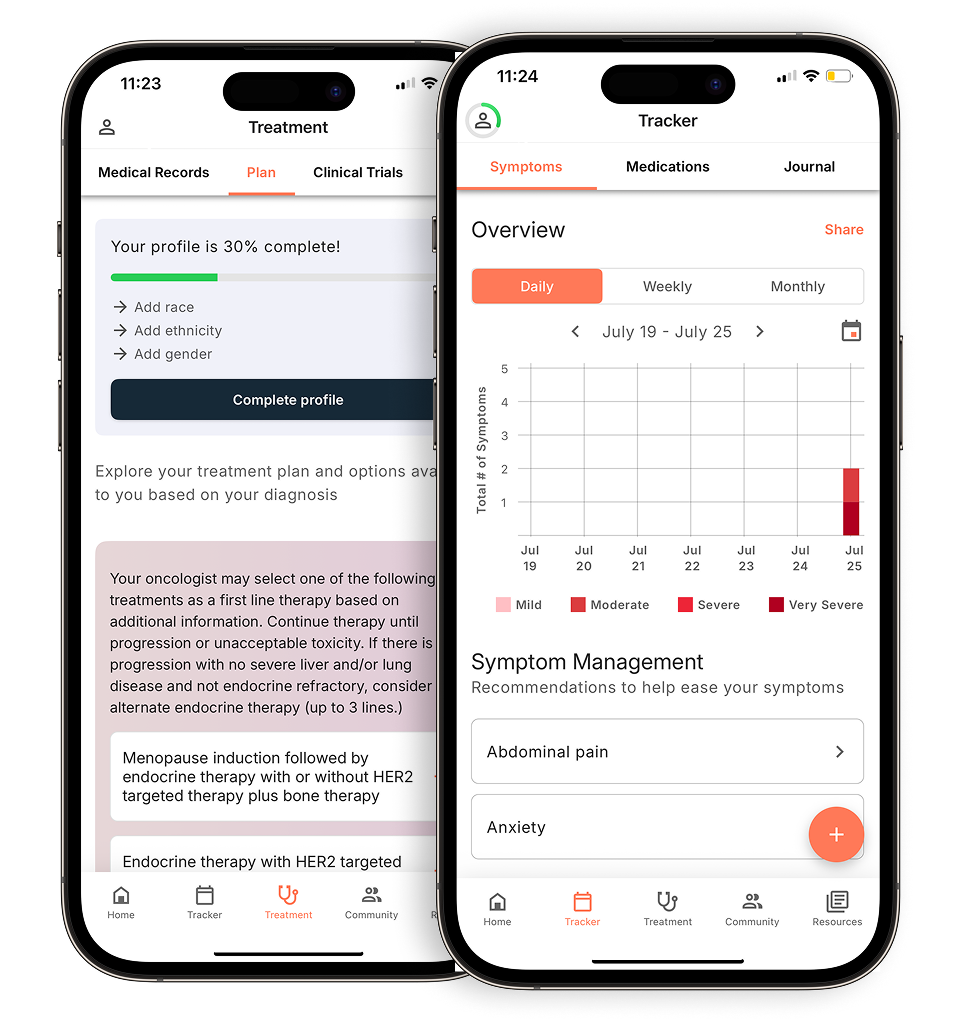
The symptoms: mastering the CRAB criteria for clinical relapse
Lab numbers can signal trouble before you feel it — but your body has its own warning system, too. While an M-protein spike in your bloodwork is often the first clue that myeloma is becoming active again, clinical symptoms frequently follow, and recognizing them early can make a meaningful difference in how quickly you and your care team can respond. The NCCN Guidelines for Patients use the CRAB acronym — Calcium, Renal, Anemia, Bone — as the clinical standard for identifying symptomatic progression.
Calcium elevation is sometimes described with the phrase “moans, stones, and groans” — a memorable shorthand for confusion or brain fog, excessive thirst, and constipation. When myeloma cells break down bone, calcium floods into the bloodstream. If you’re feeling unusually disoriented or can’t seem to drink enough water, it’s worth flagging to your care team promptly.
Renal insufficiency can be easy to dismiss. Swelling in your ankles or legs and a persistent, heavy fatigue that doesn’t improve with rest are common signs that your kidneys may be under strain. Myeloma proteins can clog the kidney’s filtering system, so these subtle physical cues deserve attention.
Anemia presents a real diagnostic challenge: treatment itself causes fatigue, and so does disease progression. The distinction matters. Progression-related exhaustion tends to deepen over time and won’t lift between treatment cycles the way treatment-related tiredness typically does.
Bone disease — specifically new “punched-out” lytic lesions or unexplained rib pain — is one of the more definitive signs of clinical relapse. These lesions appear on imaging as dark, hollow spots where myeloma has eaten away healthy bone tissue.
When to call your provider: Contact your care team without delay if you experience sudden confusion, new bone pain, significant swelling, or a sharp drop in your energy levels between scheduled appointments. Don’t wait for your next lab visit — these symptoms can escalate quickly.
Understanding how your body signals relapse sets the stage for the next critical question: once progression is confirmed, how do you build the strongest possible treatment response? That’s where the strategy of switching drug classes becomes essential.
Second-line strategy: the power of class-switching
When one drug class stops working, switching to a different mechanism — rather than simply swapping one drug for another within the same class — is how oncologists stay ahead of refractory multiple myeloma.
The core logic is straightforward: myeloma cells that evolve resistance to one drug’s mechanism often remain vulnerable to a completely different one. If your first-line regimen was built around an immunomodulatory drug (IMiD) like lenalidomide, your care team will likely anchor your second-line regimen around a proteasome inhibitor (PI) — and vice versa. This class-switching disrupts resistance pathways before they can solidify.
Cancer care guidance for every step of your journey
Get treatment options, clinical trials, and support tailored to your diagnosis--all in one place.
Get started
See treatment options, manage symptoms, and stay informed—all in the app
View treatment options and trials personalized to your diagnosis—plus track progress in real time.
Continue in appWithin the PI class itself, there’s an important distinction worth understanding. Bortezomib (Velcade) is a reversible PI and a cornerstone of first-line care. When progression occurs, carfilzomib (Kyprolis) is a proteasome inhibitor that has become an increasingly used option in second-line treatment regimens for multiple myeloma, often combined with other agents like lenalidomide and dexamethasone.
Beyond class-switching, the structure of the regimen matters just as much. Triplet therapy, which combines three drugs from complementary classes, is now the recognized standard of care at first relapse, as supported by NCCN guidelines. A typical combination might pair a PI with an IMiD and a steroid like dexamethasone, attacking the disease from multiple angles simultaneously.
For patients managing treatment around work and daily life, oral agents like ixazomib (Ninlaro) offer a meaningful advantage. As the only all-oral PI approved for relapsed myeloma, Ninlaro fits into triplet regimens without requiring clinic visits for infusions — a practical consideration that can affect quality of life over a long treatment course.
These evolving drug combinations set the stage for an even newer generation of therapies — including monoclonal antibodies and bispecific agents — that are reshaping what’s possible at first relapse.
The new gold standard: monoclonal antibodies and beyond
CD38-targeting monoclonal antibodies have fundamentally reshaped how oncologists approach first relapse — and Daratumumab (Darzalex) sits at the center of that shift. Adding Daratumumab to standard backbone regimens has significantly improved progression-free survival, according to data published in the Journal of the National Comprehensive Cancer Network. Whether a patient is being re-evaluated against the CRAB criteria myeloma teams use to confirm active disease or is progressing on biochemical markers alone, CD38 inhibitors like Daratumumab and Isatuximab (Sarclisa) are now a cornerstone of relapse therapy. They work by flagging myeloma cells for destruction by the immune system — a fundamentally different mechanism from the proteasome inhibitors and IMiDs covered in earlier lines.
Beyond CD38 inhibition, a newer class called nuclear export inhibitors brings yet another angle. Selinexor (Xpovio) forces abnormal proteins to remain inside the cancer cell’s nucleus, triggering programmed cell death — a mechanism that doesn’t overlap with prior drug resistance, making it particularly useful in heavily pre-treated patients.
The most exciting recent additions, however, are the immunotherapy-based options now moving earlier into the treatment sequence. Bispecific antibodies like Tecvayli (Teclistamab) offer an “off-the-shelf” advantage: they redirect a patient’s own T-cells to attack myeloma cells without the manufacturing wait time that CAR-T requires. CAR-T therapies deliver remarkable depth of response and are increasingly being considered earlier in relapse rather than being reserved as a last resort, as evolving R/R treatment strategies continue to shift the standard of care.
Taken together, these options form a rapidly expanding toolkit — one that’s increasingly hard to navigate without a clear sense of where you stand and what comes next.
The bottom line: what you need to know about progression
Relapsed multiple myeloma is complex, but breaking it down into a few core principles makes it far more manageable to discuss with your care team.
Progression is often a lab finding first. Rising M-protein levels or abnormal free light chains can signal a relapse months before you feel any different. That’s why routine monitoring matters — catching a shift early expands your options. When physical symptoms do appear, the CRAB criteria (elevated Calcium, Renal impairment, Anemia, Bone lesions) are the clearest indicators that myeloma is actively causing organ damage and that treatment needs to change.
Class-switching is the foundation of second-line strategy. Rather than cycling through drugs with similar mechanisms, oncologists pivot to a different drug class to overcome the resistance your myeloma has developed. A common example of this logic in action is the choice between Kyprolis vs Velcade — two proteasome inhibitors with different binding profiles that may perform differently after prior exposure. When paired with a fresh drug class, even familiar agents can regain effectiveness.
CD38-targeting monoclonal antibodies have become a cornerstone of first-relapse therapy, and NCCN guidelines are frequently updated to reflect new combinations as clinical evidence evolves. Beyond established regimens, clinical trials offer earlier access to next-generation approaches like CAR-T cell therapy and bispecific antibodies — making trial awareness a proactive, not last-resort, decision.
Understanding these principles puts you in a stronger position to ask sharper questions and evaluate your options — exactly the kind of informed advocacy the next section will help you put into practice.
Taking control: how to navigate your next steps
Understanding relapsed multiple myeloma is only half the equation — acting on that knowledge is where outcomes are made. As you move into conversations about second-line therapy, the most practical step you can take is maintaining a comprehensive record of your genetic and clinical data. That means keeping track of your cytogenetic findings (such as del(17p) or t(4;14)), your prior treatment regimens, response durations, and any documented side effects. This record becomes the foundation for every treatment decision ahead, and it puts you in a far stronger position when advocating for yourself at each appointment.
This is precisely where Outcomes4Me can help. The platform uses AI to translate the NCCN Guidelines for Patients: Multiple Myeloma — dense clinical documents that can feel impenetrable — into clear, personalized options you can actually act on. Rather than sifting through pages of oncology terminology, you get evidence-based guidance that reflects your specific disease profile, prior therapies, and current health status.
You are your own best advocate, and that advocacy is most effective when grounded in evidence-based data. First relapse is not a dead end; it’s a decision point. With the right information and the right tools, you can walk into your next oncology appointment prepared, informed, and ready to shape what comes next. Download the Outcomes4Me app to start building your personalized roadmap today.
Disclaimer: The information provided in this article is for informational purposes only and is not intended to be a substitute for professional medical advice, diagnosis, or treatment. Outcomes4Me is not acting as your caregiver, and any suggestions or guidance offered should not replace the advice of your healthcare provider or qualified medical professional. Always seek the guidance of your physician or other qualified health provider with any questions you may have regarding a medical condition.
Personalized support for real care decisions
Understand your diagnosis, explore clinical trials, and track symptoms--all in one place.
Get started
Compare treatments, prepare for appointments, and track side effects—all in the app
Built for your diagnosis, Outcomes4Me gives you the tools to make confident, informed decisions—right when you need them.
Continue in app