
The post-treatment cliff: why a plan is your best defense
Finishing active breast cancer treatment should feel like a relief, and it often does. But for many patients, it also marks the start of something unexpectedly hard. According to Living Beyond Breast Cancer, the transition from active treatment to survivorship can bring challenges, including concerns about how to move forward with your care and questions about your future health. Appointments that once filled your calendar every few weeks suddenly disappear, and the structured safety net of your oncology care team pulls back. That abrupt drop in medical touchpoints is what many providers call the “post-treatment cliff,” and it’s more common than you might think.
A survivorship care plan (SCP) becomes an incredibly important tool during this time. A survivorship care plan is a living document that captures your full treatment history and maps out a clear path forward, connecting your oncology team’s expertise to your primary care provider and the rest of your care team. Rather than leaving you to piece together your own medical narrative, an SCP consolidates your diagnosis details, the treatments you received, and the follow-up care you’ll need into one accessible record. The CDC describes it as a tool designed to keep every provider on the same page, long after active treatment ends.
The anxiety that often follows treatment comes from not knowing what to watch for or who to call. An SCP replaces that uncertainty with an “if-then” roadmap. If a new symptom appears, here’s what it could mean. If a surveillance scan is due, here’s when and why. The next step is building that foundation, starting with your clinical data.
Step 1: documenting your clinical foundation
Your survivorship care plan is only as useful as the clinical detail it contains, and for breast cancer follow-up care after treatment, that detail starts with a complete, accurate record of everything your care team did.
Think of this section of your plan as the foundation every future provider will build on. At a minimum, it should capture:
Evidence-based guidance powered by NCCN Guidelines®
Personalized treatment plans shaped by the latest oncology standards—tailored to your diagnosis.
Get started
View your personalized treatment plan in the Outcomes4Me app
Use your diagnosis to unlock personalized NCCN Guidelines®-aligned recommendations.
Continue in app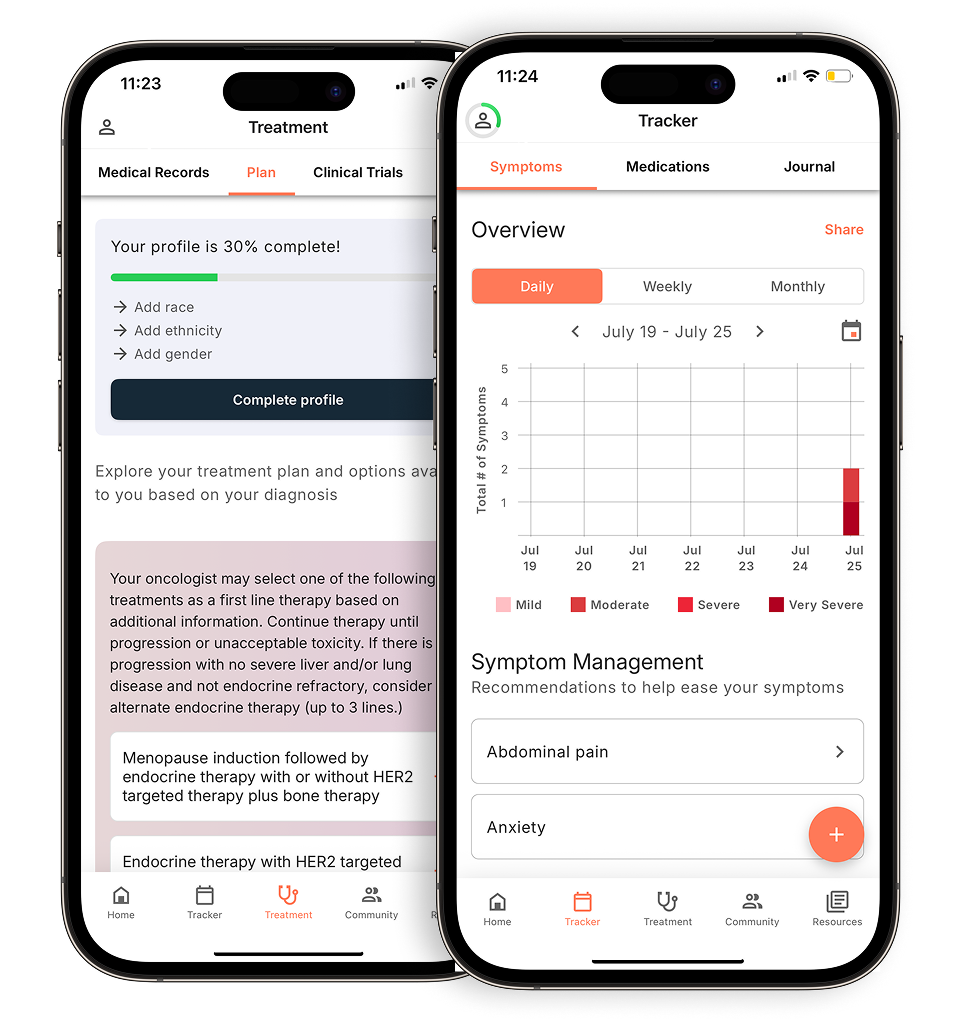
- Surgery type, lumpectomy, mastectomy, reconstruction, and lymph node status
- Chemotherapy drugs, names, and cumulative dosages, not just “chemo” but the exact agents used
- Radiation sites and total dose, including whether the chest wall or lymph nodes were targeted
- Hormone receptor and HER2 status, ER, PR, and HER2 results that shape long-term treatment decisions
Recording the specific names and dosages of chemotherapy drugs in your survivorship care plan can help your doctors monitor your long-term health. Some chemotherapy agents, including certain types like anthracyclines, may be associated with heart-related effects that your care team may want to watch for over time.
Genetic testing results deserve their own prominent place in this document. If you’ve been tested for BRCA1/2 mutations or other hereditary markers, that information directly affects screening recommendations for you and potentially for your family members. A survivorship care plan without genetic context is an incomplete picture.
Once your clinical foundation is documented, the next logical step is mapping out exactly when and how your care team will monitor you going forward.
Step 2: mapping your follow-up and surveillance schedule
A structured follow-up schedule is one of the most practical tools for protecting your breast cancer survival rates after active treatment ends. Knowing when to show up, and why, removes the guesswork and puts you in a proactive position with your care team.
NCCN Guidelines® recommend physical exams every six to twelve months for the first five years after treatment. These visits are structured opportunities to detect early signs of recurrence before symptoms become harder to manage.
Surveillance and screening are different things, and that distinction matters for your survivorship care plan. Surveillance refers to the scheduled follow-up your care team uses to monitor for recurrence in someone who has already been treated, for example, a clinical breast exam at each visit. Screening, on the other hand, applies to the general population and focuses on detecting cancer in people without prior diagnosis. For most breast cancer survivors, annual mammograms serve a surveillance function, not a general screening one. High-risk patients, such as those with a BRCA mutation or a history of dense breast tissue, may also need supplemental MRI imaging on a coordinated schedule.
Getting this schedule documented, with specific dates, responsible providers, and imaging facilities, turns a general survivorship care plan into an actionable roadmap. And once that schedule is in place, the next critical step is addressing the long-term physical effects that can emerge even after your scans stay clear.
Step 3: proactive management of long-term side effects
Side effects don’t always disappear when active treatment ends, and a personalized care plan should account for the symptoms that quietly persist long after your last infusion or radiation session.
Cancer care guidance for every step of your journey
Get treatment options, clinical trials, and support tailored to your diagnosis--all in one place.
Get started
See treatment options, manage symptoms, and stay informed—all in the app
View treatment options and trials personalized to your diagnosis—plus track progress in real time.
Continue in appLymphedema is a relatively common post-treatment challenges. Up to half of breast cancer survivors may experience some form of lymphedema following surgery or radiation. Early intervention matters here. Ask your care team for a referral to a certified lymphedema therapist before swelling becomes a chronic problem, giving you far more management options.
Cognitive fatigue, often called “chemo-brain,” is another concern that deserves a place in your care plan. Difficulty concentrating, memory lapses, and mental fogginess are valid clinical symptoms. Some patients report that cognitive changes may persist for months or even years after treatment, and your care team can help you monitor and address these experiences.
Bone density loss is a critical concern for patients on aromatase inhibitors (AIs). Aromatase inhibitors lower estrogen levels. Since estrogen may play a role in bone health, some patients taking these medications discuss bone monitoring with their care team. Ask your care team about a baseline DEXA scan and whether calcium, vitamin D, or bisphosphonate therapy belongs in your plan.
With your physical side effects mapped out, the next step is understanding how lifestyle choices, from exercise habits to nutrition, can meaningfully reduce your risk of recurrence.
Step 4: integrating lifestyle and risk reduction
Managing long-term side effects from cancer treatment involves both medical care and self-care strategies you can use between appointments, such as staying hydrated, maintaining good hygiene, regular movement, a balanced diet, and avoiding tobacco. Many lifestyle factors, such as diet, physical activity, and weight management, are areas where you may have some influence over your health after breast cancer treatment. Your care team can discuss which lifestyle choices might be worth exploring as part of your survivorship plan.
Physical activity is one of the most evidence-backed tools available to survivors. Research suggests that regular physical activity may play a role in breast cancer survivorship. Talk with your care team about whether an exercise plan is right for you. Many healthcare providers recommend aiming for around 150 minutes of moderate-intensity exercise per week as part of a healthy survivorship routine, though your care team can help you determine what’s realistic for your individual situation. That figure reflects a threshold at which measurable protective effects emerge. And if you’re navigating joint pain or fatigue from ongoing hormone therapy, even gentle movement adds up.
Diet and alcohol are equally worth addressing directly. An anti-inflammatory eating pattern, rich in vegetables, whole grains, and lean protein, supports immune function and weight management, both of which influence recurrence risk. Alcohol use has been studied in relation to breast cancer risk, and some research suggests a link that may be worth discussing with your care team.
Psychological well-being deserves the same attention as physical health. Many survivors experience PTSD, persistent anxiety, or what’s commonly called “scanxiety”, the dread that builds ahead of routine imaging. These emotional challenges are real, they’re common, and they’re treatable. Your care team can connect you with mental health professionals who specialize in oncology, and digital platforms offer additional support between visits. With lifestyle, mental health, and clinical monitoring all accounted for, you’re ready to pull everything into one actionable reference, which is exactly what the survivorship checklist in the next section provides.
What you need to know: the survivorship checklist
A strong survivorship care plan is a forward-facing roadmap that keeps you informed, prepared, and in control of your health for years to come.
Your treatment summary and surveillance schedule are the non-negotiable starting points. Your plan should document every therapy you received, the doses, and the dates, alongside a clear schedule for follow-up imaging, lab work, and clinical exams. According to the CDC, this documented record is especially critical during transition from oncology care, when your care shifts from a specialist to a primary care provider who may be less familiar with your full treatment history.
Genetic data belongs in the plan, too. If you carry a BRCA1, BRCA2, or another hereditary mutation, your screening frequency should reflect that. Integrating this information into a personalized care plan means your care team can calibrate surveillance, not apply a standard protocol that may miss elevated risks.
Digital tools make this possible in a practical way. Tracking symptoms, organizing records, and staying aligned with current guidelines between appointments is easier with digital support. Managing a plan across multiple providers and many years is difficult with paper alone, and digital approaches can make that process more sustainable.
If you have a question about navigating your breast cancer survivorship, you can connect with an Outcomes4Me oncology nurse practitioner at no charge through the Outcomes4Me app. Just use the “Ask Outcomes4Me” button.
Personalized support for real care decisions
Understand your diagnosis, explore clinical trials, and track symptoms--all in one place.
Get started
Compare treatments, prepare for appointments, and track side effects—all in the app
Built for your diagnosis, Outcomes4Me gives you the tools to make confident, informed decisions—right when you need them.
Continue in app